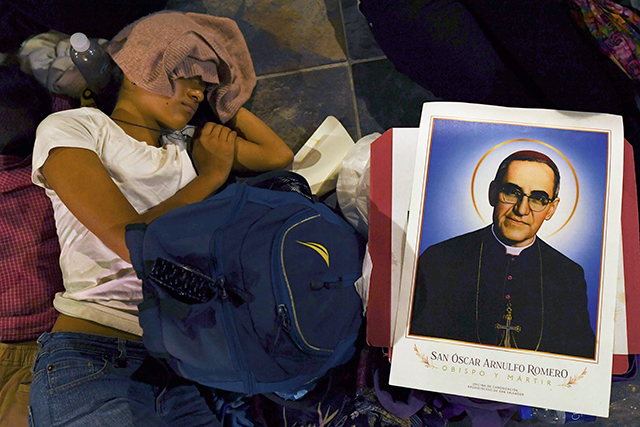
• CARLOS MARIO MARQUEZOscar Romero, the murdered Salvadoran cleric who was canonised Sunday by Pope Francis, was a powerful orator who used his pulpit to denounce rampant military repression and social injustice.
As archbishop of San Salvador, Romero emerged as a ‘;voice of the voiceless’; during intense social and political conflict in El Salvador.
He was an outspoken advocate for the poor and victims of government repression, denouncing scores of killings by right wing death squads in a Central American country roiled by protests over electoral fraud.
Romero (62) was shot through the heart by a marksman on 24 March 1980 while he celebrated evening mass in the chapel of the cancer hospital where he lived.
His death sent shockwaves around the world and escalated violence in El Salvador that would become a 12-year civil war between a series of US-backed governments and leftist rebels.
The conflict claimed 75 000 lives before it ended with a peace agreement in 1992.
“He was courageous and humble, and he remained so in the midst of persecution and threats from the powerful and even from some clerics in the country – and even from the Vatican,” said Jesuit theologian Jon Sobrino.
Sobrino, known for his contribution to liberation theology – which combines Christian theology with elements of Marxism emphasising political liberation for oppressed peoples — said the cleric was never a part of that controversial movement.
Romero was a tireless agitator for the poor however, which brought him into regular conflict with the right-wing government, and the Catholic hierarchy, which deemed him too political.
“The church of ‘;outreach’; that the pope talks about was a very real thing here in El Salvador in the 70s and 80s and some priests were killed – killed by people who went to mass,” said Sobrino.
Critics of Romero charged him with supporting violence, communism and heresy. He was lauded by others for the same reasons.
The movement to make Romero a saint was long resisted by conservative Catholics and the Salvadoran right, who saw veiled Marxism in his sermons eulogising the poor and radio broadcasts condemning government repression.
The petition languished for years at the Vatican’;s Congregation for the Causes of Saints, finally moving forward under retired pope Benedict XVI and Pope Francis, who named Romero a martyr for the Church, one of the paths to sainthood.
When he was beatified in 2015, a step toward canonisation, Romero was described by then-US president Barack Obama as an inspiration and a “courageous man who persevered in the face of opposition from extremes on both sides”.
In his vociferous defence of the poor and the persecuted, Romero “remained alone”, said his younger brother Gaspar Romero. He recalled that other government-backed bishops went to Rome to ask that he be removed as archbishop.
Two weeks before his assassination, Romero found a briefcase bomb in the basilica where he said mass and had it defused.
The day before his assassination, he made a dramatic appeal to soldiers in the army, many of them peasants, to disobey orders to shoot at people. “I beg you, I beg you. I order you in the name of God, stop the repression.”
Romero was born on 15 August 1917 in Ciudad Barrios, a coffee-growing town 160 kilometres northeast of San Salvador.
In 1931 he entered a junior seminary in the town of San Miguel, and in the late 1930s he headed to Rome to study theology. He was ordained a priest in 1942.
He moved around and rose through the ranks, from auxiliary bishop to bishop, before eventually becoming archbishop of San Salvador by 1977.
At 59, he had been known for his conservatism and had the support of the authorities – but did not have the confidence of progressive clergy.
Those who knew him say he was profoundly changed by the murder of a Jesuit priest, Rutilio Grande, together with two peasants, in March of that year.
He began to use his newfound power as archbishop to rail against injustice, and became ‘;the voice of the voiceless’;.
No one was ever convicted of Romero’;s killing, but a UN-sponsored truth commission concluded it was carried out by a right-wing death squad under the orders of Roberto D’;Aubuisson, a former army officer who died the year the war ended.
The actual murderers were never brought to justice.
– Nampa-AFP