



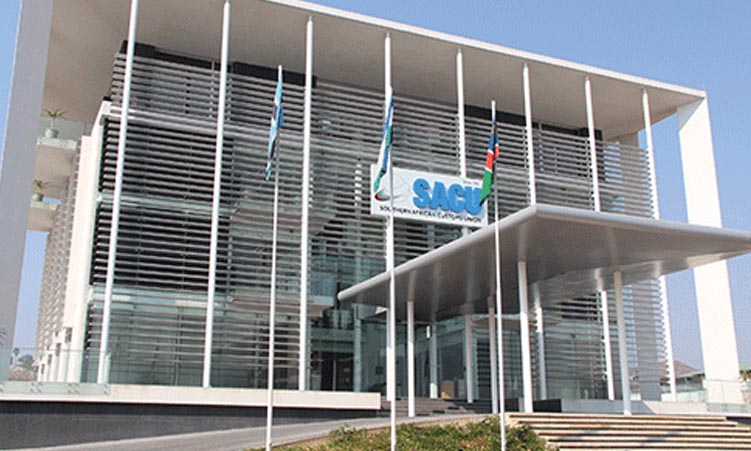
The Southern African Customs Union (Sacu) says the decision by the United States (US) to impose new tariffs on imports risks reversing vital development gains across southern Africa.
Speaking in Johannesburg, South Africa, on Monday, Sacu Council of Ministers chairperson and finance minister Ericah Shafudah criticised the Trump administration’s move to implement a universal 10% tariff, set to take effect on 9 April, without prior consultations with affected member states.
Though a 90-day pause has temporarily delayed the full impact, Sacu argues that the uncertainty created has already begun to disrupt trade flows and investor confidence.
“The US’s unilateral action to raise tariffs without prior consultations with the affected member states is a departure from the norm and will have significant implications on global trade and the foundational principles of the multilateral trading system,” Shafudah said.
Sacu – the oldest customs union in the world comprising Botswana, Eswatini, Lesotho, Namibia and South Africa – has relied heavily on trade mechanisms like the most favoured nation principle, the African Growth and Opportunity Act (Agoa), and the US generalised system of preferences.
Shafudah said these preferential trade schemes have enabled duty-free access for designated African countries, fostering increased US investment, industrial growth, job creation, and the development of intra-industry supply chains.
“For the Sacu region, the imposition of tariffs would reverse the gains made with the US which supported lifting millions out of poverty on the continent.
“The Sacu council is now calling for urgent diplomatic engagement to resolve the matter before the tariff pause expires on 9 July.
“In this regard, Sacu wishes to call upon the US to consider observing differential treatment, more especially to consider exempting least developed countries and Agoa-eligible countries from these tariff measures,” Shafudah said.
Sacu members further reaffirmed their support for a predictable, development-oriented, transparent, fair, inclusive, and rules-based multilateral trading system with the World Trade Organisation (WTO) at its core.
“The Sacu members further emphasise the need for the urgent reform of the WTO [World Trade Organisation] to address existing imbalances and provide policy space for Africa’s industrialisation,” Shafudah said.
To preserve the internal market, the bloc says it will ensure that in any efforts to conclude partnerships with the US, the common external tariff is preserved, and due regard is taken not to undermine regional industrial capabilities.
The Sacu region is ready to engage with the US to find an amicable solution to its trade concerns and to seek cooperative solutions that promote mutually beneficial trade and investment relations, as well as preserve existing supply-chains.
The Sacu members also commit to prioritise the implementation of the African Continental Free Trade Area, including finalising the outstanding rules of origin on clothing, textiles and automotives, the development of regional value-chains to set Sacu on a more sustainable development trajectory, and to coordinate export strategies to leverage existing trade agreements that Sacu is party to.
In an age of information overload, Sunrise is The Namibian’s morning briefing, delivered at 6h00 from Monday to Friday. It offers a curated rundown of the most important stories from the past 24 hours – occasionally with a light, witty touch. It’s an essential way to stay informed. Subscribe and join our newsletter community.

The Namibian uses AI tools to assist with improved quality, accuracy and efficiency, while maintaining editorial oversight and journalistic integrity.
Stay informed with The Namibian – your source for credible journalism. Get in-depth reporting and opinions for
only N$85 a month. Invest in journalism, invest in democracy –
Subscribe Now!