




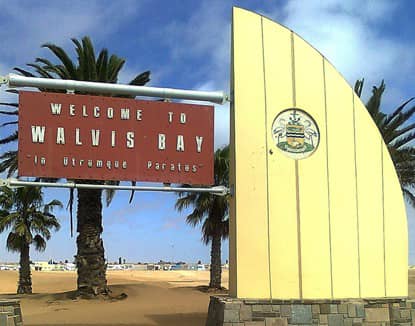
The South African High Commission in Namibia and the Walvis Bay municipality have taken steps to address concerns surrounding a number of abandoned diplomatic houses at the coastal town, which had become a hotspot for crime and public health risks.
The houses, previously owned by the South African government, were used by state officials before and after the reintegration of Walvis Bay into Namibia in 1994. Over the years, most of the occupants either retired or relocated, leaving the properties vacant. The South African High Commission has now confirmed that the properties have been sold.
The high commission ordered all illegal occupants to vacate the premises in a letter dated 15 April 2025. “The property has been sold by the South African High Commission. Whoever is staying on the property is occupying it illegally and has never been granted permission or authority to do so. Whoever is the illegal occupant is hereby instructed to vacate the premises immediately,” the letter reads.
CHANGING HANDS
Deputy high commissioner Kasturie Maharaj confirmed the sale and said the eviction notice was issued at the request of the new buyers. “The houses have been sold. The high commission has issued the letter at the request of the new owner or purchaser,” Maharaj said.
One of the properties in question is house number 520 on Sixth Street West in the Meersig area, which was sold to coastal estate agent June van Schalkwyk. Three other houses in the same area, as well as the Lagoon area have been sold off or are in the process of being sold. The high commission also had seven other properties in Windhoek, which it has been trying to get rid of since 2000.
According to documents seen by The Namibian, erf 165 on Sixth Street West at Walvis Bay was sold to Gerrit Engelbrecht in 2010. In 2007, the high commission through J&B Estate gave permission to one Paula Visser to operate a preschool at house number 30 on 9 Ninth Street West in the Lagoon area. Walvis Bay municipal councillor Ephraim Shozi also confirmed the handover process is underway.
“These houses have been sold as we speak. It is only now the ownership because the tender process is done. Once the ownership is done, the new owners will be able to properly maintain the houses,” Shozi said.
COMMUNITY CONCERNS
Shozi added that the municipality has long been aware of the criminal activities taking place at the properties.
“The council is aware of the dealings that are happening at those houses. About the prostitution, we were not aware, but we know about illegal drugs and all the things that are happening there and also the fact that the community had reported most of these concerns.”
Shozi said the South African government had not intervened in the past. “There was nothing coming forth from the South Africa government to help the situation because people were just getting tired, but the neighbourhood watch has been assisting to check what activities are taking place there. It is not conducive in that area at all, but the neighbourhood watch visits the area more often for their patrols,” he said.
Concerns were also raised by some residents regarding the transparency of the sale process. “We understand that four houses have been sold by the South African government; however, the big concern is the fact that they were not advertised. People occupied the houses illegally. How can the South African government have properties in a foreign country but not gain anything from it?” says a resident.
Shozi insisted the sale was properly advertised and that buyers were selected through the correct channels. In 2023, Walvis Bay mayor Trevino Forbes also raised the issue, saying the municipality had reached out to the South African High Commission after homeowners complained about crime linked to the abandoned buildings.
A year earlier, members of the South African parliament’s Portfolio Committee on International Relations and Cooperation visited the properties and expressed concern. Some lawmakers described the state of the houses as a diplomatic embarrassment.
A 2024 document from Namibia’s Ministry of Health and Social Services to the Erongo governor’s office described the properties as a health hazard. It said an inspection carried out under the Public and Environmental Health Act revealed the houses were in poor condition.
“Since 2000, the municipality’s environmental health practitioner has written several reports for the same reason. The building is in very poor condition, such as dilapidated, vandalised and filthy, and could be used as a hiding place for criminals,” the ministry report reads.
In an age of information overload, Sunrise is The Namibian’s morning briefing, delivered at 6h00 from Monday to Friday. It offers a curated rundown of the most important stories from the past 24 hours – occasionally with a light, witty touch. It’s an essential way to stay informed. Subscribe and join our newsletter community.

The Namibian uses AI tools to assist with improved quality, accuracy and efficiency, while maintaining editorial oversight and journalistic integrity.
Stay informed with The Namibian – your source for credible journalism. Get in-depth reporting and opinions for
only N$85 a month. Invest in journalism, invest in democracy –
Subscribe Now!