


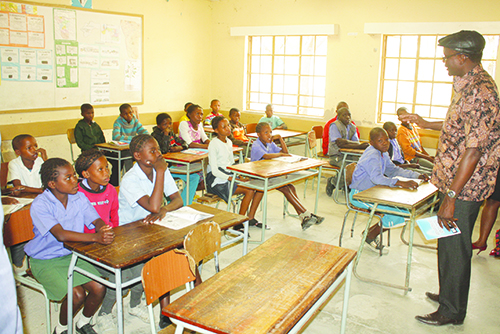
ELEVEN months after the Ministry of Education introduced the Universal Primary Education (UPE) concept, most rural schools say their standards have improved while urban schools are struggling to adjust.
For the rural schools, UPE means more computers, more activities, more textbooks and more study materials, but previous high-maintenance urban schools are feeling the pinch of having less than they are used to spending.
Head of Department at the Haisisira Primary School on the outskirts of Rundu, Bibiana Seponde, summed up free education as a “blessing”.
“We are better off now than we were before the introduction of UPE. The school has purchased a computer for the first time and we are able to take our pupils on trips for sporting and cultural activities. We have also brought football gear for the pupils,” she said.
Seponde further said her school, which has 272 learners, was allocated N$90 000 by government as part of UPE, and that the amount is just what the school needs to thrive.
“Parents used to pay N$20 per year. It was hard because some of them skipped payments, but with UPE, we are sorted,” she said.
For the Oniimwandi Primary School in Oshakati with 296 learners, the N$120 per year that was previously paid by parents for the School Development Fund could not even get the school its first computer. “This year, we received about N$34 000 from government when UPE was first introduced, and again received N$29 000 in the middle of the year,” said principle Ruth Kashinasha.
With UPE, she said, the school was able to purchase computers as well as a projector and many other resources and teaching materials. However, Kashinasha, as well as several other principals, said government has produced a strict list of expenditures that the UPE money should be used for and that every school should stick to.
“These include maintenance of buildings, school sports and cultural activities, administration necessities as well as payment for relief teachers for less than a month,” she said. “Any other expenditures not included on the list requires special permission from government.”
Some schools like the St Barnabas Primary School in Katutura, which has 950 learners, are struggling to stick to the list.
“The UPE fund is helpful, but we feel restricted because right now our school is in need of a hall and a bus, but we cannot invest in them because they are not on the list of expenditure that government has provided,” said the school’s principal Gerson Katjivena.
He also said the school has received about N$120 000 for UPE, but also relies on parents’ voluntary contributions.
Highly-maintained schools like Windhoek’s Emma Hoogenhout that used to budget a whooping N$2,2 million per year, have had to scale down on the budget to stick to government’s list.
The school has a learner population of 1 193. With the introduction of UPE, the school recently had to close down its swimming pool, discontinued its staff development programmes and is now faced with a sports field that is drying up due to limited funds.
“UPE, although a brilliant idea, is not catering for all the needs of our school. Government could have carried out an assessment to determine the feasibility of UPE when it comes to urban schools,” said the principal, Vetjiua Mukungu.
He further said the school has lost about N$627 000 since the introduction of UPE and has to look elsewhere for funds. “These days, we stick to basics such as computer maintenance and purchasing of stationary. We can no longer afford new computers,” he said, adding that his school was allocated N$144 000 at the beginning of the year, and then another N$130 000.
Earlier this year, the Pionierspark ‘Parkies’ Primary School in Windhoek made a desperate attempt to privatise the school when the board argued that the N$220 000 that government had allocated at the beginning of the year was way below the N$1,9 million budget the school had initially prepared for the year. Education spokesperson Romeo Muyunda told The Namibian that the UPE fund is not to be used for major renovations and maintenance of schools.
“The whole purpose of introducing UPE was to increase access to primary education for all. The funds provided by government are for minor maintenance such as replacing of broken equipment but it should not be used for construction and purchasing of new equipment,” he said.
He added that construction and major renovations and maintenance remain the responsibility of the ministry.
In an age of information overload, Sunrise is The Namibian’s morning briefing, delivered at 6h00 from Monday to Friday. It offers a curated rundown of the most important stories from the past 24 hours – occasionally with a light, witty touch. It’s an essential way to stay informed. Subscribe and join our newsletter community.

The Namibian uses AI tools to assist with improved quality, accuracy and efficiency, while maintaining editorial oversight and journalistic integrity.
Stay informed with The Namibian – your source for credible journalism. Get in-depth reporting and opinions for
only N$85 a month. Invest in journalism, invest in democracy –
Subscribe Now!