



It is not that difficult to make risotto and it is a great dish to have in your repertoire. Hearty and comforting, and if made correctly, something quite creamy and very special. All you need to do is follow the steps and pay attention to the elements of your dish. Timing is everything!
Risotto is made from short grain rice that is high in amylopectin starch.
Use only Italian varieties such as Arborio, Baldo, Carnaroli, Maratelli, Padano, Roma, or Vialone Nano rice.
Arborio is quite readily available in most local supermarkets, so that is most likely the rice you’d be cooking with.
In addition to the rice, your risotto also requires a very good quality stock, preferably homemade. Store bought stocks contain a fairly substantial dose of salt that acts as preservative, so if you are going to use these, check your seasoning throughout because as your risotto cooks and the liquid contents reduce, the salt becomes more concentrated and pronounced.
You need about three parts stock per one part rice.
Never wash risotto rice as this would wash away the starch that gives the finished dish its creamy texture.
Furthermore, make sure your stock is hot (not boiling). Keep it over low heat throughout to ensure that it does not cool down. This is important because if you add a cold liquid to the hot rice, it will cause the rice to cool down and this would hamper the release of the starch in the grains.
The first step towards a good risotto starts with a good Soffritto. This is a mixture of herbs and/or spices and finely chopped aromatic vegetables (usually onions, garlic and celery, the Italian Holy Trinity) that is sautéed in olive oil and/or butter. If you are using ingredients that should cook for 20 minutes to half-an-hour (e.g. meat or sausage or dried mushrooms), you’d have to add it to your soffritto.
The second step for good risotto is called Tostatura or toasting. As soon as the soffitto is cooked, the raw rice is added (without any liquid) and stirred to coat the rice grains with the warm fat (oil or butter or both). The toasting prepares the rice for the next step which is the addition of the flavourful liquid. If the rice is not toasted, it will not absorb the flavourful liquid as it should, and that means your risotto will not be as creamy as it should be. The toasting is done when the rice is too hot for you to pick up with your fingers.
Once the rice is toasted and translucent, the next step, that of adding flavourful liquid, begins. First, add a glass of wine (white or red depending on the recipe) to the hot pan with toasted rice and allow it to boil off. It adds flavour more than anything else.
Next, add the stock, one ladle at a time and stir the dish, until all the liquid is absorbed and then you add the next ladle. The continuous stirring of the risotto helps release the starch from the rice and helps the rice to absorb the flavours in the liquid. It also ensures that the rice cooks evenly. Thus, do not deviate from this simple process: add a ladle full of stock and stir until the liquid is absorbed, then add another ladle and stir.
After about 10 to 15 minutes into your risotto, you must start adding the remaining ingredients. Keep in mind that it takes only about 20 to 25 minutes in total to make a risotto, so you need to get your timing right. With only five or so minutes left, add soft vegetables that do not take long to cook. Things like tips of asparagus, mushrooms, peas and most seafood.
If you are using ingredients that require a long cooking time, it is best to cook them separately in a second pan and then add them to the risotto towards the end. You would be very disappointed if your risotto contains both over-cooked rice and over- or under-cooked, unpalatable ingredients all because you added some your ingredients too late or too early. The rice should be firm and have a ‘bite’ (not mushy or ‘tooth-chip’ hard).
After the rice is cooked, your risotto needs a breather. Remove the dish from the heat and let it rest and cool down a bit. Only a minute or three’s resting time is needed in preparation for the final step.
The final step is called Mantecatura. The rice is emulsified with (cold) butter (manteca in Spanish) and cheese (usually a hard cheese such as Parmigiano-Reggiano or Pecorino). The creamy texture of the dish is the direct result of this emulsion and thus, is the all important step for producing the perfect risotto all’onda, which refers to the perfect risotto’s soft and loose texture, so if you tilt the plate the risotto ripples in waves. The butter and cheese emulsion is caused by vigorously stirring the risotto after it has cooled down a bit during the resting step. If the risotto is too hot, the emulsion will split and the dish will be oily.
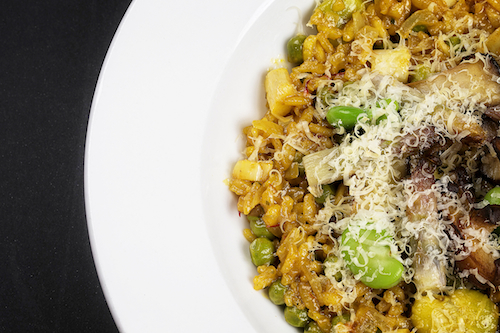
This week’s recipe is my take on a risotto with summer vegetables: white asparagus, mushrooms, peas and fresh broad beans. You could, of course, add your own ingredients but do not skip any of the five essential steps.
Buon appetito!
• 150 grams of fresh broad beans
• 250 grams of fresh peas
• 500 grams of asparagus (white or green)
• 250 grams of mushrooms
• 100 grams of olive oil
• 1 medium sized onion, finely diced
• 2 tablespoons of fresh parsley leaves, finely chopped
• 2 tablespoons of fresh mint leaves, finely chopped
• 400 grams Arborio rice
In an age of information overload, Sunrise is The Namibian’s morning briefing, delivered at 6h00 from Monday to Friday. It offers a curated rundown of the most important stories from the past 24 hours – occasionally with a light, witty touch. It’s an essential way to stay informed. Subscribe and join our newsletter community.

The Namibian uses AI tools to assist with improved quality, accuracy and efficiency, while maintaining editorial oversight and journalistic integrity.
Stay informed with The Namibian – your source for credible journalism. Get in-depth reporting and opinions for
only N$85 a month. Invest in journalism, invest in democracy –
Subscribe Now!