


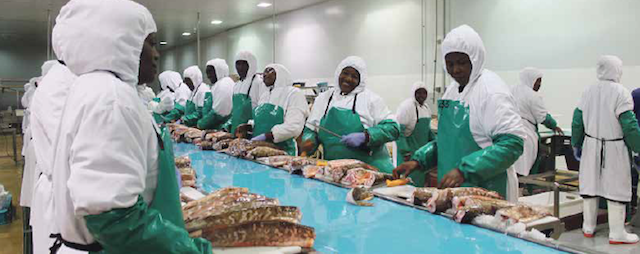
THREE ex-factory workers at Walvis Bay are helping hopefuls in the fishing industry to qualify for jobs.
Janet Nantanga, Magdalena Festus and Elizabeth Monica were employed by a fishing company for nearly 20 years when they were retrenched in 2013 as their factory closed down.
“It was quite unexpected and hard to sit without work after working for so long, but what could we do? It was the only job we knew and we were devastated,” Nantanga says.
Last year, as the trio took a walk through Walvis Bay’s industrial area, they came across a group of women at the gate of a small fishing company seeking to hire about 40 new factory workers.
“We were surprised as many of them who went inside for a practical test walked out disappointed, because they had not passed it. The test involved cutting fish. Unfortunately, the women discovered right there they had no skills cutting fish,” Festus says.
The women say cutting fish, especially filleted hake, requires a special technique only those with experience knows.
“We felt really sorry for the women. Only two out of that large group qualified, and the company decided to readvertise. That is when we decided to rescue potential factory workers by training them to cut fish.”
The women bought protective gear, knives and fish, and advertised a fish-cutting training course in October last year.
The short course stretches over five days and is presented in one of the women’s garages.
Trainees receive certificates at the end of the course to add to their CVs when applying for factory jobs.
“We started visiting factories to introduce ourselves … We hope all the factories will be able to accommodate people trained by us … We are registered with the Ministry of Industrialisation and Trade,” Festus says.
The women say before Covid-19 hit the country, there was lot of interest in their course.
Festus says she used to think retrenchment was the end, but it was just the beginning.
“We are determined to make this project a huge success, as the fishing industry is very important to the country’s economy. We have, however, been unemployed for quite a while, and would need help from good Samaritans along the way. We have to buy fish, protective gear and equipment. We also rely on people to make the certificates, which costs money. We don’t charge a lot, because the people coming for training are also unemployed,” Festus says.
The trio hopes to be employed themselves soon.
Meriam Shikeukeni, a trainee, says: “We are truly grateful and urge others to get this training.”
The women advise people who have been retrenched to take advantage of their skills to create new opportunities.
In an age of information overload, Sunrise is The Namibian’s morning briefing, delivered at 6h00 from Monday to Friday. It offers a curated rundown of the most important stories from the past 24 hours – occasionally with a light, witty touch. It’s an essential way to stay informed. Subscribe and join our newsletter community.

The Namibian uses AI tools to assist with improved quality, accuracy and efficiency, while maintaining editorial oversight and journalistic integrity.
Stay informed with The Namibian – your source for credible journalism. Get in-depth reporting and opinions for
only N$85 a month. Invest in journalism, invest in democracy –
Subscribe Now!