





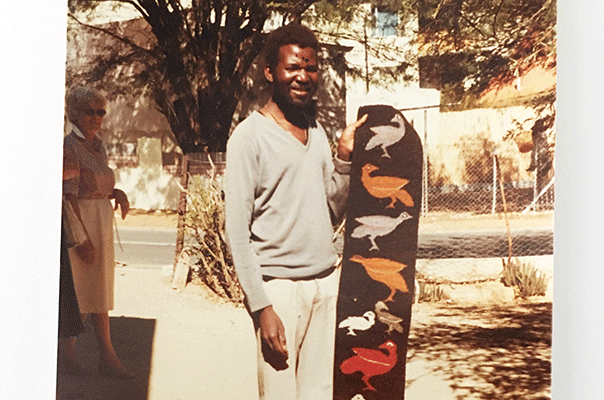
• Annaleen Eins In 1973, I had the great luck of seeing John Muafangejo’s artworks for the first time with Rosy van Seggern, who was his first agent in Namibia. She arranged for me to meet him at the Arts Association premises.
This was the beginning of a personal relationship that lasted until his death on 27 November 1987, based on my admiration for him as an amazing artist, a person of clear and steadfast ethics, a motivated colleague, a friend in mutual respect, and a great teacher working towards the vision of an independent Namibia based on truth and reconciliation.
Muafangejo was a person who always gave the impression of being a happy man and liked to make jokes. He was always very soft spoken, disliked rowdy large groups and was not given to talking just for the sake of it.
Only people who really cared and studied his art works realised that he was a very sensitive man with very deep feelings about his own traditional culture and traditions, the confusing and brutal politics of the day, the social issues we encounter as humans and his religious beliefs according to which he practically lived.
Although he suffered greatly due to the manic depression he was diagnosed with in 1968 at the Madadeni Hospital in Newcastle, South Africa, he always tried not to impose this on family and friends but took his medicine and locked himself in his room until he could cope with work and life.
He was very hospitable towards people he liked; in his home and especially after he bought his own house in Katutura, the rooms were filled with friends and relatives and customers browsing through his art works, all welcomed with a warm smile.
What kind of artist was John Muafangejo? According to Bishop Petrus Hidulika Hilukiluah he was always eager to pursue studies so that he could continue to improve his career.
“He was concerned about peace and harmony between all God’s people – both black and white.” (Bishop Petrus Hidulika Hilukiluah – John Muafangejo AAHT 2010)
He studied twice at the Rorke’s Drift Art and Craft School in Natal in South Africa during 1967/69 sponsored by the Anglican Church and again in 1974/75 with a bursary from the Arts Association of South West Africa sponsored by the Behnsen family.
He applied to the Cape Town University’s art department in South Africa to study in 1971 but was only positively accepted as artist-in-residence shortly before his death.
Muafangejo was very proud of being an artist and displayed great confidence as one.
He was one of the most hardworking artists I have ever met and worked with.
Muafangejo received many art prizes and accolades during his lifetime as well as posthumously which culminated in international recognition, not only for the narrative impact of his printed works, but also for the graphic quality he developed in the linocut medium. This skill enabled him to express his personal views and observations in a specific style, which can be described as decorative and expressive. His artistic approach is unique and cannot be categorised within current international schools or trends. Yet typical African elements are obvious, namely the narrative, decorative and didactic components, which, following tradition, are designed to serve the community.
His technique and style of creating his artworks can be differentiated in the mediums which he used, the faces, figures and proportions of his main objects portrayed, naturalism versus abstraction, use of lettering and tones and his significant use of pictorial order to create compositions by means of lines, axes and definite angles to convey the artists expression. Often objects adapt to compositional demand, which proves that Muafangejo’s art works are highly conceptualised as well as being narrative in nature.
In many of his artworks he can be seen as a naturalistic artist, following his mission to teach and to preach, striving to describe his religious, political, social and traditional observations as close to the truth as possible. Text and titles confirm the realistic approach and assist in avoiding the impression of a double meaning. His images are naturalistic, though stylised but the environmental subject matter, lines, patterns and largely simplified forms can often be described as abstract.
Intuitively and because of his technical skill and experience, he had perfect control over his subject matter and its layout. Despite the constraints of the theme of a particular linocut, Muafangejo would never neglect the overall balance of black, white and structural areas, decorating elements mediating between the images to ensure the rhythmic flow of all pictorial parts or else to denote dynamic movement.
When asked about his choice of theme or content/context to create an artwork he explained that he listened to the radio, read newspapers, discussed issues with family and friends and always remembered beautiful traditional customs and happenings from his happy childhood. He often told me that before he fell asleep and during the night he often had joyful or disturbing thoughts pressing on his chest and only once he could express these thoughts as an artwork could he find relief and peace.
Working with Muafangejo for 14 years was one of the most inspiring times of my life, and having a small share in his creative power, difficult, positive, often sad but always amazingly successful life and artistic development.
John Ndevasia Muafangejo – the artist, and the legacy of his art works – will always remain two of the most important facts in the history of the visual arts in Namibia.
An internationally recognised graphic artist from the African continent with his own authentic artistic expression which signifies his crucial contribution to contemporary art in Africa.