



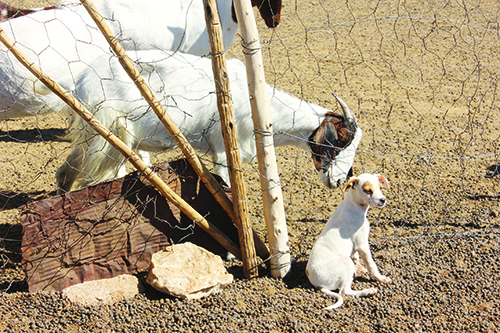
• GAIL POTGIETERAS many Namibian children start their first year of school in 2014, some of their four-legged counterparts have began their on-farm schooling in the southern parts of Kunene.
Puppies born to litters in Sorri-Sorris, Ûibasen Twyfelfontein, ≠Khoadi-//Hôas and Torra conservancies have been placed on communal farms in the region, to start their training as livestock guarding dogs.
The new owners are hopeful that their canine employees will grow up to protect their sheep and goats from predators such as jackals and cheetahs.
Although all of the puppies come from working livestock guarding dogs, the real work for this generation of dogs begins now.
During their first month at their new homes, the puppies will be kept with young livestock in the kraal throughout the day and night to introduce them to the livestock.
Once they have met their new ‘families’, the pups will start accompanying their flocks into the field with their respective herders.
During this crucial time, a young guarding dog must be taught valuable lessons to ensure that they become effective working dogs. They need to bond with their new goats and sheep, learn about their new homes, build a trusting relationship with their co-workers (herders), and learn to distinguish between friends (like donkeys, chickens) and foes (such as jackals).
Like schoolchildren, the puppies were a little nervous when they reached their new homes, and missed their siblings and mothers during their first day at ‘school’. Nonetheless, with the right training and care, each puppy has the potential to become a confident livestock guardian.
Once fully grown, each dog will provide a valuable service to their owners by guarding livestock against predators.
Adult guarding dogs need not be able to chase and/or kill predators to be effective. Their main function is to provide extra-sharp eyes, ears, and noses in the field when the livestock are grazing. As dogs will often become aware of a predator’s presence before their human counterparts, they can act as an early warning system by barking loudly.
Predators will rarely follow through with a planned ambush once they have been spotted, and the dog’s barking signals to them that the game is up. Herders may also react to the dog’s warning and help to see off the predator.
The new dog owners were given all the information necessary to train their puppies with the livestock and to keep the dogs in tip-top condition. The management and care for the breeding dogs, along with the technical support provided to the new dog owners is currently provided by the Namibia Nature Foundation, with funding from the Millennium Challenge Account, Namibia.
It is hoped that each conservancy will use the lessons learned over the last year to continue their breeding programmes into the future.
The success of the communal conservancy system in the southern Kunene has allowed populations of prey species (e.g. mountain zebras, springbok, gemsbok) to increase. Predator populations have apparently responded by increasing in the region. Although this is good for conservation and the ecological health of the region, livestock farmers have reported higher losses to predation in recent years.
The conservancy-based livestock guarding dog breeding programmes in the southern Kunene aim to help the local farmers to reduce their losses. Human-predator conflict is a major challenge throughout Namibia, but these conservancies are hoping to tackle this challenge – one puppy at a time.
In an age of information overload, Sunrise is The Namibian’s morning briefing, delivered at 6h00 from Monday to Friday. It offers a curated rundown of the most important stories from the past 24 hours – occasionally with a light, witty touch. It’s an essential way to stay informed. Subscribe and join our newsletter community.

The Namibian uses AI tools to assist with improved quality, accuracy and efficiency, while maintaining editorial oversight and journalistic integrity.
Stay informed with The Namibian – your source for credible journalism. Get in-depth reporting and opinions for
only N$85 a month. Invest in journalism, invest in democracy –
Subscribe Now!