



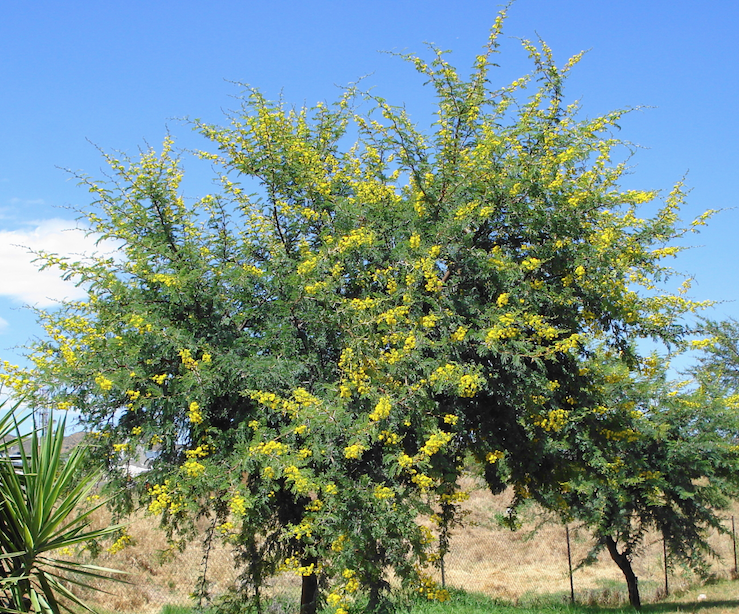
•LUISE HOFFMANNUP TO a few years ago, these spike-thorned shrubs were known as Maytenus and are listed under that name in older sources.
Usually they are dense thorny shrubs. They have single thorns, which in fact are small branches ending in a very sharp point. Consisting of the same material as the branches on which they grow, they are very strong.
The red spike-thorn or confetti spike-thorn (Gymnosporia senegalensis = Maytenus senegalensis).
This is a many-stemmed shrub of about three , sometimes eight metres, with strong thorns of up to seven centimetres. The blue green leathery leaves often grow on the thorns and are covered in a whitish, waxy-looking layer. The margins are regularly serrate or scalloped and the leaf-stalk of young leaves is pinkish or redddish. The midrib may also be reddish.
Names: Both species are generally known by the same common names. E. Confetti spike-thorn, confetti-bush; G. Sprossdorn; A. bloupendoring [G. senegalensis], pendoring; H. omutungambara. The meaning of Gymnosporia is not known, senegalensis means ‘from Senegal’.
The confetti spike-thorn occurs in Egypt, Morocco, southern Spain, Arabia, India and Pakistan. In Namibia it is widespread but not always common from about Keetmanshoop northwards. It also grows along the Fish River Canyon, but is most common in the Karstveld up to the Angolan border and in eastern Zambezi.
The pale grey stem is fairly smooth. Numerous, small, sweetly scented flowers are greenish-white to cream and arranged in dense clusters. Appearing mostly in May, they may be found throughout the year. The small, ball-shaped reddish or yellow-brown fruit, six millimetres in diameter, are leathery capsules and usually split into two, sometimes three parts.
The flowers drop in large numbers resembling confetti – hence the English common name. Antelope and other animals browse the leaves and birds eat the fruit. Shrikes impale their prey on the sharp thorns while several butterflies lay their eggs among the flowers. The strong spines are used when stretching skins to cover drums.
Medicinal: Boiled roots are placed on the chest as a poultice to treat pain. The water in which the roots were boiled serves to strengthen weakened patients. The root also alleviates the suffering of patients vomiting blood. The pulverised root mixed with mustard oil is said to be a good remedy for head lice. In Botswana, the root is highly valued as an aphrodisiac for which purpose it is chopped finely and mixed with beer. Drunk very quickly, it is said to work wonders.
In the central parts of the northern half of Namibia the confetti bush may be confused with the so-called common spike-thorn (A. gewone pendoring) (Gymnosporia buxifolia), called Maytenus heterophylla in older books. It can be distinguished by its thinner, irregularly toothed, papery leaves, which rarely grow on the spines. The small white to cream flowers have a strongly unpleasant scent and the rough-textured fruit usually splits into three parts. It is called common spike thorn because in South Africa it is more common than G. senegalensis.
Currently
conspicuous:
Trees and shrubs with small hooked thorns found on rocky sites and now covered in delicate feathery leaves and creamy flower spikes are mountain thorn (Acacia hereroensis), Bergdorn, bergdoring, oro.
Untidy shrubs bearing numerous four-winged fruits, cream-coloured to all shades of pink, are brittle thorn (Phaetoptilum spinosum), Flügelfruchtstrauch, brosdoring, bankrotbos.
In an age of information overload, Sunrise is The Namibian’s morning briefing, delivered at 6h00 from Monday to Friday. It offers a curated rundown of the most important stories from the past 24 hours – occasionally with a light, witty touch. It’s an essential way to stay informed. Subscribe and join our newsletter community.

The Namibian uses AI tools to assist with improved quality, accuracy and efficiency, while maintaining editorial oversight and journalistic integrity.
Stay informed with The Namibian – your source for credible journalism. Get in-depth reporting and opinions for
only N$85 a month. Invest in journalism, invest in democracy –
Subscribe Now!