



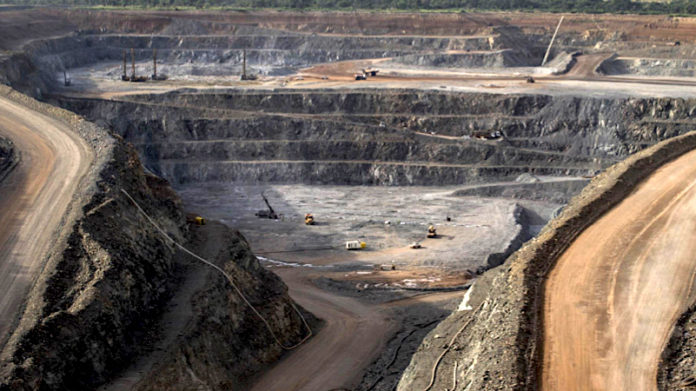
B2GOLD’S Otjikoto Mine in Namibia produced 199 139 ounces of gold in 2025, near the high end of its guidance range of between 185 000 and 205 000 ounces.
This production has contributed to the Canadian company’s record annual revenue of US$3.06 billion (about N$60 billion).
According to a company statement issued by chief executive Clive Johnson, the Fekola, Masbate and Otjikoto mines continued their strong performance in 2025, producing 926 434 ounces of gold at the mid-point of their guidance range of between 890 000 and 965 000 ounces.
A total of US$7 million (about N$112.5 million) was budgeted for exploration at Otjikoto last year.
The focus of the exploration programme was drilling the Antelope deposit, located approximately 3km south of Phase 5 of the Otjikoto open pit, with a total of 39 000m of drilling planned.
The Antelope deposit, comprised of the Springbok Zone, the Oryx Zone, and a possible third structure, the Impala zone, subject to confirmatory drilling, was discovered in 2022 following deep drill testing by B2Gold exploration personnel on three-dimensional models of airborne magnetic data.
For the year ended on 31 December 2025, the company incurred US$8 million (about N$128.3 million), which included 35 924m of diamond and reverse circulation drilling at the Otjikoto Mine area.
Johnson says for the year ended 31 December 2025, mill feed grade at Otjikoto was 1.83g/t (grams per tonne), mill throughput was 3.44 million tonnes, and gold recovery averaged 98.7%.
“In the fourth quarter of 2025, Otjikoto Mine produced 50 793 ounces of gold, significantly higher than expected, primarily due to the continued processing of high-grade open pit ore stockpiles after the end of open-pit mining at the beginning of the fourth quarter of 2025,” he says.
Johnson says in the fourth quarter of 2025, mill feed grade was 1.91g/t, mill throughput was 0.84 million tonnes, and gold recovery averaged 98.7%.
The executive says the majority of preproduction capital is expected to be spent in 2026 and 2027.
The preliminary economic assessment indicates an initial mine life of five years and total production of 327 000 ounces, averaging approximately 65 000 ounces per year over the life of mine.
In combination with the processing of existing low-grade stockpiles, production from the Antelope zone has the potential to increase Otjikoto Mine’s production to approximately 110 000 ounces per year from 2029 till 2032.
Otjikoto Mine is expected to produce between 70 000 and 90 000 ounces of gold in 2026 at cash operating costs of between US$1 200 and US$1 300 per ounce, produced and all-in sustaining costs of between US$1 830 and US$1 980 per ounce sold.
“Gold production at Otjikoto is anticipated to be lower than 2025 due to the completion of open-pit mining activities in the fourth quarter of 2025.
For the full year of 2026, Otjikoto is projected to process a total of 3.4 million tonnes of ore at an average grade of 0.80g/t gold with a process gold recovery of 97.4%.
“Processed ore will be sourced from the Wolfshag underground mine, supplemented by existing low-grade ore stockpiles,” Johnson says.
According to the statement, capital expenditures for Otjikoto Mine in 2026 are expected to total US$57 million.
– email: matthew@namibian.com.na
In an age of information overload, Sunrise is The Namibian’s morning briefing, delivered at 6h00 from Monday to Friday. It offers a curated rundown of the most important stories from the past 24 hours – occasionally with a light, witty touch. It’s an essential way to stay informed. Subscribe and join our newsletter community.

The Namibian uses AI tools to assist with improved quality, accuracy and efficiency, while maintaining editorial oversight and journalistic integrity.
Stay informed with The Namibian – your source for credible journalism. Get in-depth reporting and opinions for
only N$85 a month. Invest in journalism, invest in democracy –
Subscribe Now!