



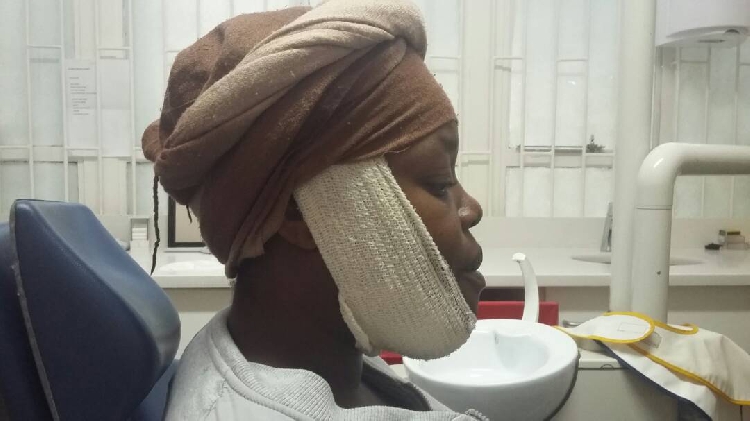
WHEN Windhoek-based doctor Panduleni Itula was approached by a 32-year-old mother of four with a facial deformity because of a tumour, he knew that he had to do something to bring back her smile.
Joaquina Macana was suffering from Ameloblastoma, a medical condition that caused a big growth on her jaw and had turned her life upside down.
The growth forced her to stop working because she did not feel she looked like a human being and that society was judging her.
“The idea is not to leave the person disfigured,” Itula told The Namibian during an interview last week.
Ameloblastoma is a tumour that starts in the jaw, often near the wisdom teeth or molars, from cells that form the enamel that protects the teeth.
Itula explained that because of the enamel, the tumour affects the jaws only and not other bones.
He added that he does not know of the statistics in Namibia and the success records because of the difficulty of keeping track of those who suffer from the condition or have been treated.
He did, however, say that for reasons unknown to him, most of the patients he has treated are either from northern Namibia, Zambezi region, Rundu or southern Angola.
Itula said the Ameloblastoma tumour develops slowly and at times painlessly. He explained that they are benign, meaning that they do not spread to other parts of the body.
He added that because the tumours do not react to chemotherapy, the affected part usually has to be removed.
The tumour causes swelling that results in the disfiguring of the face.
A tumour usually grows slowly. For a while, the only symptom a patient may experience may be swelling in the back of the jaw and at times also toothaches and headaches.
Itula said early detection is always best because it will rule out the need to remove the whole jaw.
“It is advisable that people go for regular check-ups at the dentist and dentists should conduct thorough check-ups,” he said.
Macana is the second patient on whom Itula conducted an operation that resulted in the removal of the whole jaw and reconstructed a new one from the patient’s rib.
The first part of the six-hour surgery was conducted by a thoracic surgeon (of the chest), Jones Nghaamwa.
Dr Nghaamwa removed the rib used to reconstruct Macana’s replacement jaw.
Itula then carried out the maxillofacial surgery which is the surgery in the face and neck area.
The operation is carried out by a dental specialist who treats conditions, defects, injuries and aesthetic aspects of the mouth, teeth, jaws and face.
“The operation is very meticulous, and a lot of training and patience is needed,” said Itula.
He said many patients blame the condition on witchcraft and would at times seek traditional healing first before consulting a doctor.
Ameloblastoma develops most often in the jaw near the molars.
Ameloblastoma begins in the cells that form the protective enamel lining on your teeth.
Although it can be diagnosed at any age, Ameloblastoma is most often diagnosed in adults in their 30s and 40s.
The deformity can be very aggressive, growing into the jawbone and causing swelling and pain.
It can sometimes be painless.
In an age of information overload, Sunrise is The Namibian’s morning briefing, delivered at 6h00 from Monday to Friday. It offers a curated rundown of the most important stories from the past 24 hours – occasionally with a light, witty touch. It’s an essential way to stay informed. Subscribe and join our newsletter community.

The Namibian uses AI tools to assist with improved quality, accuracy and efficiency, while maintaining editorial oversight and journalistic integrity.
Stay informed with The Namibian – your source for credible journalism. Get in-depth reporting and opinions for
only N$85 a month. Invest in journalism, invest in democracy –
Subscribe Now!