




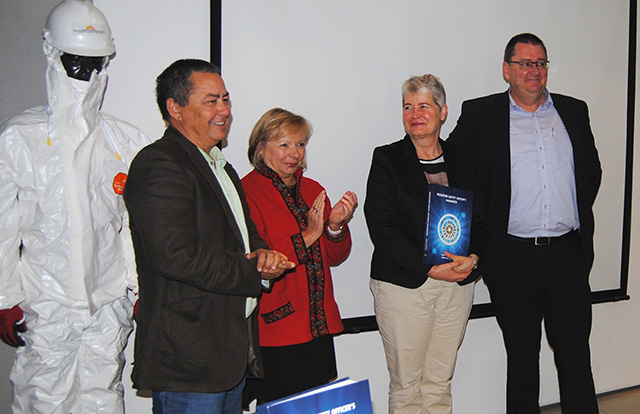
THE radiation safety officer’s handbook was launched at the Namibian Uranium Association (NUA) at Swakopmund last week.
NAU is the representative body of the country’s uranium industry and the leading point of contact between the government, the media, public and private stakeholders, and anybody interested in the position, policies and procedures of the NUA as they apply to the country’s uranium industry.
Its members include all Namibian uranium mining operations, most uranium exploration companies, and numerous associated service providers active in the field.
NUA promotes the industry’s adherence to sustainable development, product stewardship, and the compliance with all facets of the Namibian and international legislative and regulatory environment.
The NUA established the Namibian Uranium Institute (NUI) as part of the association’s commitment to product stewardship.
The institute’s primary purpose is to actively promote knowledge and capacity building in specialised skills such as radiation safety, environmental management and health, and to be the communications hub for the uranium industry in Namibia.
NUI provides opportunities for members of the NUA to jointly collaborate to improve their health and safety performances through the identification of leading best practices and their local implementation.
The institute works closely with the Namibian government and various state agencies, and also has close ties with the Namibian University of Science and Technology (NUST).
Since 2009, NUI offers training and certification courses for radiation safety officers, as well as a variety of short specialised radiation safety training courses.
At the time, the Atomic Energy and Radiation Protection Act had just been promulgated, and the need for a structured approach to educating radiation safety officers became obvious.
This was when the institute approached Gunhild and Detlof von Oertzen, both of whom have many years of experience in the field of radiation safety, with the request to design and offer courses to address the gap that existed in applied radiation safety. They created and offered numerous radiation safety courses, including the NUI’s radiation safety officer’s course, which is the flagship radiation safety course.
This was in addition to a variety of specialist radiation safety courses, including radiation safety for sealed radioactive sources, radiation safety in the transport of radioactive materials, emergency responses in case of accidents involving radioactive materials, and various others.
The courses were continuously refined, and have matured into highly respected offerings that lay the foundation of the application of the radiation protection principles and practices in the country.
However, while taught courses are an essential tool in the training of professionals, the need for a radiation safety officer’s handbook as a reference volume that can be consulted on a regular basis if and when the need arises, became apparent.
“With the subsequent allocation of funds in the budget of NUI and the much-appreciated financial support of the Namibian Chamber of Environment, which is herewith gratefully acknowledged, a project of realising such a handbook materialised. Gunhild and Detlof von Oertzen could be engaged to write such a handbook,” said NUA chairman Percy McCallum at the launch.
“Based on their qualifications as trained nuclear physicists and their experience, they have compiled an impressive book that will, without doubt, be the reference volume in the field of radiation safety in Namibia for a long time to come.”
He said the development of a radiation safety officer’s handbook is another milestone in meeting industry requirements, international obligations and ensuring leading best practice. The book condenses the years of development and refinement of the courses into one reference text that systematically introduces all aspects of relevance for practising radiation safety officers.
As such, the book is expected to appeal to professionals active in the field, as well as those who are only starting their careers in radiation protection.
As seasoned professionals, the authors have created a real and accessible guide, which shares their fascination and passion for radiation protection and radiation safety.
The radiation safety officer’s handbook can be obtained at the offices of the NUI at Swakopmund.
In an age of information overload, Sunrise is The Namibian’s morning briefing, delivered at 6h00 from Monday to Friday. It offers a curated rundown of the most important stories from the past 24 hours – occasionally with a light, witty touch. It’s an essential way to stay informed. Subscribe and join our newsletter community.

The Namibian uses AI tools to assist with improved quality, accuracy and efficiency, while maintaining editorial oversight and journalistic integrity.
Stay informed with The Namibian – your source for credible journalism. Get in-depth reporting and opinions for
only N$85 a month. Invest in journalism, invest in democracy –
Subscribe Now!