









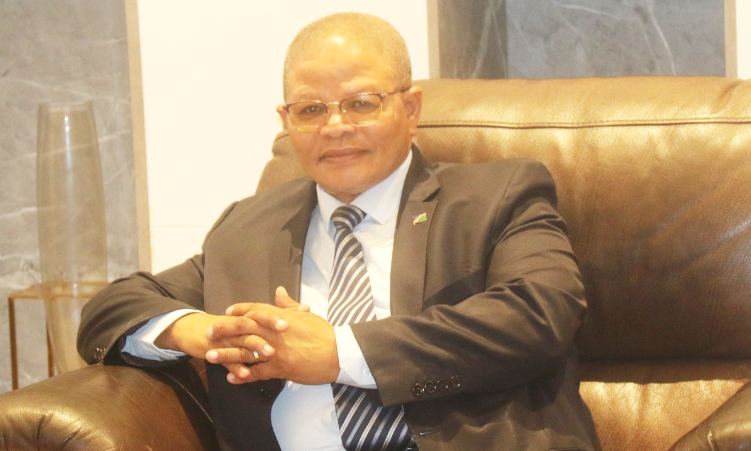
The Office of the Prime Minister says no decision has been made yet regarding Public Service Commission (PSC) chairperson Salmaan Jacobs continued tenure as PSC chairperson.
Jacobs has been ordered to report to a prosecutor at the Keetmanshoop Regional Court by the end of next week, after his acquittal on a charge under the Anti-Corruption Act dating back 19 years was overturned by two judges of the Windhoek High Court on Friday.
Jacobs now has to return to court to be sentenced on a charge on which he was found not guilty in March 2014.
He was initially prosecuted on five counts of unlawfully obtaining gratification, but was pronounced not guilty on three of the charges in June 2013, and thereafter was acquitted on the two remaining charges in March 2014.
“It might be a decision that will have to go to her excellency [president Netumbo Nandi-Ndaitwah],” OPM executive director Gladice Pickering yesterday said.
“If you consider the provisions of the Public Service Commission Act, it indicates that the commissioners, as well as the chairperson, are nominated by the president and appointed by the National Assembly.”
Pickering explained that in terms of the act, the president may remove a member of the PSC from office on grounds of misconduct, among other reasons.
“The president may also require a member of the commission to absent himself or herself temporarily from duty to afford the president an opportunity to consider possible removal,” she said.
“If the president decides to remove such a member, she must communicate that decision and the reasons for it to the National Assembly within 14 days. The National Assembly will then follow the prescribed process to remove the member,” she added.
Presidential spokesperson Jonas Mbambo was not reachable for comment yesterday.
Jacobs is waiting for a full written judgement of the High Court before commenting on his next move in relation to a corruption conviction he has received in the Windhoek High Court.
Jacobs’ legal representative, Zadré Vogel, yesterday confirmed that Jacobs would not comment until the complete judgement is available on the judiciary’s electronic case system.
Jacobs did not respond to several calls to his cellphone yesterday.
After the state appealed against Jacobs’ acquittal on the last two charges, acting judge Marilize du Plessis and judge Naomi Shivute on Friday upheld the appeal on one charge, found Jacobs guilty of unlawfully obtaining N$30 000 in gratification, and referred his case back to the Keetmanshoop Regional Court for sentencing.
The state’s appeal against Jacobs’ acquittal was delayed because an appeal notice could not be served on him during a period when he was outside Namibia on a diplomatic mission, prosecutor general Martha Imalwa said yesterday.
That led to the state’s appeal being struck from the High Court’s roll, she said.
The state’s appeal notice was served on Jacobs after his return to Namibia, and the state’s appeal was then re-enrolled in the High Court, she said.
‘GARDEN PROJECT’
The charge on which Jacobs has now been found guilty involves an allegation that he unlawfully obtained N$30 000 in gratification through a close corporation, Sadadi Enterprises, in July 2006, while he was the chief regional officer of the ||Kharas Regional Council.
The ||Kharas Regional Council transferred N$30 000 to a bank account of Sadadi Enterprises, in which Jacobs and his wife, Annarine Jacobs, were equal members, in July 2006, Du Plessis recounted in the appeal judgement.
The money was paid subsequent to a proposal, drafted by Jacobs in the name of Sadadi Enterprises, to establish a vegetable garden project at a fountain at Berseba in the ||Kharas region.
Jacobs drafted the project proposal on behalf of his nephew.
Du Plessis recounted in the appeal judgement: “The garden was never established and by the time the Anti-Corruption Commission started investigating the matter, all that could be seen at the fountain at Berseba were a fence around the fountain, a water tank and a broken solar panel.”
Du Plessis also noted that a cheque in an amount of N$4 517 was drawn on the bank account of Sadadi Enterprises six days after the regional council had paid N$30 000 into the account.
The N$4 517, together with N$2 000 in cash, were used to pay arrears on a hire purchase account for a private car of Jacobs.
According to the then governor of the ||Kharas region, Dawid Boois, the Berseba garden project was never discussed or approved by the ||Kharas Regional Council, and he was not aware that money had been paid by the council for the project.
Du Plessis also noted that according to evidence before the trial court Jacobs did not declare his interest in Sadadi Enterprises as was required by the regional council’s human resource policy.
She commented: “It is difficult to see how the failure of the accused to disclose his interest in Sadadi was not deliberate.”
The state proved that Jacobs was the driving force behind the Berseba garden project proposal, Du Plessis said.
As chief regional officer, Jacobs must have been aware that the regional council did not discuss or approve the garden project, she said.
Despite that knowledge, Jacobs instructed a subordinate official of the council to pay N$30 000 into Sadadi Enterprises’ account, Du Plessis added.
There was “no doubt in this court’s mind that the accused used his position as a public officer to effect the transfer of N$30 000 into Sadadi’s account,” Du Plessis said.
The only reasonable inference that can be drawn from Jacobs’ actions is that he was being wilfully dishonest, with the result that his actions were corrupt, she stated.
“The state has proven beyond reasonable doubt that the accused received gratification in the amount of at least N$4 500 as a result of his corrupt actions,” Du Plessis said.
Shivute agreed with the judgement.
State advocate Basson Lilungwe represented the state in the appeal.