



IN the hope of bringing innovation to the troubled African housing situation, Project 38, which is run by three Namibians and a Dutch partner, has introduced a new method of building fast, affordable housing.
The partners are Charlotte Kapose, Ester Imbondi and Diego Majiedt – all Namibians – and Peter Matthjis the Dutch.
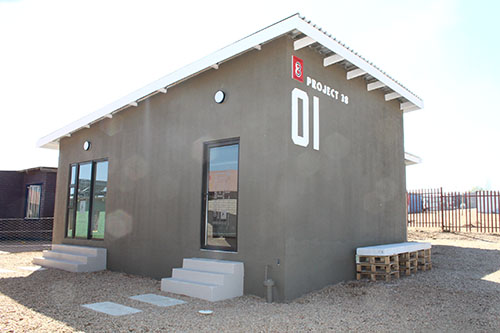
A model two-bedroom house was unveiled on Tuesday at Hope Village Orphanage in Katutura to introduce this innovation to the Namibian market.
The houses are built entirely out of Ytong aerated concrete slabs and an industrial adhesive – Silka calcium silicate.
Not only is this building structure more affordable than comparative brick and mortar homes, but it also requires little training to put up, minimal labour and is vastly more time efficient.
The show house was completed in three days, before the team started putting on the finishing touches.
Patron of the initiative, Windhoek City mayor Muesee Kazapua commended the company for taking up the challenge to find innovative solutions to assist the state and local government in fulfilling their mandate of overcoming the “profound housing constraint” that the nation is facing.
The Belgian-designed Green Wall Building Solution has won numerous international awards from leading testing institutes and also certification from the International Standardisation Organisation (ISO).
The advanced panels and adhesive offer superior insulation against heat, cold and noise, while also being flame resistant and are factory guaranteed for a minimum of 10 years. No specialised skills are needed to erect the structure and Project 38 offers support from beginning to end.
“A team of only four could have the basic structure of a unit up within a day. This is just an amazing system. Imagine how quickly and without fuss you could extend your house for instance,” said a local contractor, Willem Oliver, who with his team got first- hand experience working with the system.
The panels also offer great versatility and could even be used to build large-scale structures of up to four storeys, without costly delays like having to wait 28 days for it to set as is the case with conventional slabs.
Tommy Tjaronda, strategy officer for Project 38, urged people to embrace innovative solutions to age-old problems.
“We’ve been building with bricks and mortar for hundreds of years, however our circumstances are vastly different and we have incredible materials available to work with now. We need modern solutions to modern problems. Precursors to this system have been used in Belgium for over 70 years, Its success has been proven in a variety of conditions and through the construction of this show house we want to show how it is perfectly suitable to our local context. “
Speaking at the inauguration, Majiedt, operations manager for Project 38 said the aim of the show house was “to showcase this innovative technology and make it available for public viewing and inspection by industry stakeholders for the whole of next month. Thereafter it will be donated to Hope Village”.
The company plans to build more “show” projects throughout the country and engage the state and private sector to undertake large-scale projects in housing and construction of offices, hospitals, schools and other much needed infrastructure.
This will allow the company to continue on their long-term expansion plans which includes the construction of a manufacturing plant that would produce the Ytong AAC panels and the patented adhesive. Tests are currently underway to ascertain whether local lime, sand and cement are of adequate quality.
“This will make the product not only cheaper, but skills will be transferred to local businesses, contractors and workers so that they may also take advantage of this technology, for the benefit of all Namibians in need of housing.” said Tjaronda.
The show house was beautifully finished with the help of sponsors Kansai Plascon, BanardMutua Archietects, SolSquare and Magnet bureau de change.
The show house with top finishes was built at a cost of N$3 500 per square metre, nearly half of the market average N$6 500 per square metre and considerably less than the N$5 600 NHE budgeted per square metre for the mass housing programme. The total cost for the 95m square show house came to N$332 500.
Namibia’s housing backlog stood at over 140 000 by the time the mass housing initiative was launched in 2013.
The race was on to secure a lasting solution that could provide homes to the low and middle-income households, but a few years and several hundred million dollars later, the project has stagnated and has been put on hold, leaving contractors and workers in the lurch and those dreaming of one day owning their own homes out in the cold.
The total number of houses constructed to date stands at below 2 000, while several thousand more are still to be completed to reach government’s initial target of 10 043 houses in the first phase of the Mass Housing Programme which comes to a close at the end of this year.
In an age of information overload, Sunrise is The Namibian’s morning briefing, delivered at 6h00 from Monday to Friday. It offers a curated rundown of the most important stories from the past 24 hours – occasionally with a light, witty touch. It’s an essential way to stay informed. Subscribe and join our newsletter community.

The Namibian uses AI tools to assist with improved quality, accuracy and efficiency, while maintaining editorial oversight and journalistic integrity.
Stay informed with The Namibian – your source for credible journalism. Get in-depth reporting and opinions for
only N$85 a month. Invest in journalism, invest in democracy –
Subscribe Now!