



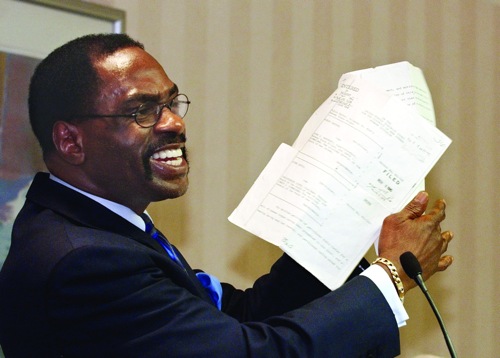
•GREG BEACHAMRubin ‘Hurricane’ Carter never surrendered hope of regaining his freedom, not even after he was convicted of a triple murder, then convicted again and abandoned by many prominent supporters.
For 19 long years, the prizefighter was locked in a prison cell far away from the spotlight and the adulation of the boxing ring. But when he at last won his biggest fight – for exoneration – he betrayed little bitterness. Instead, Carter dedicated much of his remaining life to helping other prisoners and exposing other injustices.
The middleweight title contender, whose murder convictions became an international symbol of racial injustice and inspired a Bob Dylan song and a Hollywood film, died on Sunday. He was 76.
The New Jersey native, who had suffered from prostate cancer, died in his sleep at his home in Toronto, said John Artis, his former co-defendant and long-time friend and caregiver.
Carter “didn’t have any bitterness or anger – he kind of got above it all. That was his great strength,” said Thom Kidrin, who became friends with Carter after visiting him several times in prison.
The boxer, a former petty criminal, became an undersized 160-pound contender and earned his nickname largely on his ferocity and punching power.
Although never a world champion, Carter went 27-12-1 with 19 knockouts, memorably stopping two-division champ Emile Griffith in the first round in 1963. He also fought for a middleweight title in 1964, losing a unanimous decision to Joey Giardello.
But his boxing career came to an abrupt end when he was imprisoned for three 1966 murders committed at a tavern in Paterson, New Jersey. He was convicted in 1967 and again in 1976 before being freed in 1985, when his convictions were thrown out after years of appeals. He then became a prominent public advocate for the wrongfully convicted.
His ordeal and its racial overtones were publicised in Dylan’s 1975 song ‘Hurricane’, several books and a 1999 film starring Denzel Washington, who received an Academy Award nomination for his portrayal.
In a statement, Washington praised Carter’s “tireless fight to ensure justice for all”.
Carter and Artis had been driving around Carter’s hometown on the night that three white people were shot by two black men at the Lafayette Bar and Grill.
They were convicted by an all-white jury largely on the testimony of two thieves who later recanted their stories.
Carter was granted a new trial and briefly freed in 1976, but he was sent back for nine more years after being convicted in a second trial.
“I wouldn’t give up,” Carter said in an interview in 2011 on PBS. “No matter that they sentenced me to three life terms in prison. I wouldn’t give up. Just because a jury of 12 misinformed people … found me guilty did not make me guilty. And because I was not guilty, I refused to act like a guilty person.”
Carter eventually won his freedom from US District Judge H Lee Sarokin, who wrote that the boxer’s prosecution had been “predicated upon an appeal to racism rather than reason, and concealment rather than disclosure”.
Born on May 6 1937 into a family of seven children, Carter struggled with a hereditary speech impediment and was sent to a juvenile reform centre at 12 after an assault. He escaped and joined the Army in 1954 and learned to box while in West Germany.
After returning home, he committed a series of muggings and spent four years in various state prisons. Upon his release, he began his pro boxing career, winning 20 of his first 24 fights mostly by knockout.
At 5-foot-8, Carter was fairly short for a middleweight, but he was aggressive and threw waves of punches. His shaved head and menacing glower gave him an imposing ring presence but also contributed to a forbidding aura outside the ring. He was quoted as joking about killing police officers in a 1964 story in the Saturday Evening Post, which was later cited by Carter as a cause of his troubles with law enforcement.
Carter boxed regularly on television at Madison Square Garden and overseas in London, Paris and Johannesburg. Although his career appeared to be on a downswing before he was implicated in the murders, the 29-year-old fighter was hoping for a second middleweight title shot.
Carter eventually wrote and spoke eloquently about his plight, publishing his autobiography, ‘The Sixteenth Round’, in 1974. Benefit concerts were held for his legal defence featuring Dylan, Joni Mitchell and Roberta Flack.
Although many of his celebrity friends abandoned the cause after his second conviction and an allegation of assault during his brief release, other advocates worked tirelessly on his behalf, culminating in Sarokin’s ruling and two subsequent failed prosecutorial appeals to have the convictions reinstated.
Each year on the anniversary Sarokin’s decision, Carter called the judge to thank him.
Canadian director Norman Jewison made Carter’s story into a biographical film. Washington worked closely with Carter to capture the boxer’s transformation and redemption.
The makers of ‘The Hurricane’, however, were widely criticised for factual inaccuracies and glossing over other parts of Carter’s story, including his criminal past and a reputation for a violent temper. Giardello sued the film’s producers for its depiction of a racist fix in his victory over Carter, who had long acknowledged that Giardello deserved the win.
Artis said Carter will be cremated and didn’t want a funeral or any memorial. Artis has been taking care of him since 2011.
“He was a champion of the underdog,” he said. “He was like the David against the Goliath of the justice system.” – Nampa-AP
In an age of information overload, Sunrise is The Namibian’s morning briefing, delivered at 6h00 from Monday to Friday. It offers a curated rundown of the most important stories from the past 24 hours – occasionally with a light, witty touch. It’s an essential way to stay informed. Subscribe and join our newsletter community.

The Namibian uses AI tools to assist with improved quality, accuracy and efficiency, while maintaining editorial oversight and journalistic integrity.
Stay informed with The Namibian – your source for credible journalism. Get in-depth reporting and opinions for
only N$85 a month. Invest in journalism, invest in democracy –
Subscribe Now!