


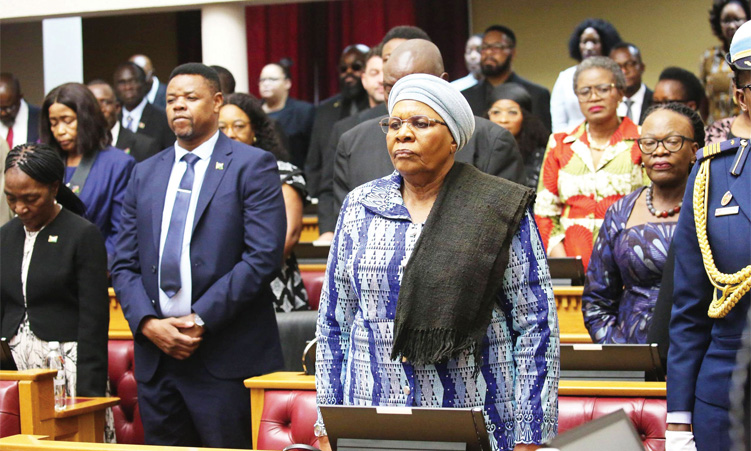
President Netumbo Nandi-Ndaitwah (NNN) addressed parliament on Wednesday, answering questions on the Welwitschia Sovereign Wealth Fund, land delivery, genocide reparations, the government’s stance on the veterinary cordon fence, and the demotion of the former deputy prime minister and minister of industries, mines and energy.
Among those who asked questions after she delivered her second state of the nation address (Sona) were Imms Nashinge of the Independent Patriots for Change, McHenry Venaani of the Popular Democratic Movement, Job Amupanda of the Affirmative Repositioning, Vetaruhe Kandorozu of the National Unity Democratic Organisation, and Kalimbo Iipumbu of the Namibia Economic Freedom Fighters.

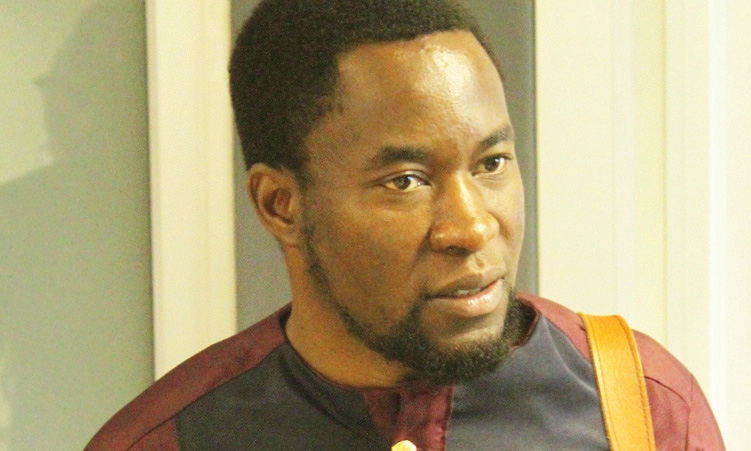
Imms Nashinge
Nashinge: Under what authority is the Welwitschia Sovereign Wealth Fund operating without enabling legislation, and when will the law be tabled?
NNN: The fund already exists, but the legal instrument to govern it is still being developed . . . The fund is meant for long-term national security rather than day-to-day spending. It’s a sovereign fund that could even be accessed 50 or 100 years from now when the country is in a serious crisis and you want to save your nation.
It’s not a normal fund that when you feel you want to build a road you go and withdraw from it . . .
As for the oil, I’ve talked about it. We will have to get our maximum benefit from it – a delay has been created.
McHenry Venaani
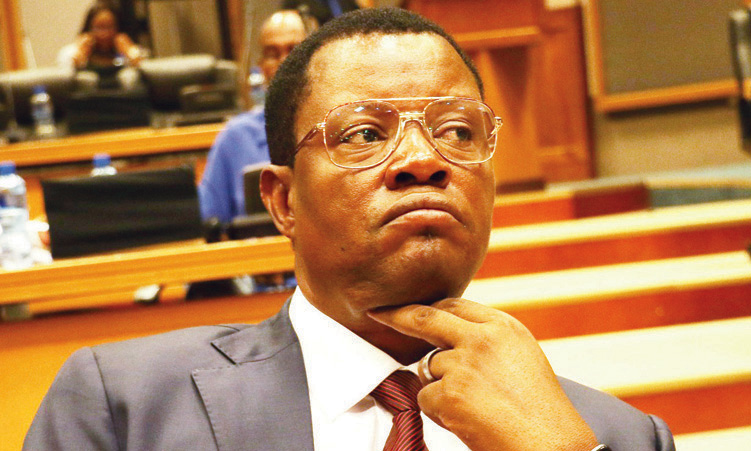
Venaani: Why is the government accepting Germany’s genocide deal, and how would land delivery be improved?
NNN: On the joint declaration with Germany, Namibia rejected an earlier clause that would have closed the matter.
When we first brought the joint declaration here, you remember there was Article 21 talking about closing the chapter, and that’s where we say, no, this we cannot . . .
That is why it’s now open so that we can continue in the same way they are treating Jews. They should treat us the same.
On housing and land, the government wants serviced land to go directly to residents instead of to developers.
We should no longer allow municipalities to give serviced land to the private sector. The private sector should be given virgin land.
Those we are servicing as a government must be given directly to individuals who can build houses.
The government is looking at cheaper building materials and a possible housing finance window.
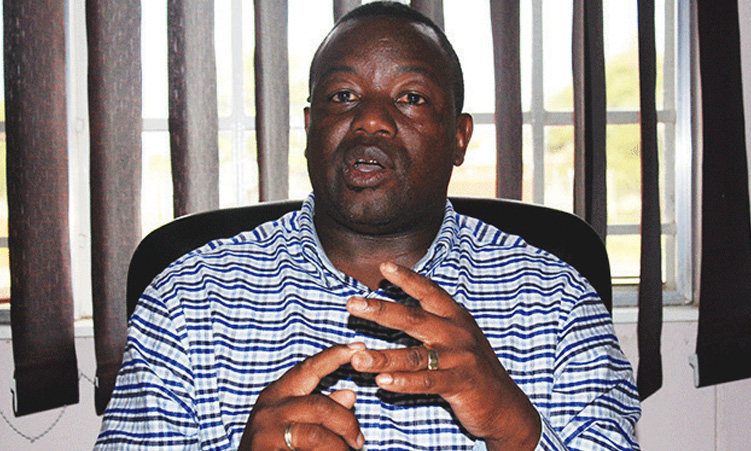
Job Amupanda
Amupanda: What is the government’s position on the redline, parliamentary reform, and appointments to the Anti-Corruption Commission?
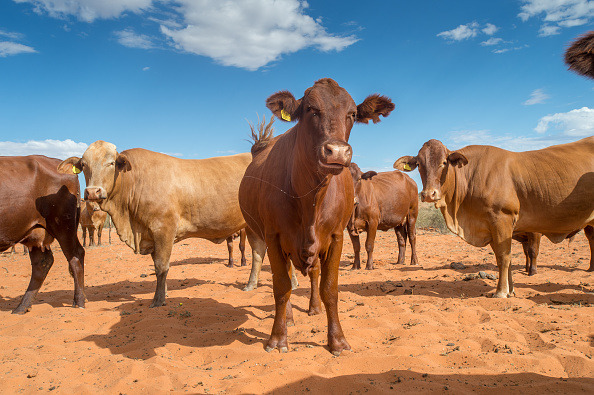
NNN: The veterinary cordon fence remains necessary under current disease-control conditions.
As I’ve said in my statement, we’ve already reactivated the redline in the south because of a foot-and-mouth disease outbreak. Movement on the northern side will depend on international animal health requirements. We have to work with the World Animal Health Organisation that has to declare all those areas to enable us to get to the level we want to be at.
In the ‘Agenda for Change’ document, I believe in what I proposed at the time, but some recommendations were not implemented after debate in the parliament.
I believe in what I have put there, but after the debate, different decisions were taken, and that’s why some of the things that are there are not being implemented.
On the appointment of the Anti-Corruption Commission director general, the parliament may advise, but the final decision rests with the president.
Vetaruhe Kandorozu
Kandorozu: Why was the deputy prime minister removed, and what is your position on EPL 37, Agribank, Meatco, Cape Fria, and the Ovathemba Traditional Authority?
NNN: I have appointed so many ministers and nobody has even asked me to come here and report on why I appointed them.
It’s the same thing that was in the paper. I learned about it for the first time when it was in the newspaper.
I didn’t know, I didn’t know anything about it.
[On Agribank] We shouldn’t just make it an agriculture and commercial bank, because you might end up becoming more commercial than agricultural, and then the agriculture part will suffer.
[Meatco] We agreed also that incrementally, until we come to 100%, we should stop selling live animals outside Namibia . . . and the Mauritius deal also showed that South Africa is not the only market.
On Cape Fria and Angra Fria, the public must be cautious of schemes using her name. Some of them I attended, but I’m not convinced Namibians don’t allow my name. If they are scamming, they are scamming.
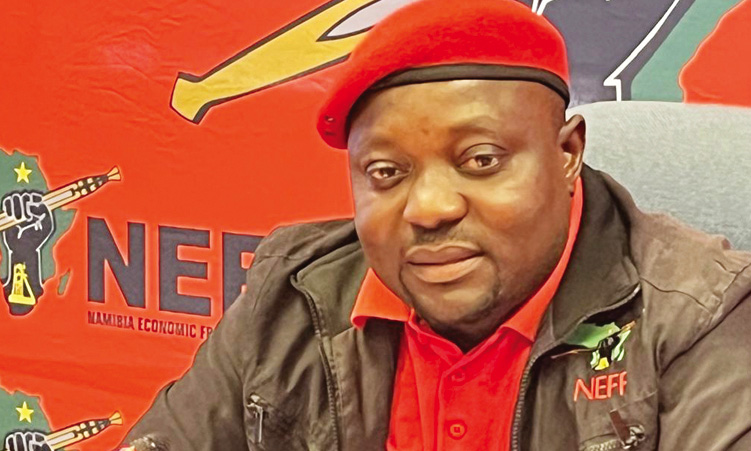
Kalimbo Iipumbu
Iipumbu: What is being done about the Ohangwena aquifer and labour hire?
NNN: The government is considering how to unlock economic value in communal areas without exposing them to outside exploitation.
We want the whole of Namibia to have value, so that economic transformation can take place.
This must be approached carefully to avoid communal land, ending up in the hands of foreigners through local proxies.
The programme we have to follow is slow, because communal areas can end up in the hands of foreigners using indigenous people.
[Agriculture] This year is not the year for planning, this is the year for implementation.
The decision to link trade to international relations, and economic diplomacy should help attract investment.
In an age of information overload, Sunrise is The Namibian’s morning briefing, delivered at 6h00 from Monday to Friday. It offers a curated rundown of the most important stories from the past 24 hours – occasionally with a light, witty touch. It’s an essential way to stay informed. Subscribe and join our newsletter community.

The Namibian uses AI tools to assist with improved quality, accuracy and efficiency, while maintaining editorial oversight and journalistic integrity.
Stay informed with The Namibian – your source for credible journalism. Get in-depth reporting and opinions for
only N$85 a month. Invest in journalism, invest in democracy –
Subscribe Now!