


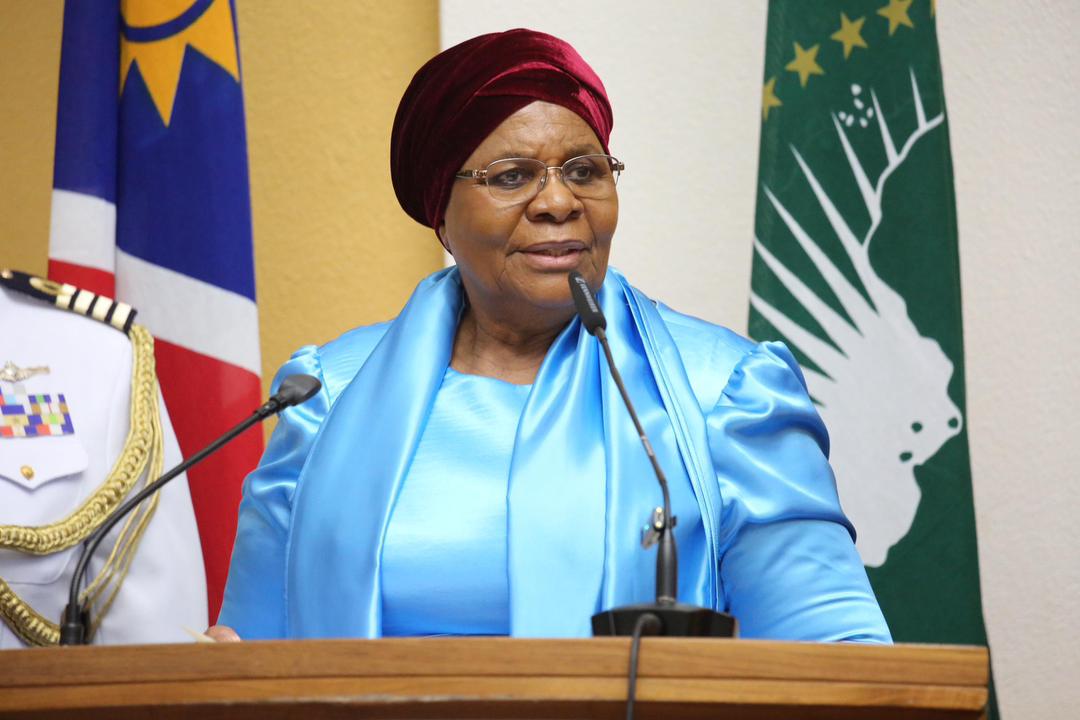
By Netumbo Nandi-Ndaitwah, president of the Republic of Namibia. National Assembly, Windhoek. Tuesday, 3 February 2026.
___________________________________________________________
February is a month of reflection and remembrance in the history of democratic and independent Namibia. During this month, we lost our third president, Hage Geingob, and our founding president and father of the Namibian nation, Sam Nujoma, who passed away on 4 and 8 February, respectively. In their memory and to honour their legacy, let us observe a moment of silence.
As the new year unfolds and members return from the festive season recess, I join you in this chamber as you resume your national duties on behalf of the people of the Republic of Namibia. Although it is February, I wish you all a blessed and productive new year, 2026.
Let me also congratulate and welcome all members of the National Council who have joined parliament following the 2025 regional and local authorities elections. You have joined this august House with the great responsibility of making laws for this nation.
The opening of this third session of the eighth parliament under the theme ‘Enhance the Role of Parliament for Inclusive Development and Participatory Democracy’ signifies a renewed sense of responsibility, reflection and resolve as we carry on the work entrusted to us by our people.
This parliament reconvenes amid rising public expectations. Citizens closely follow parliament’s work with keen interest, because it creates laws and influences policies and decisions that impact their lives.
Article 44 of the Constitution of the Republic of Namibia bestows legislative authority on parliament. This mandate assigns you the responsibility to enact, amend and repeal laws; to scrutinise bills, treaties and conventions; to approve the national budget; to oversee government performance and hold state institutions accountable; and to debate matters of national importance to the Namibian people.
This constitutional responsibility carries considerable importance. Laws enacted in this august House serve as the foundation for social order, economic growth and democratic governance. They establish stability, fairness and predictability, safeguard fundamental rights, encourage investment and innovation, and ensure disputes are settled peacefully.
Hence, the need for a strong legal framework that strengthens democracy, enhances effective service delivery and builds public confidence in state institutions.
As you discharge this mandate, it is imperative to recognise that Namibia does not legislate in isolation. We are navigating an increasingly unpredictable global environment, characterised by geopolitical tensions, shifting alliances and, in some cases, disregard for established norms of international law. Powerful nations are increasingly asserting their interests in ways that challenge multilateralism and the rules-based international order.
For a small but principled nation like Namibia, whose foreign policy is firmly anchored in multilateralism, respect for international law and peaceful coexistence, this reality requires foresight and prudence.
The laws crafted in this House must therefore be strong, principled and forward-looking. They must protect our sovereignty, enhance democratic governance and help Namibia navigate the unstable global landscape, while remaining a trustworthy and responsible member of the international community.
Over the past year, our country has continued to face social and economic challenges, including high unemployment, inequality and poverty among members of our society. These challenges strain the social fabric of our society and call for collective effort and shared responsibility from all three branches of government to create positive change in people’s lives. They remind us of the core truth which I often say: we are too few to be poor.
These domestic challenges are further compounded by global economic uncertainty, climate-related pressures and geopolitical instability. In this context, parliament’s role in creating responsive, inclusive and protective legislation becomes even more vital. The resilience of our people must be complemented by the foresight of our laws.
When the eighth administration assumed office on 21 March 2025, we were fully aware of the depth and scale of the economic challenges confronting our nation. Our immediate focus was on stabilisation, restoring confidence and re-energising growth.
We remain dedicated to expanding production, increasing participation in the economy and ensuring that our people are active contributors, not just spectators, in national development.
The wealth generated in this country should benefit many of our people, not just a few. As parliament continues to pass legislation, it must ensure that Namibia’s natural resources are used responsibly and sustainably. Adding value to our products should be one of our core principles to stimulate and grow our economy. It should be our future strategic goal to gradually stop extracting our resources without local beneficiation.
Last year, the government called on the public to propose amendments to any of our laws in order to address the needs of our people holistically. Some of the critical proposed amendments from the public include those that will ensure meaningful national benefit from our resources. It is therefore important that when those amendments are brought to parliament, they are considered with urgency.
We continue to prioritise agriculture, manufacturing and the digital economy, where young people leverage technological advancements to create jobs for themselves and their peers, while maintaining fiscal discipline and strengthening revenue collection.
Namibia remains an active participant in regional and global inter-parliamentary forums, including the Southern African Development Community Parliamentary Forum, the Pan-African Parliament, the Inter-Parliamentary Union and the Commonwealth Parliamentary Association.
These platforms support policy dialogue, legislative harmonisation with international standards, capacity building and parliamentary diplomacy to promote economic transformation, among others. The insights gained from these forums must inform our domestic legislative efforts and strengthen our dedication to a rules-based international system.
Authority in the Republic of Namibia resides with the people, who exercise their sovereignty through democratic institutions and elect their representatives. Parliament therefore carries a responsibility not only to legislate, but also to uphold the dignity and integrity of this august House, as members are here on behalf of all Namibians.
Robust debate is a cornerstone of our democracy. However, it must always be conducted with respect, discipline and purpose. Our people expect their representatives in parliament to work diligently. They want debates that lead to solutions, laws that improve lives and oversight that reinforces governance in a timely manner.
Furthermore, the rule of law remains the foundation of peace, justice and sustainable development. Therefore, in the Republic of Namibia, no individual, authority or institution is above the law. Our commitment to accountability, transparency and the fight against corruption remains strong. This is not about witch-hunts, but about restoring and maintaining public trust in our institutions.
Over the past year, parliament considered and tabled several bills, including the appropriation bill, the Regional Councils amendment bill, the land bill, the public enterprises governance amendment bill, the mental health bill and the appropriation amendment bill. Notices were also issued for the introduction of the accountants and auditors regulatory authority bill, the income tax amendment bill and the petroleum (exploration and production) amendment bill.
Regrettably, of these nine bills, only two budget-related bills were passed. This is disappointing because the people of Namibia deserve better services from their elected representatives. It is the hope of our people that such a situation will not repeat itself in the second year of the eighth parliament.
Some parliamentarians may be attempting to score political points through debates. However, I strongly believe the majority of our people want to see parliamentarians performing their fundamental constitutional duties of making laws that guide and address the actual needs of our citizens.
While we may hold diverse political views as elected public representatives, we should be united by a common goal: the prosperity and well-being of the Namibian people. Democracy relies on differing opinions, but it survives through shared commitment to the national interest.
I therefore call upon all members of parliament, regardless of political affiliation, to rise above partisanship, to conduct themselves with dignity and to restore public confidence in this institution. Let this parliament be remembered for constructive engagement, principled leadership and timely, tangible outcomes that improve the quality of life for our people.
The path ahead requires mutual cooperation and a renewed sense of urgency from the three organs of government. The executive, for its part, remains dedicated to working closely with parliament to prioritise sustainable development. We are all leaders and we must lead with passion.
I am confident that together we can build a Namibia that is prosperous, fair and just. In this context, I look forward to productive parliamentary results in 2026.
I now have the honour to declare the third session of the eighth parliament officially open.
May the Almighty God continue to bless the Republic of Namibia.
I thank you.
In an age of information overload, Sunrise is The Namibian’s morning briefing, delivered at 6h00 from Monday to Friday. It offers a curated rundown of the most important stories from the past 24 hours – occasionally with a light, witty touch. It’s an essential way to stay informed. Subscribe and join our newsletter community.

The Namibian uses AI tools to assist with improved quality, accuracy and efficiency, while maintaining editorial oversight and journalistic integrity.
Stay informed with The Namibian – your source for credible journalism. Get in-depth reporting and opinions for
only N$85 a month. Invest in journalism, invest in democracy –
Subscribe Now!