




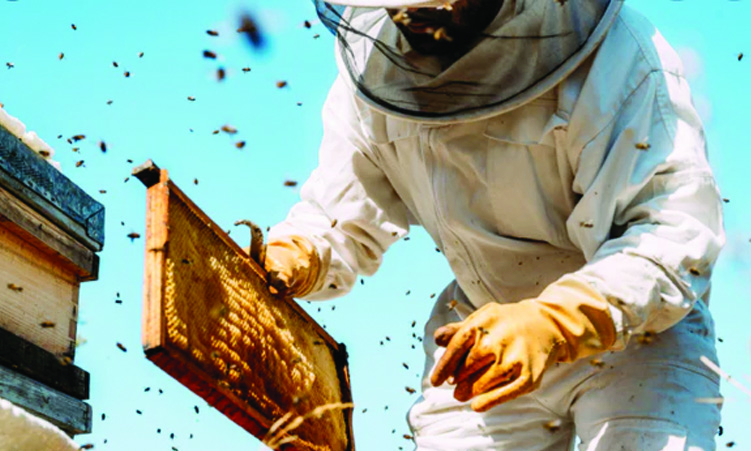
Namibia is considering importing honeybees from South Africa to help with the pollination of blueberries grown in the Kavango East region.
While it could boost the blueberry harvest, local beekeepers and enthusiasts are against the idea, saying it could destroy honeybee colonies and threaten native bee species.
The two blueberry farms in the Kavango East region are Mashare Berries Farming, 50km east of Rundu, and Namibia Berries at Divundu.
Beekeeping Association of Namibia managing director Gretchen Burmeister warns that although the country is facing a shortage of pollinators, it lacks the necessary quarantine systems to prevent the spread of diseases and invasive traits.
Instead of addressing this gap through imports, she says the government should invest in strengthening local beekeeping capacity and protecting existing pollinator populations.
“This is not a reversible process. Once harmful species of diseases are introduced, they can’t be eradicated,” she warns.
Burmeister says Namibia’s pollinators play a critical role in food production and biodiversity, with bees responsible for the majority of crop and vegetation pollination.
However, she warns that any disruption to this system could have far-reaching consequences for food security and the environment.
Burmeister calls on the government to prioritise local solutions, including training new beekeepers, expanding research and improving data collection on the sector.
There is only one bee species in Namibia, the Apis mellifera scutellata, says bee enthusiast Roland Graf zu Bentheim.
He warns that imported bees may overtake local colonies by killing the queen, ultimately destroying the hive and replacing it.
“Imported bees bring in diseases such as Varroa mites and American foulbrood, which kill bees,” Graf zu Bentheim says, adding that the country has honeybees capable of pollination.
They, however, are not enough to meet agricultural demands.
He adds that local bees are vulnerable during rainy and cold weather, as they tend to remain in their nests and be less active in pollination.
“Honeybees live up to six weeks, while bumblebees live for four months. The queen can live for five years,” he says.
He adds that even importing the same species is dangerous.
The Namibian Chamber of Environment, in an article published on 18 March, says protecting native pollinators from external threats should be a priority as they provide crucial pollination services for our crops and plants.
“Their importance cannot be overstated. Without bees, fruit and vegetable crops in northern Namibia would collapse, taking the food and livelihoods of many Namibians with it,” the article reads.
Mashare Berries and Namibia Berries could not be reached for comment.
A senior official at the Ministry of Agriculture, Fisheries, Water and Land Reform says the ministry’s mandate is only to issue permits in this case.
“For as long as the animal is healthy for importation, the ministry will import, unless our counterpart (environment ministry) says the animal will disrupt the country’s biodiversity,” they say.
Ministry of Environment and Tourism spokesperson Vilho Hangula has confirmed that the importation of honeybees would pose significant risks to Namibia’s native bee species as it carries high risk for introduction of diseases, pathogens, mites and pests.
He says there is a serious risk of genetic dilution.
“Interbreeding with imported bees may weaken certain traits, ultimately reducing the resilience of local populations,” he says.
Hangula says imported bees may compete with indigenous species for resources, potentially leading to a decline in native bee populations.
He says the directorate of forestry within the ministry is currently observing daily reports of honeybees invading residential areas.
“Such observations suggest that Namibia already has a sufficient honeybee population, and additional importation may not be necessary. Importation is not advisable,” he says.
In an age of information overload, Sunrise is The Namibian’s morning briefing, delivered at 6h00 from Monday to Friday. It offers a curated rundown of the most important stories from the past 24 hours – occasionally with a light, witty touch. It’s an essential way to stay informed. Subscribe and join our newsletter community.

The Namibian uses AI tools to assist with improved quality, accuracy and efficiency, while maintaining editorial oversight and journalistic integrity.
Stay informed with The Namibian – your source for credible journalism. Get in-depth reporting and opinions for
only N$85 a month. Invest in journalism, invest in democracy –
Subscribe Now!