



RUTH KAMWIAN EMPTY beer bottle stands where it was discarded by the roadside and the atmosphere is filled with the suffocating stench from a burst sewer valve somewhere.
A football team comprising young boys play barefeet in the dusty setting. For some reason, Windhoek’s blistering summer temperatures feel much hotter today.
Despite the apparent hardships faced by the residents of this high-density location, life must go on for some. In a nearby cemetery, a person is being laid to rest by a small gathering of mourners consisting of close friends and relatives.
That scene causes one to ponder on what could have claimed the life of the deceased. The possible causes are difficult to fathom – maybe they are many. However, this scene is a flashback to the deaths caused by the hepatitis E virus that still haunts the country.
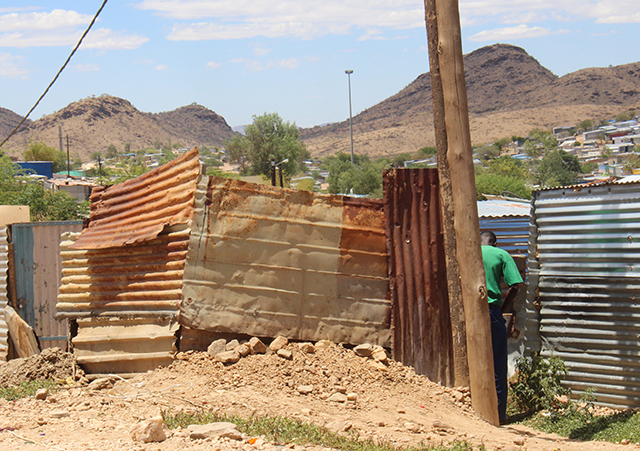
Upon entry into the Havana informal settlement, The Namibian is welcomed into the home of a thousand corrugated kambashus (zinc shacks) whose silver metallic exterior shines from a distance.
A man who appears to have overslept, emerges from his home, clad in a black sports short and red T-shirt. With a red, medium-sized jar in hand, he gurgles and then spits some of the brew out.
A while later, we are greeted by the unsightly large municipality bins, filled to the brim. The waste that decomposes within has not been collected for a long period.
Unthought of, another health hazard looms.
Not only is the place a residential area riddled with potholes; there are car washes, bars, vendors, hairdressers (some illegal) and…more bars.
The place is undeniably a hive of activity.
The toilets are difficult to spot. Nothing defines them as such. The toilets seem to be too few for the number of people one can see in the surroundings.
Some are overflowing while others do not work at all.
Near a bar in Havana 1, there are two toilets which were recently constructed by the City of Windhoek.
Sadly, we learn that the toilets are out of use, despite having been erected a mere five months ago.
Aipinge Alpheus who resides in Havana 1 speaks emotionally about the conditions people have grown accustomed to living in.
He points to an area across the road, making particular mention of the sharing of ablution facilities with squatters who live in that area.
According to him, the squatters are notorious for leaving the toilets dirty. He attributes the outbreak of hepatitis E to such challenges.
Alpheus says the residents have appealed to the City of Windhoek although there have been no improvements made to date. In desperation, he also challenges the community members to become more responsible by taking the initiative to practise personal hygiene.
Sitting on wooden benches, under a tree, Saara Metumo agrees to speak to The Namibian. The young lady who resides in Havana 2, says “the toilets are in bad shape.”
Metumo who is sitting with a middle-aged woman and a young man, says the two toilets, which are situated a stone’s throw from where they are seated are not flushing.
Like Alpheus, Metumo says the residents of that area clean their toilets every weekend. However, squatters use and leave the toilets dirty.
Metumo suggests better security for the residents to restrict outsiders from using the toilets.
In addition to the condition of the toilets, Metumo appeals to the municipality to repair the burst water pipes which flow close to where the trio is seated.
The Red Cross Society in Namibia, through their humanitarian diplomacy manager, Rosemary Nalisa, weighed in on the issue, saying their main responsibility is “to educate the communities through information dissemination and report to the City of Windhoek and the Ministry of Health on whatever is transpiring.”
Nalisa further says the Red Cross Society currently has 35 volunteers (25 in Khomas and 10 in Omusati) trained by the World Health Organisation (WHO) in hepatitis E prevention.
According to her, the NGO is involved in sanitation activities in the various regions where they have over the years installed water pumps and pit latrines in the Kunene, Ohangwena, Kavango and Zambezi regions.
“The epicentre of the outbreak is collectively Havana and Goreangab informal settlements,” Kahuika further explains, also adding that 80% of the hepatitis E cases have been linked to the two informal settlements.
Kahuika says open defecation due to a lack of toilet facilities, coupled with poor hygiene, are some of the key drivers of the transmission of the hepatitis E virus.
As a precautionary measure, the National Health Emergency Management Committee was activated soon after the declaration of the outbreak. The epidemiologist urges the public to practise good hand hygiene as we approach the festive season, where a high frequency of large gatherings is expected.
In an age of information overload, Sunrise is The Namibian’s morning briefing, delivered at 6h00 from Monday to Friday. It offers a curated rundown of the most important stories from the past 24 hours – occasionally with a light, witty touch. It’s an essential way to stay informed. Subscribe and join our newsletter community.

The Namibian uses AI tools to assist with improved quality, accuracy and efficiency, while maintaining editorial oversight and journalistic integrity.
Stay informed with The Namibian – your source for credible journalism. Get in-depth reporting and opinions for
only N$85 a month. Invest in journalism, invest in democracy –
Subscribe Now!