


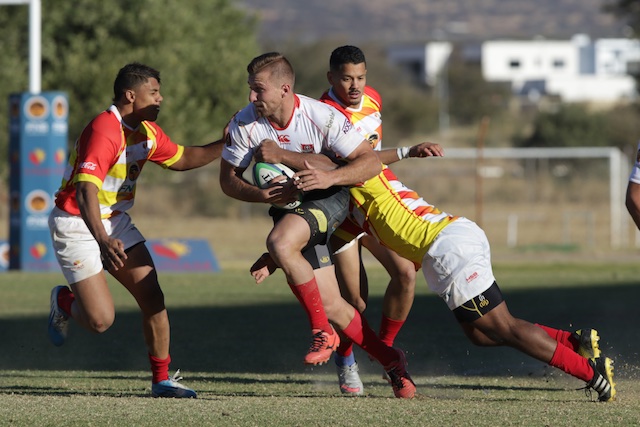
THE highlight on the local rugby calendar, the Premier League club final, will be contested between old foes Wanderers and United on Saturday, but there will be nothing but pride at stake.
Since MTC withdrew as the Namibia Rugby Union’s main sponsor six years ago, there have hardly been any monetary incentives to play for, while club rugby has continued to decline, with some clubs failing to honour their league fixtures, while others have closed down altogether.
“I think they’ve got some cheap trophy that will be given to the winners, but
there is no money at stake. But for us it’s just about the honour of the club and not the money,” Wanderers’ team manager Flip Louw said.
Back in 2012 the Premier League winners Western Suburbs received a handsome sum of N$80 000 in prize money while the runners-up, Rehoboth, received N$60 000.
At the end of that season, however, MTC ended an eight-year sponsorship of rugby which amounted to N$2,5 million in its final year. Of that amount, N$1,7 million went to the local leagues and N$800 000 to the national teams.
The sponsorship helped a lot in terms of administration, while all the Premier League clubs also received monthly grants to cover travel and accommodation expenses, which provided an equal footing for the clubs to compete on.
This was especially helpful to the clubs outside Windhoek which have to travel more, since most of the matches take place in Windhoek. A club like Kudus from Walvis Bay, for instance, has to travel to Windhoek four times as well as twice to Rehoboth during the season, while the Windhoek and Rehoboth clubs only have to travel once to the coast.
According to the former president of Kudus, Chandler Plato, it has been a big struggle for Kudus to survive financially.
“It costs us about N$40 000 per trip to Windhoek for our two teams to compete in the Premier League and the Reserve League – that’s for fuel, accommodation and food. In the past we were sponsored a bus, but now we also have to hire one,” he said, adding, “the Windhoek clubs don’t feel the pinch, but we do, because we have to travel the whole time.”
Without a sponsor, individuals have had to step in to ensure the club’s survival.
“MTC’s sponsorship was our lifeblood and when they withdrew that gap was never filled. Now it has to come from the pockets of club officials, or supporters and friends, to honour our commitments and to ensure our survival,” Plato said.
In recent years clubs like Rehoboth and Reho Falcon have failed to honour some fixtures due to the costs involved, while Walvis Bay Rugby Club even withdrew from the Premier League at the end of last season.
Rural rugby dying
Further afield, though, the pinch is more acute and in the north, clubs like Otjiwarongo and Oshakati Lions were not active at all this year. This is a sad state of affairs for Louw, who said that club rugby was dying in the rural areas.
“Club rugby has become a bit of a joke now and the regions are being hardest hit. This year there were only two teams in the northern region – Grootfontein and Etosha Lions from Tsumeb – and they just had two play-off matches the whole season. Other northern teams like Otjiwarongo and Oshakati have closed down altogether and rugby is dying in the rural areas,” he said.
“In the past Wanderers II used to go play against teams like Tsumeb and Grootfontein in the north and it was always a big occasion for these clubs. They had a big party afterwards and it was a big boost for these clubs, but that is over now and no attention is being given to these clubs anymore,” he added.
The current acting CEO of the NRU, Christo Alexander could not shed light on the issue of financial rewards for clubs, but his predecessor, Elizma Nortje said the NRU tried to assist the winning clubs financially in recent years, but that too has dried up.
“In 2016 we managed to use a bit of the government grant as prize money for the winners, but last year there was no money. In 2017 we received a small fraction of what we were supposed to get from the government, but we are aware of the economic difficulties they are facing.”
The chief administrator of the Namibia Sport Commission, Fred Mwiya said that the NRU had been allocated about N$500 000 in 2017, but due to budget cuts they were still waiting for funding from government this year.
“This year the budget was cut and none of the codes have received any grants yet, but we are still waiting for funding,” he said.
“Rugby has not received the total amount from last year yet, about N$340 000 was paid out, but they must still receive the outstanding balance,” he said, adding that this was mainly an administrative grant.
“If teams qualify for international events then that’s a separate issue that requires separate funding,” he said.
In recent years, three of the strongest clubs in the league, Unam, Wanderers and Western Suburbs have received sponsorships from First National Bank Namibia, amounting to N$250 000 per club per year, but that has also exacerbated the inequalities between the clubs.
“The clubs use that for administration, but also a bit as incentives to reward the players and for travel costs to the coast. But it’s really tough for the other clubs,” Robbie Thompson of Western Suburbs said.
“A club like Kudus has to pay about N$220 000 in travel fees per season, while Reho Falcon and Rehoboth are really struggling financially and they don’t have a big influx of Premier League players. They are also losing promising young players to clubs like Unam who at least can offer study opportunities and accommodation,” he added.
The situation is dire, but Mervin Green, the CEO of the newly established Namibia Rugby Limited company is hopeful that it can be addressed soon.
“Rugby development and club rugby falls under the NRU, while the establishment of the Namibia Rugby Limited company is solely there to commercialise the game, and in support of the national teams which participate at the Africa or World Cup level.
“But the company is ready to support the NRU to try to get sponsorship for club rugby. If we can get a sponsor on board, the first thing that I would do is to allocate an amount to a domestic league. We have made that commitment to ourselves and to the NRU and that is what we are working on,” he said.
In an age of information overload, Sunrise is The Namibian’s morning briefing, delivered at 6h00 from Monday to Friday. It offers a curated rundown of the most important stories from the past 24 hours – occasionally with a light, witty touch. It’s an essential way to stay informed. Subscribe and join our newsletter community.

The Namibian uses AI tools to assist with improved quality, accuracy and efficiency, while maintaining editorial oversight and journalistic integrity.
Stay informed with The Namibian – your source for credible journalism. Get in-depth reporting and opinions for
only N$85 a month. Invest in journalism, invest in democracy –
Subscribe Now!