MARIE WOLFROM and MICHEL MOUTOTAuthorities are battling popular uprisings in several parts of the world at once as people from vastly different countries – from Chile to Hong Kong – rage against common enemies: Economic inequality and perceived marginalisation.
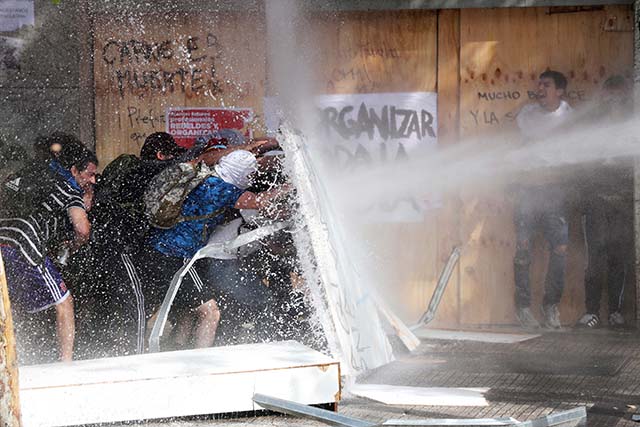
In Chile, it was a 30-peso (about N$0,60) rise in the price of a metro ticket that brought people out on the streets in anger, in Lebanon it was a tax on WhatsApp calls in a country with already high rates.
“This is not happening because they raised the metro fare by 30 pesos,” said a man who gave his name only as Orlando, taking part in protests in Santiago this week against the growing gap between rich and poor.
“This is about the situation of the last 30 years,” said the 55-year-old, lamenting long queues at clinics, waiting lists at hospitals, high medicine prices and declining purchasing power.
“Inequalities are widening everywhere,” said analyst Thierry de Montbrial of the French Institute of International Relations.
“It is linked to globalisation, to the technology revolution, and the societal changes this has brought about. The crushing of the middle class is […] a global phenomenon.”
In a report in January, poverty monitor Oxfam said the world’s 26 richest individuals now own the same wealth as the poorest half of the world’s more than seven billion people.
While billionaires saw their combined fortune grow by US$2,5 billion (about N$36 billion) each day in 2018, the world’s poorest 3,8 billion people saw their relative wealth decline by US$500 million (about N$$7,3 billion) per day, or 11 percent in 2018.
This is just the kind of imbalance fuelling people’s anger with ruling elites that often boost their already big fortunes through corrupt means.
On the streets of Beirut, for example, protesters called parliamentary speaker Nabih Berri, who has accumulated vast wealth in his 27 years on the job, a “thief”, and railed against reports that prime minister Saad Hariri had paid US$16 million (about N$235 million) to a South African model.
All this while “we are dying at the hospital gates”, lamented Hoda Sayyour, one of the demonstrators.
More and more, ordinary citizens are clamouring to have a say in government decisions, and rejecting the top-down imposition of leaders and policies.
In Hong Kong, protests against a proposal to allow extraditions of criminal suspects to mainland China morphed into increasingly angry and sometimes violent anti-government, pro-democracy mobilisation.
In Algeria, anti-regime protests have been under way since February, with demands for political reform and the removal of regime insiders ahead of a presidential vote to replace longtime leader Abdelaziz Bouteflika, who resigned in April.
“The traditional system of enforcing power from top to bottom is increasingly being challenged […] there is a social revolution with a growing demand for participatory democracy,” said De Montbrial.
In Spain, it is a quest for independence that has brought Catalan separatists out on the streets as the government refuses to talk to their leader.
En masse, young people worldwide are rejecting traditional concepts of power and authority, recently taking to the streets of world capitals in their tens of thousands under the logo Extinction Rebellion to denounce the harm humans are inflicting on the planet. The movement advocates non-violent civil disobedience to drive the point across.
The current rebellious climate spreads easily on social media, which has become an ever more popular platform for mobilising the disaffected – including France’s anti-government ‘yellow vest’ protesters who have no traditional leadership or organisational structure.
“Social networks allow people who do not know each other to mobilise around a shared cause,” said Arnaud Mercier of the Pantheon-Assas University in Paris.
“It offers a simple way to circulate information, call meetings, and give instructions.”
With no hierarchy and often no leader, these modern-day protesters baulk at the traditional ways of negotiating with law enforcement and public authorities, which has completely “shaken up” the status quo, he added.
This has caught many governments by surprise.
“The regimes of the day, like in 2011 [when popular revolts overthrew dictators in Egypt, Libya and Tunisia] are reacting too little too late to the aspirations of their own people, displaying their ignorance of the changing dynamic and their lack of knowledge of their own societies,” Didier Billion wrote in a recent analysis for the Institute for International and Strategic Relations think tank. – Nampa-AFP