



The sound of the Investec Cape Town Art Fair is a medley of excited chatter, searing live performance and the fizz of champagne.
But it is also the sound of silence. It’s the moment when an art piece speaks, the noise of the conference centre melts away and one can sink into the festival theme of ‘Listen’.
While listening to visual art may seem a sensory paradox, the idea is that you pause a little longer, immersed in encounters that pull you beyond the frame into a space of context, narrative as well as personal and collective history.
To attempt this task amid more than 34 000 visitors in-between 126 exhibitors featuring over 490 artists from 34 global cities, I endeavour to listen to photography but primarily to photographic archives.
Set to this frequency, I listen to South African jazz legend Hugh Masekela immortalised by eminent documentary photographer Alf Kumalo.
I hear Setswana folk tales retold by artist Tshepiso Moropa and her family who, lifted from cherished photo albums, come to life as characters in cultural mythology.
I also listen to Namibia’s Nicola Brandt speak of the country’s German colonial scars as well as its current, activist-led thrust towards decoloniality as she archives photographically and in real time.
In the age of social media, photographs have become ephemeral. Between the immediacy of the 24-hour Instagram Story and the ever-changing glut of still and moving images, the idea of viewing, discussing and retooling photographs from the past seems somewhat antidotal and particularly precious.
An image that elicits many shouts of delight is of Masekela clutching a trumpet gifted to him by American jazz icon Louis Armstrong in 1956.
At the time, Masekela is about 16 years old. Kumalo has captured Masekela suspended in the air mid-leap as a large crowd looks on in Sophiatown, Johannesburg.
Listening to this photograph, one hears the sound of township jazz and the applause that will follow Masekela during his long and storied career.
But eventually the clamour and terror of the National Party’s apartheid era’s forced removals creep into the sonic frame. So too, does the hum and roar of resistance.
Between 1955 and 1960, thousands of mostly black residents of Sophiatown were forcibly removed and had their property destroyed to curb expansion and encroachment towards so-called white areas.
The image, exhibited by Peffers Fine Art, is part of a segment titled ‘Cabinet/Record’.
On a walking tour, curator Beata America delivers her insights directly to our headsets as she references American writer Tina Campt’s ‘Listening to Images’.
“‘Cabinet/Record’ broadens our understanding and relationship to the visual components of sound, through the expression and listening of photographs as record-keeping devices,” says America in her curatorial statement.
“In reference to Tina Campt’s text ‘Listening to Images’, ‘sound can be listened to, and, in equally powerful ways, sound can be felt, it both touches and moves people’,” she says.
“Sound could also be understood as the absence of auditory frequencies, the sound of silence. An acknowledgement that, even in quiet moments, there is something to be heard.”
Accessing silence in a crowded, constantly moving visual art space is harder than it seems but, faced with certain works, the noise gives way.
This is true of Moropa’s embodiments of Setswana folklore, which harness photography, mythology, family photo albums and public archives to preserve her cultural heritage in still frames and in film.
Though people often think of photographic archives as strictly documentary, Moropa’s application is mythological, narrative and tender, elegantly blending the personal with the collective while breathing new life, and a certain whimsicality, into existing photographic images.
“My practice is deeply rooted in dreams, folktales and folklore, especially those passed down through family, memory and imagination. Much of the imagery I work with comes from my own family archive, which I treat as both a personal and collective record.
“These photographs become starting points. Materials I cut into, reassemble and reimagine, allowing new narratives to emerge,” says Moropa in a film about her methodology.
“I’m interested in how stories travel across generations, how they shift over time and how they continue to shape who we are.”
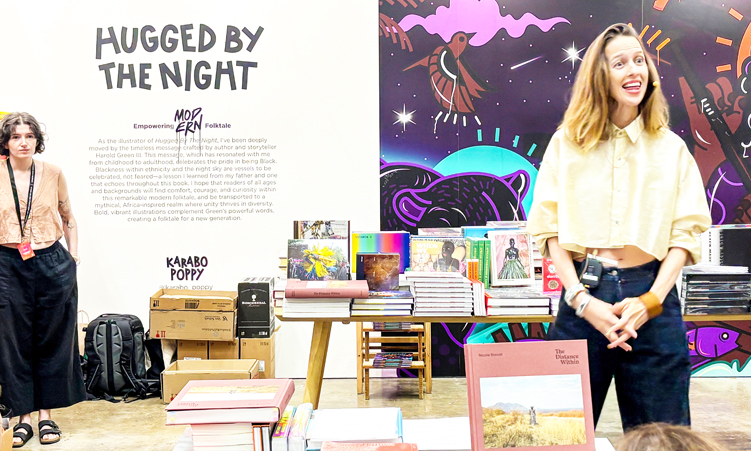
For Brandt, who presents a talk on her new book, ‘The Distance Within’, published by Steidl, photographic archives are something she is constantly creating, contesting and updating.
Documenting and often reframing key moments, monuments, places and performances that speak to Namibia’s German colonial and apartheid history, Brandt attempts to grapple with her own heritage while amplifying the voices of descendants of an often diminished genocide as well as the activists bringing these histories and lingering realities to the fore.
“Growing up in Namibia, the values of my immediate surroundings were that of a middle-class, largely white community with historical ties to northern Europe and South Africa, a context that made me deeply ambivalent towards my roots,” says Brandt in her book.
“The work in this book, which spans more than a decade, is an attempt to reflect critically on my inheritance and to question and deconstruct certain ways of seeing.”
During Brandt’s talk at the fair, hosted by Clarke’s Bookshop, visitors listen to a brief introduction to the book as well as to insights on the journey of photographic book-making and their importance as art and thought objects.
“Such books can travel in ways that perhaps an exhibition cannot and involve a different type of engagement than say scrolling on a phone or looking at a computer screen. I think it activates a different type of thinking,” she says.
While Brandt acknowledges the increased access and democratisation of the image inherent in viewing art and photography on one’s personal devices, the documentary photographer also makes a case for the good old exhibition.
“Because of this avalanche of imagery, the chances are perhaps less for having iconic photographs that circulate in our subconscious. And in some ways that’s a bit sad, because it reflects the speed at which we’re moving and the consumption levels,” says Brandt.
“But, on the other hand, the image has become even more democratic than ever because people can see great photography on their phones whereas before maybe some photography was inaccessible in albums, museums and elsewhere,” she says.
“What a fine art print means in our current context is also complex. I do think having an image in an exhibition, beautifully printed and framed where you’re in the presence of another person and you can have a conversation, is very special.”
All things considered, Brandt does believe image-making is in crisis for a variety of reasons, which render documentary photography more valuable than ever.
“Throughout history, photography has been manipulated. But now, more than ever, one can change the shape, look and feel and create an image out of nothing. I think this gives a certain type of photography even more relevance in the context of the early days of artificial intelligence,” she says.
“The integrity of the straight documentary image is more important than ever. We are, in our beings, record-keepers and makers and I think documenting our lives in changing politics, histories and contexts will have its value,” she says.
“Especially if there is integrity behind the storytelling that is held and sensed by others.”
– martha@namibian.com.na; Martha Mukaiwa on Twitter and Instagram; marthamukaiwa.com
In an age of information overload, Sunrise is The Namibian’s morning briefing, delivered at 6h00 from Monday to Friday. It offers a curated rundown of the most important stories from the past 24 hours – occasionally with a light, witty touch. It’s an essential way to stay informed. Subscribe and join our newsletter community.

The Namibian uses AI tools to assist with improved quality, accuracy and efficiency, while maintaining editorial oversight and journalistic integrity.
Stay informed with The Namibian – your source for credible journalism. Get in-depth reporting and opinions for
only N$85 a month. Invest in journalism, invest in democracy –
Subscribe Now!