



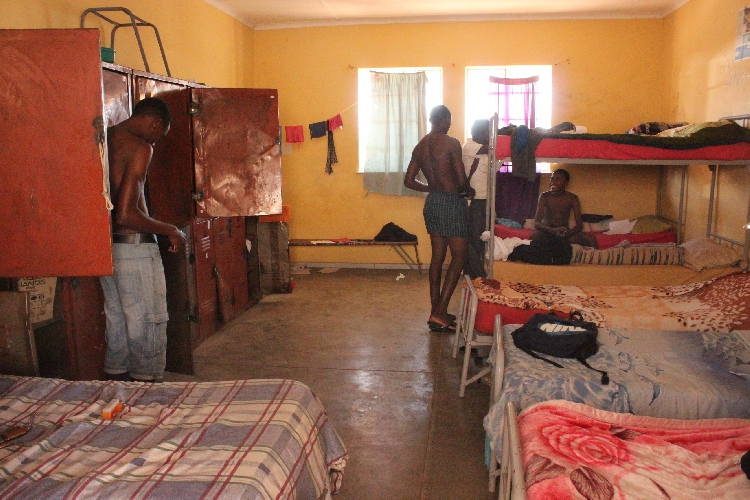
HOSTEL dwellers live under unbelievably bad conditions at the Petrus Ganeb Secondary School at Uis. Conditions are so bad that even the school principal, Ebson Vekooka, and the Erongo region’s hostels administrator Monica Gawises have to admit that there is a problem.
All the hostels in Erongo were inherited from the previous government, and no hostels were built in the region since independence. There are 14 public hostels for primary and high schools.
More than 200 of the 305 Grades 8 to 12 learners live at the Petrus Ganeb hostel where some rooms have up to 12 children sharing. The biggest problem at this hostel is the old infrastructure.
The geysers are broken down. Children take cold showers. Toilets do not always flush because the drains are blocked or are overflowing.
Some bedrooms are crammed with beds, while some windows, doors and lights are broken. Locks are also broken, and some doors cannot close properly. Walls and floors need maintenance.
The list is long, with little difference between the boys’ and girls’ hostels.
It may be for these reasons that boarders allegedly slip out at night to find accommodation elsewhere at Uis.
While there are challenges when it comes to infrastructure and low government support, some blame also goes to the children for not taking care of their hostels. In many cases, vandalism is rife.
Only two of the four hostel blocks are currently in use. The other two are either damaged beyond repair due to structural weaknesses, or are in desperate need of maintenance.
According to Vekooka, the works ministry is responsible for the maintenance and renovation of the buildings ‘but there always seems to be a problem’ when they are needed.
“We need help. We do not have enough money to do the renovations, ” he stressed.
He added that they are not looking for cheap materials after having learnt the hard way when a cheap geyser fell from its mounting and almost caused a fire.
The perimeter fence is another problem and needs repairs. Although there is some form of security, the guards are not considered reliable and do not do spot checks, Vekooka said.
He believes that hostels are a big liability for government, especially with the provision of food and constraints with the capital budget.
“The budget is small, and needs to be spread out to cover all the schools. We do what we can, with the little we get, ” he explained.
Assistant hostel supervisor Loretha !Gaoses said in reference to the problems facing them at the moment that the building infrastructure needs attention, apart from the current water shortage in the area, which is an added inconvenience.
Vandalism is likewise a major problem. It is so bad that nearly all of the boys’ rooms have wire shields instead of windows. Lockers and cupboards are broken, and cannot be used in many cases. Due to vandalism, chairs and tables are also limited.
“They have no respect for government property. We want good facilities, but they vandalise it and then they are the first to complain, ” said Vekooka.
Hostel food is ‘alright’, some children told , but the kitchen is filthy and most of the kitchen equipment does not function properly anymore.
Kitchen staff who have been working there for decades complain that they must do the best they can with the little they have.
“Nothing is working. The [large electrical] pots have been broken since 1981. Only two are working. Others are cracked. We also do not have proper uniforms, ” some of the kitchen staff explained.
They believe that for things to work, there should be motivated inspectors, principals, teachers and even kitchen staff and cleaners.
Gawises said there is a national performance standard for schools and hostels, with set criteria which have to be met. She would inspect hostels based on this standard annually.
She added that there are two sets of fees: for the hostel development fund, and the hostel fee (which goes to state revenue).
The hostel development fund should be used by the superintendent for hostel needs, although government does provide food and furniture and the ministry of works is responsible for the infrastructure.
“However, when there are emergencies, we are there and we will help, ” she said about the Erongo directorate.
A light at the end of the tunnel, though, was that there were ex learners from both Dibasen and Petrus Ganeb who were hard at work raising funds to help renovate the buildings.
“I have to assure you that compared to hostels in other regions – and I have been everywhere – Erongo is far, far better off, ” she said.
In an age of information overload, Sunrise is The Namibian’s morning briefing, delivered at 6h00 from Monday to Friday. It offers a curated rundown of the most important stories from the past 24 hours – occasionally with a light, witty touch. It’s an essential way to stay informed. Subscribe and join our newsletter community.

The Namibian uses AI tools to assist with improved quality, accuracy and efficiency, while maintaining editorial oversight and journalistic integrity.
Stay informed with The Namibian – your source for credible journalism. Get in-depth reporting and opinions for
only N$85 a month. Invest in journalism, invest in democracy –
Subscribe Now!