







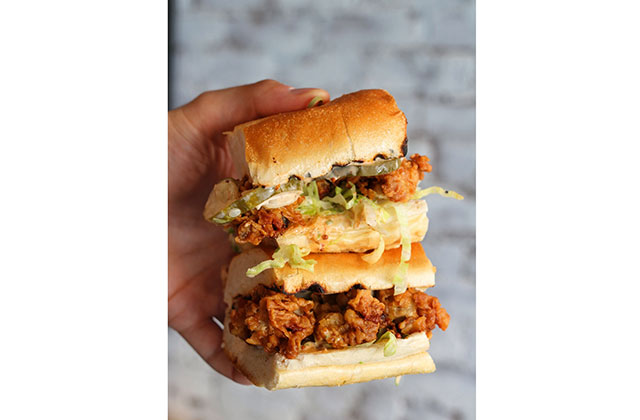
Oysters – people either love them or hate them. They are one food item that is eaten the same way today as was done way back when we first discovered them as a food source: Raw. Some like them with hot sauce, others with lemon juice, but all agree: They need to be fresh. Real fresh.
They ought to taste like the sea, briny, which is the easy bit in getting into eating oysters. Most people would be able to get their head around the briny taste of fresh oysters, only to trip up on the soft, slippery texture. It is for good reason that Irish satirist Jonathan Swift remarked that: “He was a bold man that first ate an oyster”.
Whether you swallow them whole or chew them, if you don’t appreciate soft and silky textured foods, fresh oysters are not going to be much of a delicacy for you.
Oyster is the common name for a number of different families of salt-water bivalve molluscs that live in marine or brackish habitats. Ancient dumpsites for human waste called middens contain remains of oyster shells that suggest that humans consumed them as far back as 10 000 years.
Of all oyster species, it is the ostreidae that are considered the ‘true oysters’ that include most species of molluscs commonly consumed as oysters. Oysters cultivated for the production of pearls, so-called ‘pearl oysters’, are not closely related to true oysters, being members of a distinct family, the feathered oysters (pteriidae).
Oysters have been produced commercially in Namibia since the late 1980s when commercial oyster farms were established with juvenile oysters imported from Chile.
Early on, oyster farms at Walvis Bay were only ‘maturing facilities’ aimed at growing the imported juvenile oysters into market-ready adults for the local market mostly. This has since changed with the establishment of a heated aquarium at Swakopmund that breeds oyster spores locally before selling oyster spat to the commercial farms.
These farms then transport the oyster spat to nurseries and farms around Lüderitz where they are allowed to grow for about a year to ‘cocktail size’ – 30 to 50 grams.
Once to size, the juvenile oysters are brought back to Walvis Bay to reach full maturity when they’ll be shipped to local and international markets. This strategy of moving oysters up and down the Namibian coast allows the oyster producers to avoid the risks of regular red tide and sulfur eruptions (which kills oysters) and occasional elevated cadmium levels (which makes oysters unfit for human consumption) – which occur along the coast at Walvis Bay and Swakopmund but not at Lüderitz – and benefit from the very advantageous feeding conditions at Walvis Bay (that do not exist at Lüderitz) to get the oysters ready for the market as soon as possible.
Local and international consumer safety standards require regular testing of all shellfish, including oysters, and the Namibian Standards Institution (NSI) is responsible for such tests. It is their task to issue public warnings when such products are not fit for human consumption.
Namibia’s cold Benguela Current is among the most fertile marine habitats anywhere in the world. It contains extraordinary volumes of oxygen and plankton, which greatly speeds up the time it takes the oysters to reach market size.
Much of Namibia’s oysters are exported to Europe, South Africa and Asia, where Hong Kong and China are the most important importers and consumers of Namibian oysters. Namibian oysters can range in size from 30 grams (cocktail oysters) to 150 grams (full maturity).
The local market for oysters has grown significantly over the past two decades, yet it seems to be limited to the coastal regions close to the production farms and upmarket restaurants in the capital city. As such, it is yet to be embedded in Namibian cuisine.
Cooking oysters is a great way of overcoming the difficulties of eating them raw. They are quite versatile: They can be grilled, baked, pan-fried, deep-fried, steamed, poached, blanched, stewed or ‘cooked’ with acid, ceviche-style.
Oysters pair well with butter, garlic, soft herbs like thyme and parsley, acidity such as lime and lemon juice, heat from hot sauces, a variety of cheeses such as emmental, gruyère and brie, and a great many classic sauces such as mignonette, tartar and remoulade. The latter two are commonly used with breaded and deep-fried oysters, the former with fresh oysters.
It also pairs well with other seafood in a soup or stew, and fits well as part of a surf-and-turf dish with meat (pork or beef). Oysters together with beef and a dark beer such as stout are key ingredients in a British beef and oyster pie, and the carpet bag steak is an Australian classic that combines fresh oysters with beef fillet wrapped in bacon.
Today’s dish is native to New Orleans and its history – as is nearly always the case with classic – is contested and cast in controversy.
The New Orleans po’boy is a classic oyster sandwich and is most likely a variation of the famous ‘oyster loaves’ – fried oysters on French loaves – which were popular in the city way back during the late 1800s.
The exact origin of the name po’boy is uncertain but one theory states that it was started by two brothers who served these fried oyster sandwiches from their restaurant to striking street car conductors during the strike of 1929. The Martin brothers had both been street car conductors themselves prior to entering the restaurant trade, and are said to have referred to their former colleagues as ‘poor boys’, which in the New Orleans dialect got shortened to po’boy.
The strikers must have loved these sandwiches and stayed on strike for four months. The name stuck and today the po’boy is one of America’s classic sandwiches.
• 40 large oysters, shucked
• 1 tablespoon garlic powder
• 1 tablespoon paprika
• 3⁄4 teaspoons dried thyme
• 3⁄4 teaspoons oregano
• 3⁄4 teaspoons cayenne peper