



On the floor of a shack lie rolls of fabric materials.
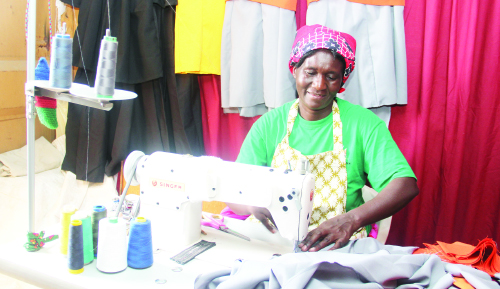
Angela Heinrich sits restlessly in a corner, sewing several school dresses which are part of the most recent order clients placed with her.
Her fingers work through her single thread sewing machine to produce the N$120 school uniforms.
“I have to finish all these before the end of the day,” she says.
Next to her is a workbench covered with sewing material. She grabs a bowl full of buttons. One at a time, she sews each button on the freshly pressed dresses, which she hangs on a rail behind her.
She eventually stands up and takes a step back to admire her work but the joy is short-lived as desperation sets in because she does not get funding.
Heinrich is one of many self-employed tailors working at their shacks in various Goreangab informal settlements. They produce assorted school uniforms for unemployed parents in their communities.
For Heinrich it all started in 2004 when she approached the Ministry of Gender Equality and Child Welfare seeking assistance to start a garment business.
However, she had to wait for six years to get help in the form of a sewing machine from the gender ministry.
Although the machine does not suit her choice, it nevertheless helps her to work on her style which is detailed and impeccably embodied on the neckline of her garments.
With the machine, she is able to produce up to 20 school uniforms a month. She admits that the number is too small for a tailor like her.
Heinrich said the machine has, however, further motivated her to continue working harder. She says production is a bit slow as she currently does not have an overlocking machine. As a result, she relies on friends to overlock her garments.
“I struggle a lot to make these [dresses] because I only have this Singer machine. If I had two more sewing machines, especially overlocking machines, then I could produce more uniforms,” she says.
Even though Heinrich learned how to sew in the 1980s already, it was not until 2001 when she bought her first sewing machine that she became active. It was an antique Singer sewing machine with a treadle base and made from old golden brown wood.
The machine today rests against the iron sheets of her shack, rusting away.
Mother of four children and a grandmother of six, Heinrich spends many hours each day producing uniforms to put food on the table.
In addition, she also sews other types of clothes such as graduation gowns and traditional Owambo dresses.
Many tailors like Heinrich are crying out to the government to help fund their businesses. Her hope is that one day government will reach out to SMEs like hers.
“It’s a good initiative that the government has stopped importing uniforms. But we need it to support us and to start recognising our skills,” she stresses.
Since 2006 Heinrich has been training young and middle-aged women to become tailors.
She has trained over 20 individuals and currently has four others who are ready to start. A hard-working Heinrich tells The Namibian that she does this with the hope of empowering other people to generate their own income, especially women. She charges them N$150 per month.
An industry that is booming but blighted by the lack of government interest, Heinrich is just one of many left out from government funding.
In an age of information overload, Sunrise is The Namibian’s morning briefing, delivered at 6h00 from Monday to Friday. It offers a curated rundown of the most important stories from the past 24 hours – occasionally with a light, witty touch. It’s an essential way to stay informed. Subscribe and join our newsletter community.

The Namibian uses AI tools to assist with improved quality, accuracy and efficiency, while maintaining editorial oversight and journalistic integrity.
Stay informed with The Namibian – your source for credible journalism. Get in-depth reporting and opinions for
only N$85 a month. Invest in journalism, invest in democracy –
Subscribe Now!