JOHN-COLIN NAMENE and PUYEPAWA NAKASHOLE IT is around 20h45 on a cold Friday evening and Windhoek is getting quieter by the minute.
All that is left on the roads are vans and sedans with blue and red lights getting ready to enforce the Covid-19 curfew.
The Namibian meets with deputy commissioner Nikolaus Kupembona of the Namibian Police at the police headquarters in the capital’s central business district.
He agrees to the newspaper accompanying the law enforcers on their patrols.
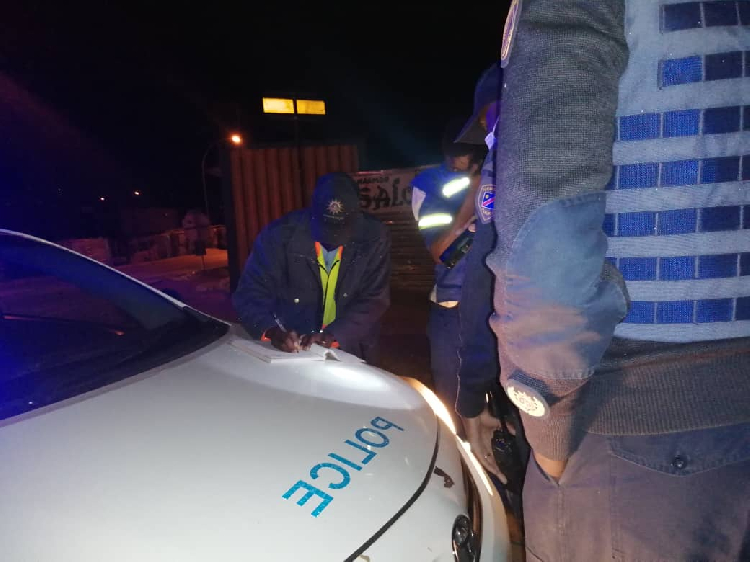
Their first stop is the intersection of Rooivalk and Moses Garoeb streets, where five Nampol vehicles are stationed.
Kupembona says: “We make sure our presence is felt everywhere, however, we look at areas with a high influx of vehicles, as well as areas we have identified to have the most traffic.”
The clock strikes five minutes past 21h00, and police officers start pulling vehicles over.
“You see how our people do not want to comply,” Kupembona says.
He says the police do consider essential service employees and the employees of businesses which close late.
He, however, urges motorists and citizens to still make sure they adhere to the curfew to the best of their abilities.
Kupembona says although the law does not provide for police officers to be lenient, officers may let motorists who have been stuck in traffic off the hook.
“There is no grace period really. At 21h00 every citizen must be at their residence, with the exception of those rendering essential services. That is what the government says,” he says.
Their next stop is the intersection between Green Mountain and Matshitshi streets at Goreangab.
This area is busy, although most motorists provide the police with essential services permits.
Kupembona says the police have noticed essential service providers and other citizens with permits abusing this privilege.
“Some drivers who have permits may be transporting people who do not have permits,” he says.
He warns that the law will take its course if people abuse their permits.
The Namibian follows Kupembona and his team to the Windhoek-Okahandja roadblock where the driver of a vehicle provides the law enforcers with an expired permit.
At the same time the driver is transporting two passengers.
“This one is going to sleep here. There is a question mark on the car, and there is a question mark on his permit. He seems to have been drinking as well,” one of the officers at the roadblock says.
Kupembona says traffic department officers are in constant communication with the police on patrols in case they are needed.
Another driver, who is transporting a seemingly intoxicated passenger, has difficulty matching his identity to the information on his driving licence.
The motorist is followed home by traffic officers to verify his identity.
Kupembona says citizens often start after-hours activities too late.
“This is not applicable to everyone though, the majority of the public is really trying,” he says.
“We are trying our best to protect ourselves – just like any other citizen. We have also been mandated to enforce this [curfew] law, so we have to look after ourselves by adhering to all the protocols so as not to compromise our own health,” he says.
Ismael Basson, Khomas regional police commander, says the life of a police officer is always in danger – especially during a pandemic.
He says the risk of contracting Covid-19 is big for police officers.