I don’t know many countries where you can still see donkey carts in daily use, or the numbers that you see in Namibia.
Whenever I see a donkey cart, I appreciate this old, more environmentally friendly mode of transport. Always happy to see them, I make a point of stopping when I do and chat to the friendly occupants.
There was a time when donkey carts played a major role in the world, especially in desert areas where donkeys and mules are more adapted to the harsher environment. And they are still a common sight in Namibia’s rural areas. I call them ‘the 4x4s of the countryside’.
I’ve been visiting the regions north of Etosha National Park, usually referred to simply as ‘the north’, for the last 15 years and have noticed the changes time has brought with it. There used to be many donkeys visible in the towns, often proving quite a hazard on the roads.
Now, after years of drought and the erection of fences as people receive customary land rights, only a few can be seen.
But when you travel into the unfenced rural areas where their movement is not curtailed, there they are, and there you can still see donkey carts travelling along the roads as in days of old. And they make me smile, as usual.
On a recent trip to Lake Oponona, I noticed something else that I find fascinating.
The donkey carts in northern Namibia seem to differ in appearance to those in the south. In southern Namibia they are usually made from the back of old bakkies or using the axle from an old car, and they have a seat in the front and are often beautifully decorated.
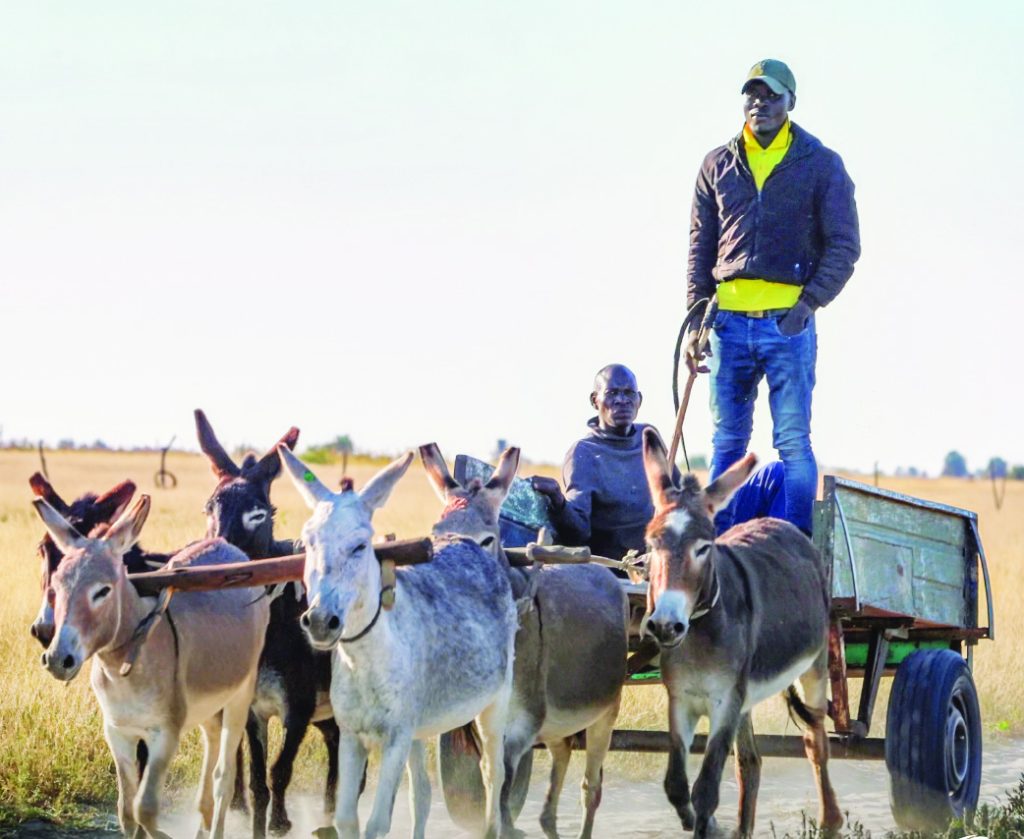
In the north, the donkey carts have more of a manufactured appearance with the axle made from square tubing, almost like a trailer. There is often no seating and the driver stands in the front holding onto the reins in a type of Wild West fashion.
The cart’s design is for the purpose of transporting goods like wood, water and thatching grass rather than for conveying people. And, interestingly, more donkeys are used to share the load. The usual two donkeys per cart are replaced by three or more. I even saw a cart with nine donkeys!
We enjoyed one of the Wild West scenes when we passed a shebeen on a Saturday. Parked outside were all manners of donkey-carts – 2x4s, 4x4s and 9x4s.
One of the only shebeens in the area, it was well-frequented and the donkey carts were serving as taxis on the occasion. As we neared, we saw a donkey cart leaving the shebeen transporting a very happy man in the back. The driver was standing, holding the reins and travelling at full speed, raising a cloud of dust behind him.
I also noticed that many of the young people working on Ohambo, taking cattle to other areas for grazing, have a lot of time on their hands, which they often use to train their donkeys. With hardly any cellphone reception, they spend their time in different ways than youngsters in the city.
The image of the donkey cart hurtling off in a cloud of dust stays with me – its driver standing up, reins in hand. They are the scenes from a different way of being, and one which still holds value in a changing world.