


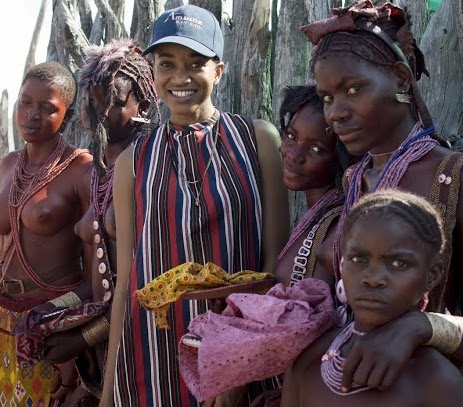
WHILE the rules and regulations of what makes a woman, and an Aawambo woman at that, have changed, the olufuko which my paternal grandmother Elfrieda Shalongo Sheimi took part in almost 70 years ago is back in our community.
Eager to find out more about my history and heritage, I sit with my grandmother to ask her how it was in her day.
Speaking to elders always makes me anxious because they tend to be impatient when explaining Aawambo matters to me whom they consider to be an anomaly.
I was warned by my father, cousin and aunt that my grandmother is not like other elders because she is very chatty and could tell me about her past for days on end. They fear that I will lose interest.
It is hard for me to believe now that a generation ago, a man was allowed to marry more than one woman, namely both my maternal and paternal grandfathers.
To be considered a woman, at least in the Ombalantu culture then, she had to go through olufuko, or something similar for the other Aawambo groups. It was because it protected a girl and her family’s reputation should she fall pregnant.
While teenage pregnancy is rife in Namibia, and still something much frowned upon, it’s interesting to see the parallels of ostracising young women for falling pregnant, while the man gets off scot-free.
In one of the first chapters of the book Aawambo Kingdoms, History and Cultural Change Perspectives from Northern Namibia, scholar Lovisa T Nampala explains that children born to mothers who would not have gone through the rite of passage were considered bad luck to the community.
As a warning to others , mature girls were taken to the bush to witness the disgraced girl’s abortion, which again brings us back to present-day Namibia where abortion is illegal, mostly due to Christian belief systems.
The book further explains the different rituals, the pastes made from the root of wild figs to be drunk by the girls to encourage fertility, and the different customs and ceremonies which varied from kingdom to kingdom.
In a soft-spoken voice which is barely above a whisper, my grandmother explains that a girl typically took part in olufuko in the year of her menarche, or first menstrual cycle.
Hairdresses were an integral part of the process of preparing for olufuko. She explains that the first step would be to braid their hair, using oombeke oil; and next it would be to braid their hair in extensions, made from palm leaves, which would be similar to the synthetic braids we use today.
Thereafter, they would use the seed of the eembe and make beads, which they would adorn their hair with, followed by adding short extensions to the front of their head like a fringe, while the hair in the back would stay long and loose.
They would then take the bark from the baobab tree’s roots, thin it out to use as hair extensions, and make two giant braids that would flow down until their buttocks. The two braids are then switched to four, which then flow down to their ankles. After the intricate process of going through all the headdresses, they remove it, and are finally ready to go to Olufuko.
Speaking to my contemporaries, albeit a few years younger than me, I am interested to find out what it is that they get up to during the week of their journey into womanhood. They were initially unsure of whether I am allowed to talk to them, as an older woman gives me a stern look after spending a good thirty minutes trying to convince her so as to talk to some of the girls.
After much of a fight, some luck and divine intervention which comes through in the person of Maria Nepembe, who is this year’s face of olufuko, I get to chat to three 18-year-olds within 15 minutes of each other.
The first thing I ask is whether it is their first time taking part, a naïve and stupid question, because one can only go through olufuko once. Emilia Simeon says that she decided to take part in olufuko in order to continue the tradition that her elders and ancestors have done before her.
Part of this is learning how to be a woman, which includes being taught how to uphold morals, and good conduct, how to perform domestic duties, and a whole bunch of other things that I’m not sure whether she isn’t at liberty to discuss, or we are struggling because of the language barrier, and then lastly the proposals of marriage.
Today, none of these girls are actually getting married; the youngest is around 14; while the eldest is 24. But according to my grandmother, in her time, the elders or parents would discuss among themselves who would be a good match for their sons, and later the young men would attend olufuko and tie a string around her wrist as a proposal of marriage.
A diehard romantic, I ask her whether or not they were allowed to reject a man’s proposal if they did not like them. She laughs it off, and tells me that marriage was arranged; you listen to what your parents said, and had no real say in who you were betrothed to.
That’s something which I’m sure if the practice was still followed today, my parents and I probably wouldn’t see eye to eye on.
Yola Hashingola’s father was trying to convince her to take part in olufuko for years, but she never really had any intention of doing it, until she visited the festival last year and realised that it was something that she wanted to take part in. “It’s actually been a pretty amazing experience”.
I learned to humble myself more, because I used to brag a lot. I learned to listen to my elders, and learn more about my culture. Olufuko is extremely important because you can’t wake up at 20 and be like I was a teenager, and now I’m a woman without having gone through it. I think it is a really important experience that you have to go through with your family, your culture and a chance to actually go through a ceremonial process to be called or considered a woman within your culture.”
For those thinking of taking part in olufuko in the future, Yola advises girls to be ‘open-minded, come to the festival,check it out and see if you’d like to do it. Nobody forces you to do anything you don’t want to do, except not wearing a bra’, she giggled.
Olufuko has been criticized as being a ceremony which objectifies young women and girls, and while it has changed a lot from the time that my grandmother took her rite of passage, one thing that remains the same is still its ability to ruffle some feathers.
At the time, my grandmother had just recently gotten baptised at the nearby church, and the missionaries warned the girls not to take part in olufuko as it was considered to be partaking in paganism. But my grandmother with her great love for Christianity and being conflicted about upholding her own culture secretly took part in olufuko anyway, hoping the church would not find out.
In an age of information overload, Sunrise is The Namibian’s morning briefing, delivered at 6h00 from Monday to Friday. It offers a curated rundown of the most important stories from the past 24 hours – occasionally with a light, witty touch. It’s an essential way to stay informed. Subscribe and join our newsletter community.

The Namibian uses AI tools to assist with improved quality, accuracy and efficiency, while maintaining editorial oversight and journalistic integrity.
Stay informed with The Namibian – your source for credible journalism. Get in-depth reporting and opinions for
only N$85 a month. Invest in journalism, invest in democracy –
Subscribe Now!