


HOMELY-LOOKING part-cream, part-maroon clusters of brick buildings situated along the Okahandja B2 road to Swakopmund hide rundown school hostels established before Namibia’s independence.
A worried parent, Paulus Stramiss, whose two children are alumni, while the third is still a pupil of KW von Marees Combined School at Okahandja, recently invited to see the squalid conditions of the school’s hostels.
In addition to being a long-time school parent—since 2005—Stramiss is the newly elected hostel chairperson, and declares his determination to bring change.
It is just after 12h00 when arrives at the school, whose location is initially difficult to find. However, Stramiss’ unmissable bright pink pair of trousers and continuous flagging points us in the right direction.
The hostels were constructed in 1984, as an addition to the school, which was founded three years prior.
Currently, the school has 1 300 pupils, with 190 of those being boarders. The majority come from distant farms, or Windhoek.
The hostels, which pupils have come to know as their second home, are not as hospitable as expected.
“I normally approach most of the companies in the area in efforts to rescue the situation, which is getting worse,” says Stramiss.
He explains that he has addressed the school’s management during numerous board meetings of the hostel’s hazardous situation, although his views seem to have fallen on deaf ears.
“As a parent, when I see things like this, must I keep quiet? Until when will this go on?” he questions rhetorically.
According to him, parents have been contributing a N$50 breakage fee in addition to school fees, yet they remain unaware of the appalling condition of their children’s accommodation.
“Parents are under the impression that all is well. We are lying to parents. Why should we lie to parents?” Stramiss asks.
A strong, undesirable smell hits us upon reaching the hostels and disembarking from the car in which we journey.
The smell is from a littered sewage pond which has formed outside the boys’ hostel block.
This is amidst the ministry of health recently reporting 155 new hepatitis E virus cases as having sprouted nationwide.
We get past the haunting stench and find our way inside, first to the boy’s hostel block.
The first room, close to the entrance, has a missing door, with just a scratched old red door frame.
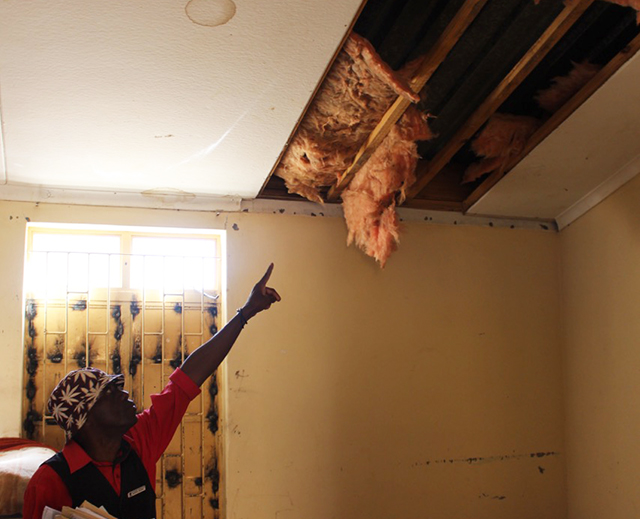
Inside the room is what seems to be a water-damaged ceiling, which hangs from wood planks exposed through an overhead opening, and is falling in.
Directly below the ceiling, which paints a seconds-from-disaster appearance, is a neatly made-up cast-iron single bed.
Minimal natural light enters the room, as metal from unused lockers has been substituted to mend broken windows.
Other iron bed frames have no mattresses on them. One is occupied by items of clothing and exercise books appearing to have been left in a rush.
After some observation, we exit the room. Electrical wires which are sheathed in red, blue or yellow stick out from electrical socket holes along the hostel’s corridors.
Other rooms have broken doors.
While our nostrils are yet to recover from the sewage stench, we inhale the reek of urine which floats in the air, as we make our way to the boy’s bathing facilities.
The bathroom floors are wet and admittedly, I hesitate having to step inside.
After gathering the courage to, I am met with bathtubs whose ceramic tiles are largely broken, tap-less bathtub faucets, and seatless toilets— some whose flush tanks have no lids.
Some girls have decorated the doors leading into their rooms with light-hearted posters, which read:
“Come to: I care about your health. Doctor Liina. Just 10 cents or 5 cents.”
“Hair salon. Plz support us!!! Plz (sic).”
In an age of information overload, Sunrise is The Namibian’s morning briefing, delivered at 6h00 from Monday to Friday. It offers a curated rundown of the most important stories from the past 24 hours – occasionally with a light, witty touch. It’s an essential way to stay informed. Subscribe and join our newsletter community.

The Namibian uses AI tools to assist with improved quality, accuracy and efficiency, while maintaining editorial oversight and journalistic integrity.
Stay informed with The Namibian – your source for credible journalism. Get in-depth reporting and opinions for
only N$85 a month. Invest in journalism, invest in democracy –
Subscribe Now!