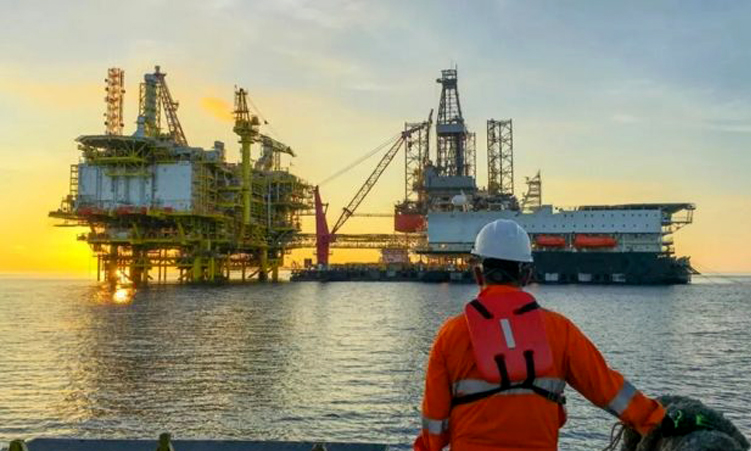
Oil is being discovered and prepared for production faster than gas, which is still a longer-term prospect.
This is according to Paul Eardley-Taylor, the head of oil and gas coverage for southern Africa at Standard Bank.
He recommends that Namibia first focus on oil, while laying the foundation for future gas monetisation.
“Namibia is in a really interesting position at the moment, because with the more wells that get drilled, the oil is becoming nearer, but the gas is going slightly further away,” Eardley-Taylor says.
“The challenge is really: How does the country lead with the oil first, but always keep the gas in mind?”
He says while Namibia holds significant gas volumes – estimated at 550 million standard cubic feet per day of reinjected gas, on par with Mozambique’s Coral South liquid natural gas project – the country lacks immediate production capabilities, aside from the BW Kudu gas-to-power project.
Eardley-Taylor says gas infrastructure development cannot be left solely to the private sector, and calls for a government-led approach.
“Shared infrastructure is something that will come in time. Probably what you will have to have is a situation where the state almost frontloads development,” he says.
“We don’t think the private sector can do it on its own – it really has to be government driven.”
Eardley-Taylor proposes that a centralised site in southern Namibia be identified for shared infrastructure, suggesting Elizabeth Bay over Lüderitz due to fewer competing interests.
“Lüderitz is a fishing port. It’s a tourist town. There are obviously historical issues at the site as well,” he says.
Eardley-Taylor also warns that without a coordinated approach, companies that take the lead on gas projects could be burdened with high infrastructure costs.
“You can almost think of it as a first mover disadvantage if you’re the company that leads the gas project but then gets encumbered with the big infrastructure build-out,” he says.
BW Energy’s deputy general manager of BW Kudu, Manfriedt Muundjua, agrees that infrastructure costs pose a major challenge, especially for early stage gas projects.
He says BW’s current gas plan requires a 12-inch pipeline to transport 140 million standard cubic feet – much smaller than the infrastructure needed for broader gas transport.
“To transport the gas, a pipeline between 24 to 36 inches is needed,” he says.
“A mechanism must be agreed upon with other operators or the government to cover the investment gap and ensure the infrastructure is available for shared use.”
Meanwhile, Ian Thom, the research director for Upstream at Wood Mackenzie, says Namibia’s gas strategy is still under development and lags behind ongoing efforts to produce oil and implement local content policies.
“If you look at Namibia’s priorities today, you have a big focus on getting first oil, continuing the exploration programme, and also the local content policy. The gas strategy is sort of competing with all of that for time and attention,” he says.
Thom says the gas master plan is expected to take shape over the next six to nine months, and emphasises the need for regulatory clarity and investor confidence.
In an age of information overload, Sunrise is The Namibian’s morning briefing, delivered at 6h00 from Monday to Friday. It offers a curated rundown of the most important stories from the past 24 hours – occasionally with a light, witty touch. It’s an essential way to stay informed. Subscribe and join our newsletter community.

The Namibian uses AI tools to assist with improved quality, accuracy and efficiency, while maintaining editorial oversight and journalistic integrity.
Stay informed with The Namibian – your source for credible journalism. Get in-depth reporting and opinions for
only N$85 a month. Invest in journalism, invest in democracy –
Subscribe Now!