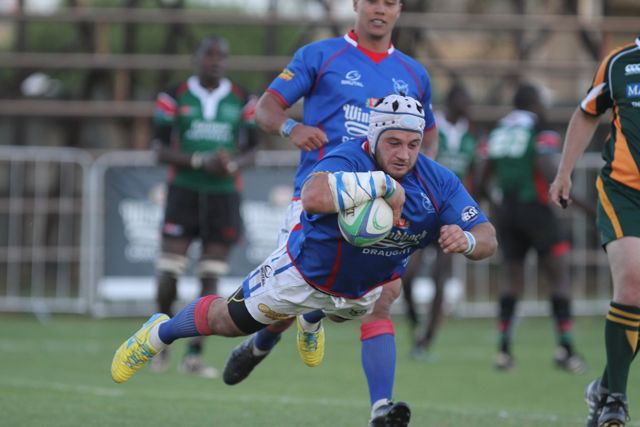
Kenya’s ambitions to qualify for the 2015 Rugby World Cup received a boost with its inclusion in this year’s South African Vodacom Cup series, but the CEO of the Namibia Rugby Union, Sybrand de Beer was not unduly concerned, saying that Namibia’s own preparation would suffice.
Kenya and Namibia will be battling it out with Zimbabwe and the host nation Madagascar at the end of June, with the winner automatically qualifying for the 2015 Rugby World Cup, while the runner-up will still have a chance to qualify via a play-off match against a European nation.
Last week it was announced that Kenya will compete in the 2014 Vodacom Cup, in place of the Argentinian Pampas who presumably withdrew due to financial constraints. The extra competition will give Kenya much needed preparation since the squad will play seven matches in three months while it will be based in Cape Town.
According to De Beer, however, there are pros and cons to Kenya’s inclusion in the Vodacom Cup.
“Most of Kenya’s players are local-based so being together for about three months and competing at a higher level of intensity will definitely improve their conditioning as well as their tactics like defensive play and so on. But at the same time, they run the risk of injuries while big losses in the Vodacom Cup will not be good for their morale,” he said.
Namibia competed in the Vodacom Cup in 2010 and 2011 but financial constraints saw them withdrawing and with the NRU still without a main sponsor, it has become too costly to participate.
“We would need to budget about N$4 million to participate in the Vodacom Cup, but most of our players are working and they cannot afford to take two months off, like Kenya who will be staying in Cape Town. Otherwise, flights and accommodation in South Africa alone will amount to N$2 million and since we still don’t have a sponsor we cannot afford that,” he said.
“The fact that only about 12 of our local based players are in the World Cup squad will also not help much, because our foreign-based players will only be able to join a few weeks before we go to Madagascar,” he added.
De Beer said the NRU’s preparations were well on track and he was confident that their preparations would suffice.
“We will play a South African invitational team at the end of May while we are busy negotiating to play two Currie Cup teams in June. We will be at full strength with all our foreign-based players for these matches before the team leaves for Madagascar,” he said.
According to reports, Zimbabwe has also stepped up its preparations with an intensive training camp due to start in April, while it has lined up five matches against South African provincial sides.
Last year, Namibia beat Zimbabwe 35-26 and Kenya 55-35 to win the Windhoek Draught Ti-Nations trophy in Windhoek, but De Beer acknowledged that both opponents would be stronger this year.
“Kenya and Zimbabwe will definitely be stronger this year so we will just have to work harder and step up our preparations,” he said.
Meanwhile, De Beer said the local league would probably start at the beginning of March, although they were still discussing what format it would take.
“We are still considering whether to hold the club league over two rounds, or whether we should start with a regional competition and then hold the club league over one round later in the year. If we hold a regional league, we will first have regional club competitions before regional selected sides will compete against each other as well as against the national squad,” he said.
Last year a regional competition was hosted for the first time with Navachab Gold Mine coming on board as the official sponsor, but opinions regarding the competition’s worth to the national team varied. De Beer however maintained that they were still discussing possible changes to the format with the sponsor and will make an announcement in this regard soon.