



The appointment of three non-Namibian judges for Namibia’s High Court is intended to be a temporary measure to address a shortage of judges who handle civil cases in the court, the Judicial Service Commission (JSC) says.
In a media statement issued on Friday, the JSC said it has proven to be difficult to source judges for the High Court’s civil stream from the country’s magistracy, from which suitably qualified candidates for the court’s criminal stream have been drawn for many years.
“Magistrates seldom gain the depth of experience in civil procedure or the substantive branches of civil law required for complex civil adjudication in the High Court,” the commission stated.
It added that senior legal practitioners with extensive civil experience have historically been reluctant to accept permanent judicial appointments, and have instead made themselves available only occasionally as acting judges.
“Appointments of acting judges have provided some relief, but such appointments are inherently limited in duration, with most acting judges available to serve for periods of no more than three months at a time,” the JSC said.
It also said the number of permanent judges in the High Court’s civil stream has seen a steep decline over the past two years as a result of retirements, and that resulting vacancies have remained unfilled.
“The sustained shortage of suitably qualified candidates has placed an excessive burden on the few permanent judges in the civil stream at a time when the volume and complexity of civil cases have grown significantly,” the JSC said.
“This situation poses a material risk to the timely and effective administration of civil justice and, left unaddressed, threatens to undermine the court’s ability to meet its constitutional obligations to the public.”
The court has a training programme for aspirant judges that is designed to equip magistrates and other justice sector professionals with civil law knowledge and practical experience necessary for future appointment to the court’s civil stream, but capacity-building of that nature requires time to yield results, the JSC stated.
The commission has decided to recruit some suitably qualified retired or out-of-service judges from comparable southern African jurisdictions that share Namibia’s common-law legal tradition, the commission said.
“These appointments will be made on fixed-term contractual bases and are intended strictly as a temporary measure to address immediate capacity shortfalls while domestic solutions continue to be developed and pursued,” it stated.
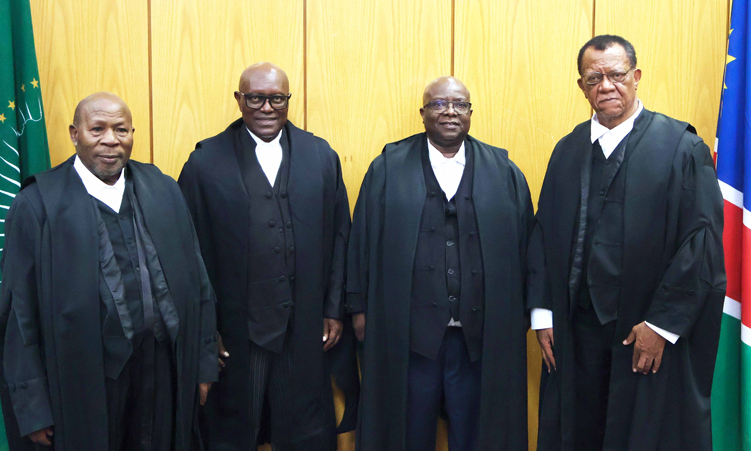
Three judges appointed with effect from the start of March took their oaths of office in the Windhoek High Court on Monday.
Judge Gabriel Komboni, who is a former judge of the High Court of Botswana, has been appointed as a judge of Namibia’s High Court for a period of two years and five months.
A retired judge of the High Court of Zimbabwe, David Mangota, and a former judge of the High Court of Zimbabwe, James Devittie, have been appointed as acting judges of the High Court for three years.
The JSC also announced on Monday that former High Court judge Marlene Tommasi has been appointed as an acting judge of the High Court from the start of April to the end of June.
The executive director in the Office of the Prime Minister, Gladice Pickering, has also been appointed as an acting High Court judge from 16 March to the end of June.
Pickering previously served as a magistrate for seven years and is also a previous executive director of the Ministry of Justice.
In an age of information overload, Sunrise is The Namibian’s morning briefing, delivered at 6h00 from Monday to Friday. It offers a curated rundown of the most important stories from the past 24 hours – occasionally with a light, witty touch. It’s an essential way to stay informed. Subscribe and join our newsletter community.

The Namibian uses AI tools to assist with improved quality, accuracy and efficiency, while maintaining editorial oversight and journalistic integrity.
Stay informed with The Namibian – your source for credible journalism. Get in-depth reporting and opinions for
only N$85 a month. Invest in journalism, invest in democracy –
Subscribe Now!