



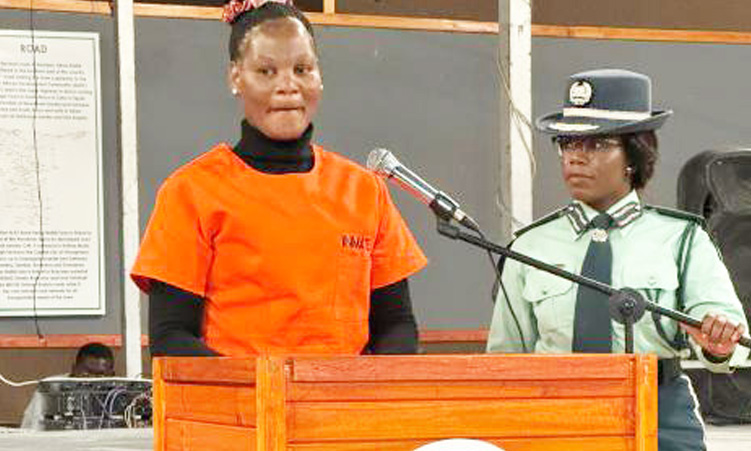
Paulina Nghipunya, a 35-year-old woman serving a 10-year sentence for the murder of her three-week-old baby boy, recently shared her life story in a testimony.
Her account reveals a devastating cycle of abuse, rejection and systemic neglect that she believes culminated in the tragic crime.
Incarcerated at the Windhoek Female Correctional Facility, Nghipunya’s journey began with a childhood marked by abandonment.
“My mother abandoned me when I was just two weeks old. Sadly, she still wants nothing to do with me,” she says.
This initial trauma set the stage for a childhood of hardship and exposure to violence.
She recalls living with her aunt and watching her being abused by her husband. The abuse was so severe that at times, her aunt could not even move.
As a child, Nghipunya was forced to care for her younger cousins, a role that left emotional scars and shaped her view of the world.
Her path grew darker.
At 15, she moved in with her maternal grandmother, only to endure more emotional cruelty.
“She treated me like I did not belong,” says Nghipunya, adding that her grandmother’s constant insults and reminders of her abandonment made her feel worthless.
“I was desperate for my mother’s love and went to Windhoek, where I found her, but was met with more rejection.”
“Instead of caring for me, she tried to force me into relationships with men, maybe hoping one of them would take responsibility for me,” the inmate adds.
This pattern of seeking love in all the wrong places led her to a relationship at age 17 that was initially good. But after her first son was born, the man turned physically, emotionally and sexually abusive.
“I felt trapped and endured the abuse,” Nghipunya says, adding that the experience felt like she was reliving what her aunt went through.
Eventually she left the man and returned to her grandmother’s house, hoping things would be better, but her abuser begged for a second chance.
“I believed him and went back. Soon after, I became pregnant with my second child, but the violence continued.”
Her tragedy came in October 2013. After being kicked out of her grandmother’s house with her two children and with the father of her children wanting nothing to do with them, Nghipunya found herself at Ondangwa with her five-year-old and three-week-old baby.
She says she felt hopeless, rejected and alone.
“My mind was filled with dark thoughts. I kept asking myself why my life had turned out this way, why nobody wanted me, not even my own mother,” she recalls.
In a moment she describes as her mind “going dark”, she took her three-week-old baby to an open field and drowned him.
She recalls wrapping his body in nappies and burying him in a shallow hole she dug.
Shortly thereafter, she was arrested.
Nghipunya says she was too ashamed and afraid to tell the truth.
For years, Nghipunya carried the weight of her secret.
But at the Namibia National Women’s Conference held at Helao Nafidi over the weekend, her testimony was a plea for a better future for other women.
“I felt deep shame, especially because I had harmed my own child,” she states.
During her incarceration, Nghipunya attended a programme on gender-based violence (GBV) and a bible course called ‘The Prisoner’s Journey’.
She says she now understands what a healthy relationship looks like and where to go for help when confronted with abuse.
Her testimony highlighted a national crisis that was further emphasised by police inspector general Joseph Shikongo at the event.
Shikongo indicated that a total of 4 089 GBV cases occurred during the 2024/25 financial year, with common assault being the highest reported offense.
Out of the total reported GBV-related cases, the Ohangwena region accounts for 461.
From this year April to May, a total of 647 GBV cases have been reported countrywide, with Ohangwena accounting for 79 cases.
Shikongo noted that common assault followed grievous bodily harm.
“GBV is a national crisis and a violation of human rights. Violence against women is not a women’s issue, it is a national crisis,” said Shikongo.
He added that many of these crimes are preventable and are rooted in societal behaviours and attitudes.
Shikongo called on women to speak out, seek help and report these crimes without fear.
He also urged men to be partners in the fight against violence to create safer spaces for women and girls in schools, homes, the workplace and public areas.
The Namibia National Women’s Conference, held under the theme ‘Creating the Safest Environment for Girls and Women to Live, Learn and Lead’, aimed to unite, advocate and inform while creating real solutions to the root causes of GBV and other social problems in Namibia.
– Nampa
In an age of information overload, Sunrise is The Namibian’s morning briefing, delivered at 6h00 from Monday to Friday. It offers a curated rundown of the most important stories from the past 24 hours – occasionally with a light, witty touch. It’s an essential way to stay informed. Subscribe and join our newsletter community.

The Namibian uses AI tools to assist with improved quality, accuracy and efficiency, while maintaining editorial oversight and journalistic integrity.
Stay informed with The Namibian – your source for credible journalism. Get in-depth reporting and opinions for
only N$85 a month. Invest in journalism, invest in democracy –
Subscribe Now!