


JORING VON GOSSLERIT is widely believed that Namibia, together with the rest of SADC region, is heading for an electricity shortage from 2016, when the power purchasing agreement with Eskom ends.
Eskom is struggling to meet South Africa’s demand and is unlikely to renew power-purchasing agreements with its neighbours.
Namibian Engineering Corporation (NEC) believes the “energy crisis” that Namibia is heading toward could be avoided if the right projects are supported and incentives provided to the private sector.
Nampower should enter into 25-year power-purchasing agreements with multiple private plant operators. These plants should be 1-10 MW each, owned by Namibians and produce clean, cost-effective and local power. These plants could be solar PV, solar thermal, wind parks or bush-to-gas power plants, all powered by renewable energy sources found in Namibia.
As fossil fuels are becoming more expensive and harder to come by, renewable power plants on the other hand, have a constant electricity production price and will become cheaper than fossil fuel power stations in just a few years (and already are, if some fuel types are compared).
To “store” the energy from the renewable power stations across the country, Nampower could spend a fraction of the money planned for Kudugas, to rebuild the sluice gate at the Calueque dam in the Kunene river in Angola. This would provide the optimal solution to have constant and permanent power from Ruacana (clean and renewable), right through the year.
Power production by hydropower stations can be effectively and quickly controlled. The dam for the turbines could act as a “national battery” to the renewable power suppliers of the country.
As the sun rises and more of the national grid is powered by solar (thermal or PV) the turbines at Ruacana could be throttled back. As clouds cover some of the solar farms or night falls, Ruacana and bush-gas-to-electricity plants could react and produce more power. This would ensure a 100% renewable and very affordable national smart grid for Namibia.
For future power demand for Namibia and SADC, NEC believes that a 200MW gas power plant could rather be built at Walvis Bay, where the power infrastructure is already in place and a trained labour force is close-by for installation and maintenance.
The gas could be Namibian sourced, natural Kudu gas, brought in by ship from the rigs of the Atlantic Ocean rather than spending money on Saudi-Arabian or Angolan oil, for an expensive and dirty diesel power plant.
This smaller gas turbine together with decentralised bush-to-gas and the revamped Van Eck power station could supply base-load to the country, supporting the Ruacana turbines, so that the water supply in the Calueque dam would last the entire year.
For the day time bulk power requirements, solar PV has many advantages in the Namibian context:
Small-medium (1-10MWp) systems could be installed by Namibian companies with Namibian labour force in decentralised locations across the country.
Namibian solar companies could install a minimum of 4MW per month, therefore in a very short space of time, provide sufficient power to the grid to make Namibia a net-exporter of power during the day.
Namibia has among the world’s best solar climates for PV and solar thermal plants.
Nampower could award smaller tenders (1-10 MW) to the private sector. This would greatly reduce capital outlay by the government and would provide an income to a vast number of Namibians living in rural areas around the country (as a local workforce can be used to construct the plant and the population could become co-owners of the solar farms).
ocal companies are willing and able to convert their rooftops to “small power plants”, reducing the burden on the national grid by reducing their own daytime consumption.
Local labour could be employed by Namibian companies to build these megawatt parks.
All money spent on purchasing power from our neighbouring countries could then be paid to Namibians, strengthening our economy.
Since the ECB has not yet established and enforced a net-metering agreement to be implemented by all distributors across Namibia, the best return on investment is currently achieved if the client can consume all the solar (alternative) energy they produce during the day, reducing their daytime consumption.
The net-metering implementation is expected to be enforced within the next year.
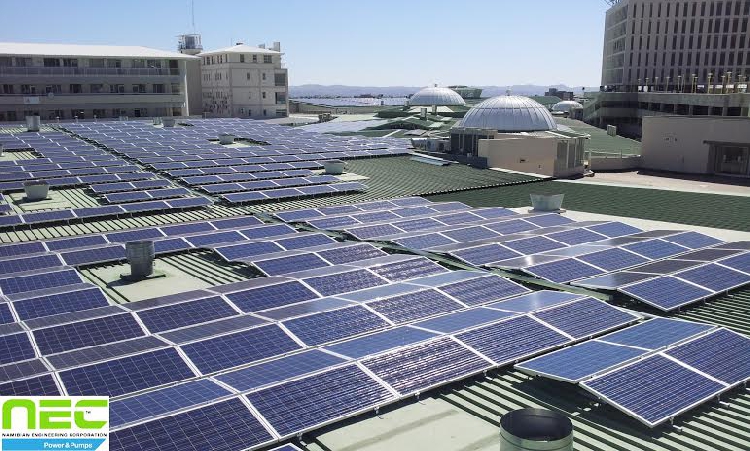
NEC has installed a 1 000 kWp solar PV grid-tied system at Maerua Mall, achieving exactly this. Reducing daytime consumption by up to 30% for the mall. Reducing monthly overheads as well as keeping future electricity cost increases to a minimum.
This is another example of how the private sector could support the national grid by reducing daytime, especially peak time, consumption.
A grid-tied solar system is an effective means to reduce monthly electricity costs. The system at Maerua Mall is anticipated to “pay back” the Solar investment in just 5 years, taking into account an estimated increase in utility power cost of 11% per year for the next five years.
The solar grid-tied system installed at Maerua Mall spans a 2 x 500kW system, where axitec polycrystalline panels were used.
The choice to go with crystalline technology was based on the fact that these modules are more efficient (higher output per roof space available), have the best factory warranties (12 years), have a 40-year proven track record for long-term performance and have the lowest degradation over their economical live expectancy of 25 years, guaranteed (no less than 85% of rated output after 25 years).
In an age of information overload, Sunrise is The Namibian’s morning briefing, delivered at 6h00 from Monday to Friday. It offers a curated rundown of the most important stories from the past 24 hours – occasionally with a light, witty touch. It’s an essential way to stay informed. Subscribe and join our newsletter community.

The Namibian uses AI tools to assist with improved quality, accuracy and efficiency, while maintaining editorial oversight and journalistic integrity.
Stay informed with The Namibian – your source for credible journalism. Get in-depth reporting and opinions for
only N$85 a month. Invest in journalism, invest in democracy –
Subscribe Now!