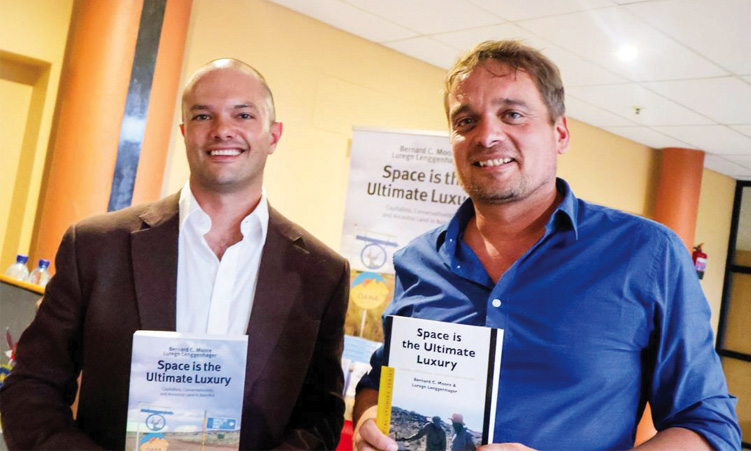
An outwardly inhospitable expanse of land along the Orange River in southern Namibia is much more than it initially seems in a book titled ‘Space is the Ultimate Luxury – Capitalists, Conservationists and Ancestral Land in Namibia’.
Written by historians Bernard Moore and Luregn Lenggenhager, the book’s southern African edition was recently launched in Windhoek.
“The far south of Namibia has stood at the crossroads of international connections and global capitalism,” said Moore reading from the book at the recent launch at the National Library of Namibia.
“For decades, its sheep satiated South Africa’s appetite for mutton and Europe’s desire for luxury lambskin fur coats. Its venison and game meat adorned the plates of hotel guests in Cape Town and Paris.”
While the book reflects on the past, including the use, dispossession and distribution of land during Namibia’s German colonial and apartheid eras, ‘Space is the Ultimate Luxury’ is a book equally concerned with the present and the future.
“Today southern Namibia is at the forefront of new, private nature conservation schemes which seek to ‘rewild’ endangered species for a high-wealth tourism clientele, monetising the region’s perceived distance from places of power,” read Moore.
While Namibia’s tourism industry profits from its vast lands, the authors highlight ongoing indigenous land use and ancestral claims.
“The book describes . . . the history of the Bondelswarts Nama community, and how they used the land of southern Namibia along the Orange River before colonialism,” says Lenggenhager.
A prominent figure in ‘Space is the Ultimate Luxury’ is Willem Basson, a Bondelswarts Traditional Authority councillor who keeps subsistence goats, sheep, cattle and donkeys with his family network along state lands bordering the Orange River.
“For at least two centuries, these families and their forebears have lived along the river, using trekpaaitjies and eventually state roads to access the communal areas near Warmbad and at towns,” write the authors.
In the years since Namibian independence, the Bassons have been increasingly constrained to a smaller and smaller area next to the Orange River. The authors suggest that those who seek to rewild such areas often envision a ‘pure’ and unspoilt wilderness where herds of animals roam unseen by humans, “at least no humans who had not arrived by private aeroplane”.
“For the Bassons and those Bondelswarts Nama living in southern Namibia, eviction, whether by apartheid police, post-apartheid irrigation businessmen or romantic conservationists, represents old wine in new bottles,” write the authors.
Reflective of the past but contemporary in its inclusion of current land use, land disputes and litigation, Moore said the book has been received positively by the Bondelswarts Traditional Authority and academia.
“We have utilised new kinds of historical records to reconstruct periods of Namibia’s past which are often ignored by historians. For context, traditional archival records are rather weak for the period after 1978,” said Moore.
“We were able to tap into new kinds of archives to fill in these gaps, including records from repositories which historians have never used before such as corporate records, prospector and investor reports from the mines ministry, and even close analysis of title deeds and land sale documents.”
Moore added that reactions to the book have been mixed.
“While many conservationists have privately reached out to us, stating that our book was important for revealing some serious problems in the industry, others have been much less thrilled,” said Moore.
“At the same time, for all the hate-mail which we have received, not once have we received any corrections or concrete responses to any of the facts which we lay out in the book.”
‘Space is the Ultimate Luxury – Capitalists, Conservationists and Ancestral Land in Namibia’ is available at Namibia Book Market and is free to read at spaceistheultimate.luxury.
– martha@namibian.com.na; Martha Mukaiwa on Twitter and Instagram; marthamukaiwa.com
In an age of information overload, Sunrise is The Namibian’s morning briefing, delivered at 6h00 from Monday to Friday. It offers a curated rundown of the most important stories from the past 24 hours – occasionally with a light, witty touch. It’s an essential way to stay informed. Subscribe and join our newsletter community.

The Namibian uses AI tools to assist with improved quality, accuracy and efficiency, while maintaining editorial oversight and journalistic integrity.
Stay informed with The Namibian – your source for credible journalism. Get in-depth reporting and opinions for
only N$85 a month. Invest in journalism, invest in democracy –
Subscribe Now!