



• LUISE HOFFMANNARBOUR Day, simply meaning ‘tree day’, originated in the US state of Nebraska. According to information obtained from the internet, a young man named J Sterling Morton had moved to what was then the completely treeless prairie state of Nebraska.
He felt the great lack of trees for protection from heat and wind, for building materials and fuel.
He became the editor of the first newspaper of Nebraska and was later elected to the State Board of Agriculture. By writing and speaking about the value of trees he created an awareness of trees and eventually suggested that individuals as well as organisations set aside a certain day of the year to plant trees.
Prizes were offered to those who properly planted the greatest number of trees.
The enthusiasm and drive of a single man led to a resounding success: on the first Arbour Day in April 1872, more than one million trees were planted in Nebraska!
Subsequently, many US states and later many countries worldwide adopted the tradition of setting aside a certain day of the year for planting trees. The particular date was determined to coincide with the beginning of spring in order to plant the trees at a time of the year when they would be most likely to survive.
In Namibia, Arbour Day is celebrated during the second week of October which, at least for the northern areas, is just before the start of the rainy season. To further raise an awareness of trees, the forestry directorate annually proclaims a ‘tree of the year’. This year’s ‘tree of the year’ is the Tamboti (Spirostachys africana).
An illustrated pamphlet on this tree is available at the Directorate of Forestry in Government Office Park, Tel. 208 7323 or 208 7349.
It is very important to plant trees, however, in our arid country and especially in view of the serious water shortage looming for Windhoek it is imperative to save and protect existing trees.
Camel thorn trees may reach an age of 1000 years, while shepherd’s trees can also become very old.
They are protected trees, beautiful and well-known to be highly drought resistant – yet only recently news broke that four Camel thorn trees were destroyed by developers on a large erf in Klein Windhoek while at least three mature Shepherd’s trees were cut down on an erf along Dr Kenneth Kaunda Str.
Surely the environmental officers of the City of Windhoek, who claim to be the custodians of the environment, should not allow such destruction.
With water restrictions bound to become more stringent as the drought continues, who knows if there will be water to plant new trees at all?!
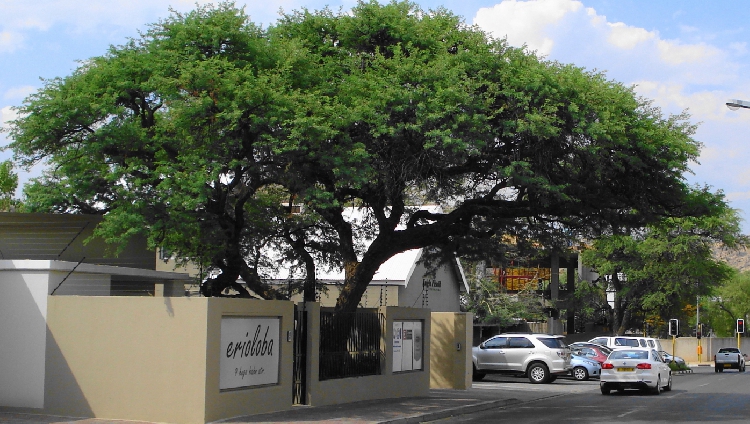
So, if you find trees on an erf you wish to develop, plan your buildings to incorporate these trees – they will be a distinctive and truly Namibian feature. Good examples of how this can be done are on the corner of Nelson Mandela Ave and Hugo Hahn Str [photo] or at the building complex on the corner of Robert Mugabe Ave and Liliencron Str.
In an age of information overload, Sunrise is The Namibian’s morning briefing, delivered at 6h00 from Monday to Friday. It offers a curated rundown of the most important stories from the past 24 hours – occasionally with a light, witty touch. It’s an essential way to stay informed. Subscribe and join our newsletter community.

The Namibian uses AI tools to assist with improved quality, accuracy and efficiency, while maintaining editorial oversight and journalistic integrity.
Stay informed with The Namibian – your source for credible journalism. Get in-depth reporting and opinions for
only N$85 a month. Invest in journalism, invest in democracy –
Subscribe Now!