



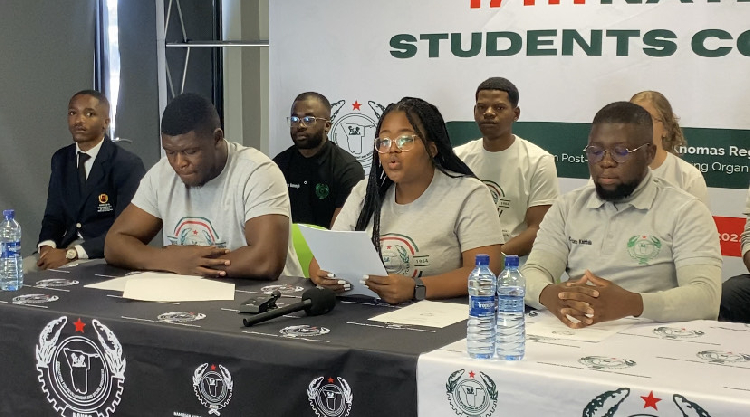
THE Namibia National Students Organisation wants the Ministry of Education, Arts and Culture to install sanitary pad dispensers in all schools across the country.
Nanso’s newly elected president Lucia Ndishishi referred to the 2014 Society for Family Health’s Water, Sanitation and Hygiene assessment report which found that only 17% of girls in rural Namibia have access to sanitary pads.
“The issue of sanitary poverty continues to be among the reasons there is a high rate of absenteeism and school dropouts among female learners,” she said.
Ndishishi wants education director Sanet Steenkamp to issue a directive calling on all schools to have fully functioning and well-equipped sanitary towel dispensers.
“Our stance is clear, no Namibian child should miss school, lessons, classes or dropout due to their inability to access sanitary products,” she added.
Nanso’s newly elected secretary general Malcolm Kambanzera told The Namibian that the organisation is aware of the country’s financial woes.
“That should not be used as an excuse,” he said.
Steenkamp yesterday told The Namibian that dispensers are not a straightforward matter, neither is issuing directives. Rather, she said it’s about what is feasible.
“Of course, we do take the issue of sanitary pads/towels provision to schools very seriously. Years ago we looked into all the possibilities,” she said.
Currently, schools are using N$5 of each pupil’s universal primary and secondary education grant as seed money for the school to start a project to buy, manage and distribute sanitary pads to pupils who are needy.
“At this stage, we will rather concentrate on accessibility of good quality sanitary products,” she added.
However, universal primary and secondary education grants have been slashed by almost half over recent years.
The grant used to give schools N$400 per pupil per year for pre-primary and primary pupils, and N$500 for secondary school pupils, to ensure smooth operations.
In the current financial year 2021/2022, approximately N$200 was allocated per pre-primary and primary pupil, while N$300 was provided for secondary school pupils.
Education, arts and culture minister Anna Nghipondoka recently said the reality on the ground is that the allocated money is not enough to cater for all their needs as planned.
Annually, the ministry received about 20% of the national budget. However, more than half of the budget goes to its wage bill of about 40 000 staff members, while allocations for pupils under the universal primary and secondary education grant have decreased over the years.
About 77% of the education ministry’s budget (N$11,6 billion) for the 2020/2021 financial year went to personnel expenditure, while N$1 billion is being used for the development budget.
DIRE SITUATION
A 2021 report, titled Comprehensive Assessment of Menstrual Health and Hygiene Management Knowledge, Attitudes, Practices on Adolescent Girls in Namibia, reveals that most girls prefer and use disposable pads, but one in four girls cannot afford them.
The report also says only one in 10 girls used reusable pads and that 4,2% of girls missed school during their periods.
The report also revealed that only half of schools had toilet paper, and soap was also in short supply.
It added that 41% of girls think they shouldn’t run while menstruating, 59% think it’s private, but 52% said they talk about it anyway, and 71% would like to talk to someone about menstruation.
Currently, there are civil society organisations that assist girls in the rural areas of the country to help lighten the burden of period poverty.
In an age of information overload, Sunrise is The Namibian’s morning briefing, delivered at 6h00 from Monday to Friday. It offers a curated rundown of the most important stories from the past 24 hours – occasionally with a light, witty touch. It’s an essential way to stay informed. Subscribe and join our newsletter community.

The Namibian uses AI tools to assist with improved quality, accuracy and efficiency, while maintaining editorial oversight and journalistic integrity.
Stay informed with The Namibian – your source for credible journalism. Get in-depth reporting and opinions for
only N$85 a month. Invest in journalism, invest in democracy –
Subscribe Now!