



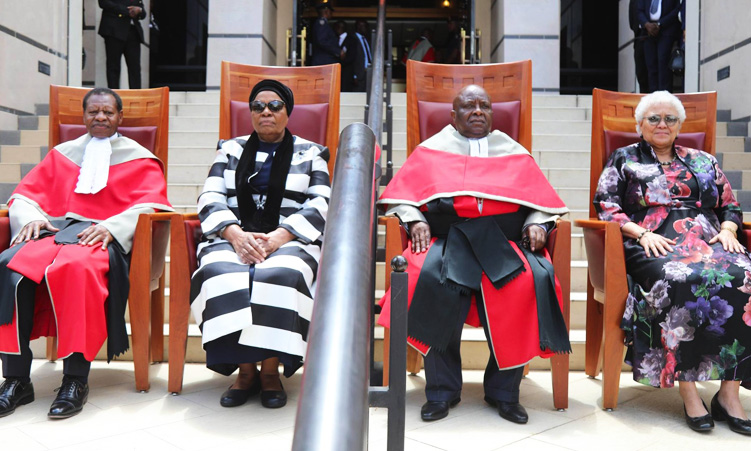
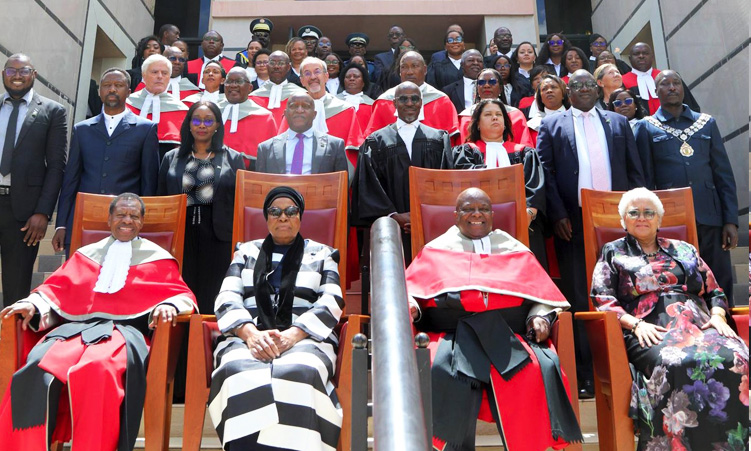
Public confidence in Namibia’s state institutions is weakened when cases involving the abuse of public resources remain unresolved for long, president Netumbo Nandi-Ndaitwah warned yesterday.
Speaking at the Office of the Judiciary’s opening of the 2026 legal year at the Supreme Court in Windhoek, Nandi-Ndaitwah said Namibians expect equitable and timely access to justice.
“They expect cases to be heard and concluded within reasonable time frames.
The backlog of cases is a long-standing challenge that must be addressed with urgency and resolve,” the head of state said.
She added: “Some of these matters involve the abuse of public resources.
When such cases remain unresolved for extended periods, public confidence in our institutions is weakened, and our national developmental efforts are compromised.”
Nandi-Ndaitwah said her administration “reaffirms its unwavering commitment to supporting a strong, independent and effective judiciary”.
“Despite the challenges and constraints that confront our justice system, our judiciary has remained steadfast in its independence, diligent in the administration of justice, and resolute in strengthening public confidence in the rule of law,” Nandi-Ndaitwah stated.
She also said: “Good governance, socio-economic development and a culture of accountability rest upon the foundation of a strong and effective judiciary.
As one of the three co-equal arms of the state, the judiciary must operate free from undue influence, whether from the executive, the legislature, or any other external force.”
The independence of the judiciary is not a privilege granted by the government, but a constitutional duty owed to the people of Namibia, Nandi-Ndaitwah remarked.
She further said: “A strong judiciary fosters an environment that is conducive to investment, innovation and opportunity.
It reassures investors, protects the vulnerable and enables the realisation of Namibia’s developmental aspirations.”
Nandi-Ndaitwah also warned: “Where the rule of law is weakened, corruption, crime and impunity find space to grow, and public trust begins to falter.”
Speaking at the same event, chief justice Peter Shivute said a shortage of judicial officers in Namibia “has reached a critical point”.
Over the past year, the civil stream of the Windhoek High Court has operated under “severe and sustained constraints in judicial capacity”, Shivute said.
He noted that during 2024, a civil bench of 13 judges managed a total of 4 987 cases, translating into an average workload of about 384 cases per judge.
During 2025, the civil bench managed 4 295 cases with fewer judges, and the average workload per judge rose sharply to about 614 cases per judge, the chief justice said.
“Judges of the High Court, in both the criminal stream and the civil stream, together with the court staff who support them, are operating under immense and sustained pressure – pressure that underscores the urgent institutional need for adequate judicial appointments and corresponding support if the administration of justice is to remain timely, effective and resilient,” Shivute said.
In the country’s magistrate courts, a backlog of cases remains the most critical challenge, Shivute also said.
He recounted that the combined backlog in Namibia’s magistrate courts increased from 57 090 cases at the end of 2024 to 63 679 cases at the end of 2025.
The growing backlog is occurring against a backdrop of persistent shortages of magistrates, resulting in unsustainable caseloads per judicial officer, Shivute said.
He further stated: “A judiciary weakened by lack of capacity affects every sector of society.
On a large scale it affects economic confidence, investment, social stability. More immediately, it affects ordinary citizens seeking timely and effective resolution of disputes.
This is not a challenge for the judiciary alone. It affects us all.”
In an age of information overload, Sunrise is The Namibian’s morning briefing, delivered at 6h00 from Monday to Friday. It offers a curated rundown of the most important stories from the past 24 hours – occasionally with a light, witty touch. It’s an essential way to stay informed. Subscribe and join our newsletter community.

The Namibian uses AI tools to assist with improved quality, accuracy and efficiency, while maintaining editorial oversight and journalistic integrity.
Stay informed with The Namibian – your source for credible journalism. Get in-depth reporting and opinions for
only N$85 a month. Invest in journalism, invest in democracy –
Subscribe Now!