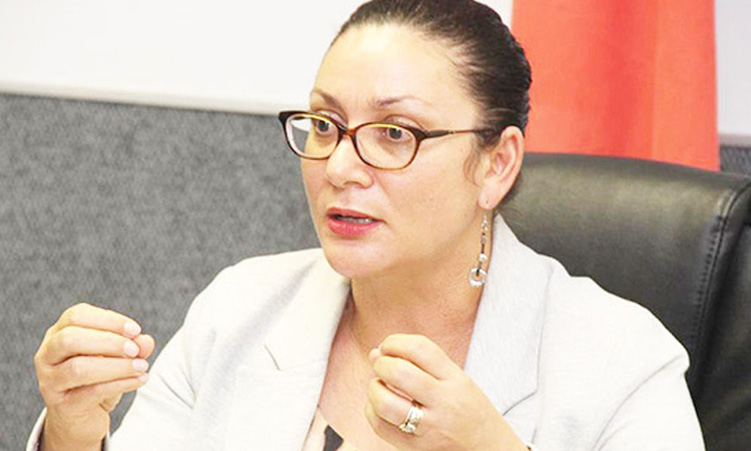
THE Namibian Ports Authority is striving to run the best-run seaports in Africa and has reviewed its corporate strategy to this effect, now including the use of technology and handling green hydrogen for exports.
The companys chief executive officer, Andrew Kanime, said the ports authority has reviewed its corporate strategy and set out strategic initiatives for the next five years. It hopes to achieve its vision through four key strategic themes, namely, building institutional capacity, driving operational efficiencies, enhancing customer and stakeholder value and optimising sustainable growth.
Kanime said this when he was addressing port users at Namports annual port users year-end engagement at Walvis Bay on Friday.
“We need to render services to our clients to the expected level of quality and timelines through appropriate training of our employees, correct work ethos and the right attitudes towards clients. There were concerns raised on certain aspects of the culture among some of our employees, which is not consistent with our values of commitment to, and care for, our customers. Customer service should be the cornerstone of our business. We have, therefore, embarked on an organisational culture transformation programme,” he said.
Kanime also noted that port users have been demanding quick turnaround times in ports and reduced port costs.
“It can only be achieved if we live by the value that superior client service is the foundation of our operations. The higher the efficacy with which we handle cargo through the ports, the faster the turnaround times and the cheaper the costs. There are current challenges on the turnaround times. This has largely been attributable to the need to upskill ourselves, realign our culture and invest in additional and new cargo handling equipment,” he said.
The company invested most of its financial resources into the watershed project of its new container terminal from 2014 until 2019. Unfortunately, it created a gap in investment towards cargo handling equipment.
“The very depressed economic environment and constrained financial resources have thus not allowed us to roll out these acquisitions at a fast pace, as we would have wanted to. In the meantime, we have been burdened with equipment breakdowns and shortages,” he said.
Meanwhile, the company has decided to replace its cargo-handling equipment gradually, starting with the areas where the requirements are more precarious. It already purchased new reach stackers, rubber tyre gantry cranes, forklifts, wharf cranes, spreaders, docking blocks and cradle wheels for the syncrolift at various stages of procurement.
It has also rolled out a new terminal operating system for general cargo and the syncrolift, which help in the streamlining of paper-based processes and enhancing the timeliness of the companys billing.
Kanime said the company strives to be successful through adapting to changing market conditions, technologies and a consistently changing environment.
“Our port users and customers constantly demand increased and improved cost-effective services. Our mantra is to strive constantly for relevance, excellence and for continuous improvement. We are rolling out digitisation as part of our focus towards enriching the customers experience and streamlining processes and operating costs. It will include the migration of physical orders, which are presently received and processed through the customer care desks, to a virtual environment,” he said.
The company has also embarked on various strategic initiatives towards the attainment of self-sustenance and an across-the-board review of its operations.
This is done to determine and address any areas where there are wastages and inefficiencies with the aim to generate the best returns with the maximum efficiency in the utilisation of resources.
The company is pursuing public-private partnerships in the roll-out of critical infrastructure and facilities in its ports. Initiatives under consideration or in the process of implementation include the development of the common user manganese export terminal at the Port of Lüderitz, development of the common user bulk terminal at the Port of Walvis Bay, possible concessioning of the Walvis Bay new container terminal, construction and operation of the LPG and LNG terminals at North Port at Walvis Bay, and the green hydrogen production and export from both North Port and the Port of Lüderitz.
In an age of information overload, Sunrise is The Namibian’s morning briefing, delivered at 6h00 from Monday to Friday. It offers a curated rundown of the most important stories from the past 24 hours – occasionally with a light, witty touch. It’s an essential way to stay informed. Subscribe and join our newsletter community.

The Namibian uses AI tools to assist with improved quality, accuracy and efficiency, while maintaining editorial oversight and journalistic integrity.
Stay informed with The Namibian – your source for credible journalism. Get in-depth reporting and opinions for
only N$85 a month. Invest in journalism, invest in democracy –
Subscribe Now!