While mining and some agriculture provide raw exports, the country imports the vast majority of manufactured and value-added goods.
The ‘order with me’ phenomenon popularised through social media groups, WhatsApp catalogues, cross-border shopping trips and online platforms has accelerated this.
Instead of supporting local manufacturers, tailors, furniture makers, food processors and light industrialists, consumers and retailers chase cheaper, often subsidised or dumped imports. Profits flow out. Supply chains for design, raw material processing, assembly, packaging, logistics and after-sales service are built and sustained in foreign countries.
Operational capital that could have financed local factories, training centres and innovation is instead consumed by importers’ margins and foreign exchange outflows.
A growing ‘import culture’ has emerged in which the easy money from trading finished goods becomes a permanent preference over the harder, longer-term work of building factories and creating sustainable employment.
THE UNEMPLOYMENT MULTIPLIER
The consequences are visible in the statistics and on the streets.
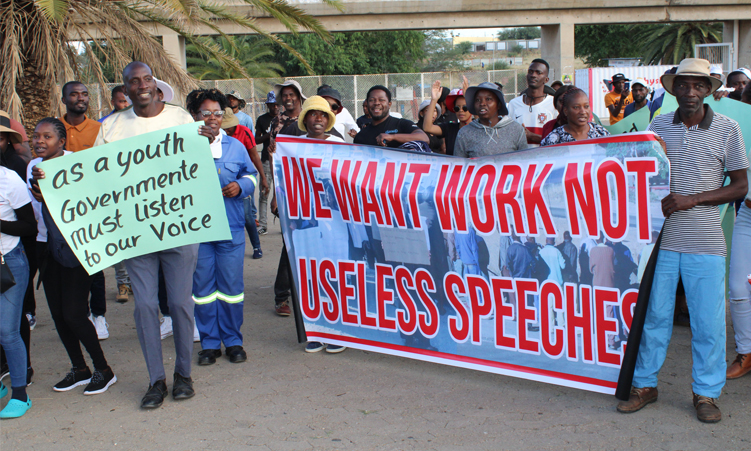
Youth unemployment remains alarmingly high. School leavers and graduates enter a job market where many traditional entry-level manufacturing and technical roles have simply never materialised or have shrunk.
Meanwhile, the informal ‘order with me’ sector absorbs some labour in trading and distribution, but offers little in terms of skills development, scalability or long-term economic security.
Young people with degrees and various qualifications, such as, biochemistry, manufacturing management, industrial engineering, mechanical engineering, textiles, food technology and carpentry sit idle or take unrelated jobs while the country
imports the very products they could be making.
Every container that lands at Walvis Bay is a missed opportunity for dozens of direct and indirect jobs across the value chain.
WHY LOCAL PRODUCTION MATTERS
Countries that have successfully industrialised from South Korea and Vietnam to closer examples like Ethiopia’s light manufacturing push did so by deliberately supporting domestic value chains.
They protected infant industries where necessary, used public procurement as a tool for local content, invested in technical training aligned to manufacturing needs, and gradually moved up the value ladder from raw materials to finished goods.
Namibia has many of the ingredients: a stable political environment, strategic port access, mineral resources that could feed downstream industries, agricultural output that could support agro-processing, and a youthful population hungry for opportunity.
Yet the ‘order with me’ culture continues to export that potential.
TIME FOR UNFINISHED BUSINESS
The deeper structural weakness is clear: an economy built around personalities, trading networks and consumption preferences rather than systems, institutions and long-term industrial strategy.
When the next generation asks why there are few factories, limited technical jobs and persistent high unemployment, the honest answer will point to decades of favouring imported convenience over domestic production discipline.
Reversing this requires more than slogans. It demands coherent industrial policy, review of procurement rules to prioritise local manufacturing capacity, investment in technical and vocational education that matches real production needs, and a cultural shift that values ‘made in Namibia’ as a point of pride and economic necessity rather than a novelty.
Ordering from outside may feel good today, but it is mortgaging tomorrow’s jobs and sovereignty. True development will come when we stop just consuming finished goods and start producing them ourselves.
The moment demands a major rethink. Successful economies support their own manufacturers first. Namibia cannot afford to remain trapped in a cycle of imported dependence while preaching industrialisation.
The time to build domestic value chains is now – before the ‘order with me’ culture becomes permanently embedded.
– Gabriel Haulyamayi is a writer, entrepreneur and commentator on socio-economic development and industrial policy.