



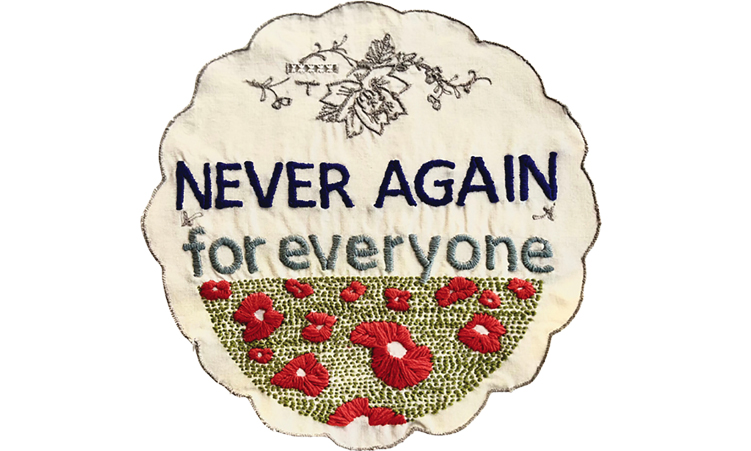
Protest is stitched, and photographic memory is defaced, reframed and reconfigured as a selection of Namibian and South African artists consider the realities and reverberations of Namibia’s liberation struggles in ‘Unresolved: Memory, Protest and Waiting’.
Currently on display at Guns & Rain, a contemporary art gallery in Johannesburg, the exhibition features the work of Nicola Brandt, Tuli Mekondjo, Jo Rogge, Ina-Maria Shikongo, David Brits and Christo Doherty.
Concerned with the conflicts that defined German and South African rule of then South West Africa (now Namibia), contemporary struggles and the lingering wounds of colonialism, the exhibition is a diverse presentation that delves into historic photographic and sartorial archives while pushing back against the injustices of the present day.
“This exhibition emanates from my long interest in Namibian histories and the country’s violent past, being first colonised by Germany and then occupied by South Africa,” says Guns & Rain curator Julie Taylor in her curatorial statement.
“It presents six contemporary Namibian and South African artists who use photography and textiles to explore war, memory and different forms of resistance,” she says.
“Together they create unexpected vantage points through which to contemplate power and tragedy, fact and fiction, past and present. Critically, this art is also about acknowledgement and healing, across generations and other social lines, and hence also for the future.”
In work by South African artists Doherty and Brits, Namibia’s Independence War (also known as the ‘Border War’) is examined through the lens of photography.
Staging wartime scenes with miniature tanks and figurines, Doherty questions the veracity of the photographic archive of the time, a period informed by the censorship, manipulation and propaganda that was part and parcel of the apartheid regime.
Marring rather than restaging, Brits scratches out faces and eyes, adds horns or highlights smiling mouths in photographs of white South African conscripts who fought in South Africa’s war against Namibia between 1966 and 1990.
With Brits’ scratches mirroring apartheid era censorship and perhaps, years later, some former South African Defence Force soldiers’ dissociation, as well as intergenerational shame, the artist calls attention to a war that seems largely unexamined, forgotten or scratched out in South African memory.
To a lesser extent, this erasure by the perpetrator is also true of Germany’s deadly campaign during the Herero and Nama genocide (1904-1908), though various contemporary Namibian artists such as Tuli Mekondjo and Brandt join Namibia’s civil society as it too guards against such forgetting.
To this end, Tuli Mekondjo stitches a skeleton onto a Schutztruppe (German colonial armed forces) uniform to recall the Nama and Herero prisoners who died at Namibia’s Shark Island before their skulls were shipped to Germany for study and display.
In her modification of a Swapo uniform, the artist additionally pays tribute to the women whose roles in Namibia’s liberation struggles are often downplayed, unacknowledged or erased.
Through the inclusion of breasts, a uterus, feminist slogans, military insignia and epaulettes, Tuli Mekondjo considers the Namibian War of Independence’s controversial alliances, internal conflicts and human rights abuses.
While Tuli Mekondjo incorporates overlooked realities through stitching, Brandt urges remembrance through photographic framing of the land. Illuminating Diaz Point, signifying Europe’s initial arrival on Namibian soil, as well as Herero and Nama memorial sites at Swakopmund and Lüderitz, Brandt highlights the unsettling mundanity of significant locations that bear no signage, no obvious memorials and which are effectively unacknowledged.
As four of the featured artists offer new entry points through which to traverse South African and Namibian history and its effects, artists Shikongo and Rogge reflect on the contemporary.
In Shikongo’s collection of stitched textile banners, the artist underscores the ongoing climate crisis, warns against extensive extraction of natural resources, particularly in Namibia, and decries capitalist greed, corporate sell-outs and empty promises.
Putting a new spin on an old décor element in a series titled ‘Jou Ma Se Doilie’, Rogge embroiders alternately comedic and serious statements onto doilies.
As facetious as doilies that declare “Gay. Uninstalling” or give being queer a one-star rating, Rogge also cheerfully refutes the archetype of the miserable ‘childless cat lady’ and is most solemn in a protest of the contemporary repetition of genocidal history.
Both using textiles as tools for awareness and objection, the artists boldly employ art as activism in their considerations of environmental and social justice.
Pertinent, diverse and novel in its examination of forgotten wars, colonial legacy and contemporary struggles, ‘Unresolved: Memory, Protest and Waiting’ will be on display at Guns & Rain (Johannesburg) until 19 September.
– martha@namibian.com.na; Martha Mukaiwa on Twitter and Instagram; marthamukaiwa.com
In an age of information overload, Sunrise is The Namibian’s morning briefing, delivered at 6h00 from Monday to Friday. It offers a curated rundown of the most important stories from the past 24 hours – occasionally with a light, witty touch. It’s an essential way to stay informed. Subscribe and join our newsletter community.

The Namibian uses AI tools to assist with improved quality, accuracy and efficiency, while maintaining editorial oversight and journalistic integrity.
Stay informed with The Namibian – your source for credible journalism. Get in-depth reporting and opinions for
only N$85 a month. Invest in journalism, invest in democracy –
Subscribe Now!