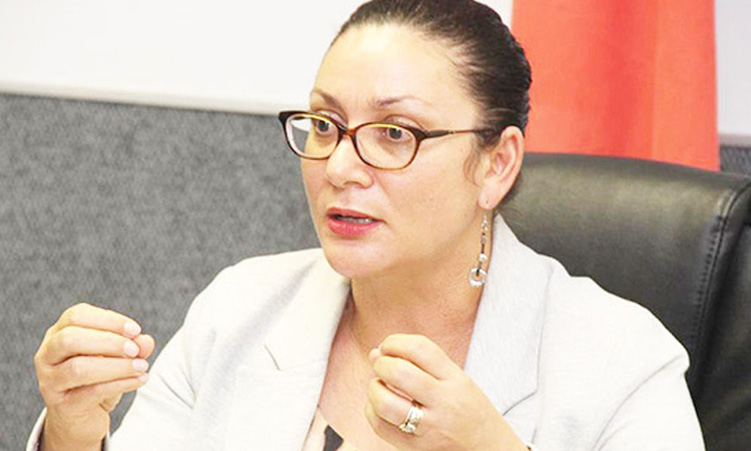
Member of parliament Tobie Aupindi, National Assembly, Windhoek, 1 April 2025
The 50-50 gender representation policies of the Swapo Party have enabled Namibia to be one of the few countries where women can flourish and achieve greatness in the world.
For centuries, women were denied their right to self-determination and emancipation. So I congratulate the president of the republic, Netumbo Nandi-Ndaitwah, the vice president and the speaker of the National Assembly, and all women who have ascended to high political office last month. This is a matter of historic significance which makes Namibia one of the most forward-thinking economies in the world.
I would like to commend the minister of finance for your presentation of the appropriation bill 2025/26.
The global economy has started the year 2025 on a firm footing, on the back of easing inflation, improving financial conditions and a resilient performance by the Namibian economy. Nevertheless, the outlook is fragile.
According to economic indicators, in 2025, the global economic outlook suggests a continued, although slower, growth trend, with projections around 3.1% to 3.3%, below historical averages. The key risks stemming from heightened policy uncertainty, particularly the trade wars and geopolitical tensions, are compelling businesses to adapt their operations and supply chains for potential policy and economic shifts.
Growth in sub-Saharan Africa is projected to strengthen to an average of 4.2% in 2025/26, driven primarily by improvements in the outlook for industrial-commodity-exporting countries, making Africa one of the economic zones with a positive high-growth outlook.
Namibia is confronted by these economic challenges that could derail the growth trajectory, as already seen in the economic decline from 4.4% growth in 2023 to 3.7% in 2024. So our path to achieving economic growth is ever so fragile.
As pragmatists, we are confronted by the dogmatic blueprint of a global economic arena that is very competitive, innovative and not caring towards smaller economies. Technological solutions and the fast roll-out of artificial intelligence, which seem great today, are often redundant the next day.
We must ensure that our economy is competitive in order to turn Namibia into a beacon of hope. I believe that if we the people work together, then we can make a meaningful contribution to the socio-economic conquest of our country.
Some will think that any consequential change in the market economy has to come all of a sudden, in the form of one system for another. I do not believe that. I believe that change can be substantial, but nevertheless gradual and experimental.
The structure of our economy must be confronted – whether we understand it, believe it, like it or not. Real change must happen around the organisation of the market economy. Namibians don’t own the market economy. So it is just not enough to regulate the market or to compensate for its inequality through retrospective tax and transfer programmes.
Namibia is urgently seeking a restless alternative solution that will give opportunities and instruments to the ordinary men and women in informal settlements or rural communities. What we need is to reshape the market in its institutional contexts, so that more people have more access to more market in more ways – not just an exclusive club of a few.
The veterinary cordon fence (redline) is a case in point. We spoke about this redline in one of the standing committees during the seventh sitting session. We cannot continue to manage two economic systems – one for the rural poor and one for the commercial elite.
The opponents of the removal of the redline usually cite that the meat from the north is not fit for consumption, yet residents in the north and tourists visiting the north are consuming the meat. If it is a matter of protecting the European meat market, then the process of quarantine must be robustly improved and certifications enhanced. Once conditions are met, farmers should be allowed to move their animals from the communal to the commercial areas, whether for commercial or personal use.
As an interim measure, I feel we must be radical and investigate if the northern farming community can meet its own market demand. If this is the case, then we should also prevent meat from the commercial area from being sold in the communal region until the current discriminatory system is totally and completely abandoned.
The reduction in the Southern African Customs Union (Sacu) receipts by N$6.9 billion to N$21.1 billion is worrisome, but unavoidable. Nevertheless, the nations of Sacu are to a large extent experiencing a new form of neocolonialism emanating from the lack of equity in terms of production and industrialisation, characterised by permanent innovation – often one-sided.
These forms of neocolonial production are making other Sacu economies highly uncompetitive and creating industrial development imbalances. These innovative vanguard styles of production are often confined to a narrow segment of the international economy, weakly connected to South Africa and the rest of the community. The larger part of the labour force in other Sacu countries is excluded from these vanguards.
We need to disseminate these advanced practices to a larger part of the Sacu economy in order to bring about equity and fairness. So the Sacu agreement must be reviewed.
There is a correlation between public safety and economic growth. While we are celebrating the massive discovery of oil play, the dangers of the petroleum industry are ever looming near our country. I can forewarn that a strategic shift must be instituted to safeguard the country’s sovereignty and territorial integrity, because the current trajectory we are on is not sustainable.
While oil players have been pushing aggressive petroleum work programmes coupled with massive geophysical programmes, the country’s legal and policy framework, strategic plan visions and security have been lagging behind. This is a clear and present danger to the country.
Namibia needs to act now before it is too late. The decision by the president of the republic to bring oil and gas into the presidium is highly commendable. However, much more should be done in order to avert the dangers that petroleum exploration and production usually bring into countries.
Negative impacts associated with the global oil and gas industry in emerging oil regions include international conflict through: (1) resource wars, in which states try to acquire oil resources by force; (2) petro-aggression, which will make Namibia more willing to engage in risky foreign policy adventurism; (3) the externalisation of civil wars in oil-producing states (‘petrostates’); (4) financing for insurgencies; (5) conflicts triggered by the prospect of oil-market domination; (6) clashes over control of oil transit routes, such as shipping lanes and pipelines; (7) oil-related grievances, whereby the presence of foreign workers in petrostates helps extremist groups recruit locally; and (8) oil-related obstacles to multilateral cooperation on security issues.
I am happy that one of the budget policy pillars includes specific provisions to address youth empowerment. The most important pitfall in any economy is the multitude of small and medium-sized businesses. Most of these businesses are owned by young people, but are pushed back to primitive productive practices and supply chains.
Leaving this to competitive market forces, free-market capitalists will not allow these small and medium enterprises (SMEs) into the supply chain. So there has to be an impositionary unitary intervention policy by the bureaucratic apparatus of the state.
Part of the agriculture ministry’s budget is earmarked for water-related projects, which is highly welcome. How much of the ministry’s strategic framework is designed towards operational effectiveness within the green schemes projects to ensure food security?
We depend a lot on South Africa and other countries for our staple food supplies – is it wise? Because if history teaches us hard lessons, we are not guaranteed sufficient food supplies from other countries should any calamity arise. The agricultural horticulture programme that will be rolled out – can it be fast-tracked, and can more resources be allocated to that or subsidies given to farmers already in operation?
The debt stock of N$165.9 billion is a concern that will require an aggressive strategy, because in the future, if borrowing is not curtailed, then the country will run out of fiscal space. Usually, we borrow in order to fund capital projects of significant value, which will in turn give some return on investment. But it is bad business to borrow just to pay operational expenses.
I believe in human creativity, endeavour and teamwork. I am confident that despite the challenges we are facing right now, they are not insurmountable. And with those few words, I support the appropriation bill.
Thank you so much.
In an age of information overload, Sunrise is The Namibian’s morning briefing, delivered at 6h00 from Monday to Friday. It offers a curated rundown of the most important stories from the past 24 hours – occasionally with a light, witty touch. It’s an essential way to stay informed. Subscribe and join our newsletter community.

The Namibian uses AI tools to assist with improved quality, accuracy and efficiency, while maintaining editorial oversight and journalistic integrity.
Stay informed with The Namibian – your source for credible journalism. Get in-depth reporting and opinions for
only N$85 a month. Invest in journalism, invest in democracy –
Subscribe Now!