



The 2020s have felt expensive. Even when headline inflation has cooled, the cost-of-living pressures have not eased in the way people expected.
In 2024, Namibian confidence in price stability fell to an all-time low, with only 14% of respondents believing the government is doing well in keeping prices stable.
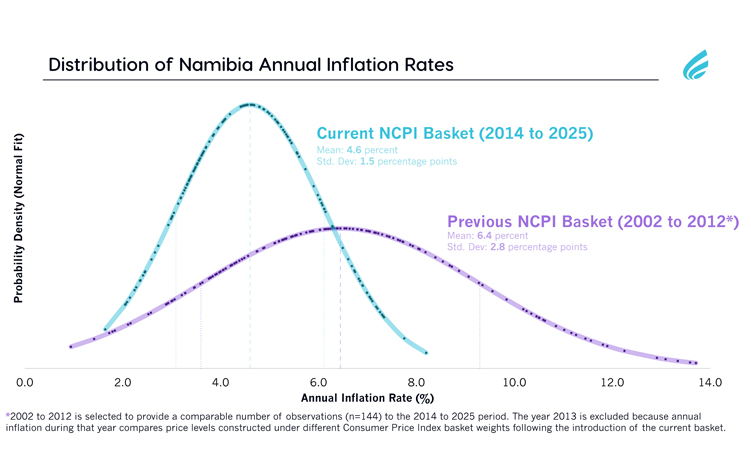
The distribution of Namibia’s annual inflation rates suggests that inflation prints over the past decade have been noticeably lower and more stable than in the preceding period.
Since 2014 (when the current weights were first introduced and comparable to itself), annual inflation has averaged a much lower 4.6%, with substantially lower volatility than the preceding period. Very high inflation outcomes have largely disappeared, and most observations fall within a narrower band centred around the 4.5% mark.
At first glance, this suggests that inflation has been meaningfully lower and more stable over the past decade. Yet this conclusion sits somewhat uneasily with the lived experience of many households in recent years.
Yes, there have been periods of low inflation (Covid-19 and 2025 stand out), but the perception of a cost of living struggle still lingers as a result of the high inflation in 2022 and 2023 (post-Covid demand rebound and the oil crisis).
Namibia’s 2022 to 2023 inflation was meaningfully lower than 70% of countries where data exists, including South Africa, most first-world countries and the global average.
There is evidence to suggest that this measured inflation appears more subdued than what households perceive because the current Namibia Consumer Price Index (NCPI) basket itself is now significantly outdated.
The ‘basket’ refers to a list of hundreds of common goods and services that Namibians spend their money on. Each item is given a weight based on how much households spend on it on average.
Things that people spend more on, like housing or food, receive larger weights, while things that people spend relatively less on receive smaller weights.
Headline inflation is, therefore, a weighted average of the price increase of this basket.
The basket currently used to measure Namibia’s CPI was introduced in December 2012, and the data that was used to build this comes from Namibian consumption data from 2009. So, Namibian players in the economy anchor many decisions based on consumption data that is almost two decades old.
South Africa has updated their basket four times since. Over this period, household spending patterns have shifted considerably because of both the structural changes in consumption (inelastic consumption of food and fuel, substitution effects due to historical price changes, new goods, etc.) and because of the prolonged period of weak income growth following Namibia’s post-2015 economic slowdown.
The Namibian CPI is very clearly no longer a representative indicator of the actual consumption patterns of Namibian households.
Items that have become more important in household budgets are underweighted, and those that have become less important are overweighted.
Goods which are not really consumed today are still in the basket and have high weights, while many new items which households spend a sizeable amount on are not even considered in the index because they were invented or introduced into the market post-2008.
There are reasons to expect that a future update to the NCPI basket would modestly shift measured inflation higher. Real wage growth in Namibia has been weak for several years, which tends to push households toward a larger share of spending on essentials such as food and basic services.
These categories typically exhibit higher and more volatile inflation than discretionary goods. If updated expenditure weights place greater emphasis on these items, the measured inflation rate could increase somewhat, even if underlying price dynamics remain broadly similar.
In 2025, inflation averaged 3.5%, the lowest average rate since 2020 – 2.2%, which was the lowest ever recorded. Yet, core inflation finished the year above the headline rate, and services finished above goods inflation.
Service price increases are stickier, because the domestic cost structures (wages and rents) adjust more slowly, some of which through contracts. They are adjusted differently to goods, typically because of inflation in the preceding year.
There has been no slowdown in the price increase of services, as operators and businesses have still been playing catch up from the 2022 and 2023 inflation.
In this sense, the relatively mild inflation is arguably misleading, with a few key base effects and old weightings leading to low measured inflation.
– Tannan Groenewald is the head of data & analytics at Cirrus Capital
In an age of information overload, Sunrise is The Namibian’s morning briefing, delivered at 6h00 from Monday to Friday. It offers a curated rundown of the most important stories from the past 24 hours – occasionally with a light, witty touch. It’s an essential way to stay informed. Subscribe and join our newsletter community.

The Namibian uses AI tools to assist with improved quality, accuracy and efficiency, while maintaining editorial oversight and journalistic integrity.
Stay informed with The Namibian – your source for credible journalism. Get in-depth reporting and opinions for
only N$85 a month. Invest in journalism, invest in democracy –
Subscribe Now!