Namibia’s growth struggles to bridge population gap
The 2023 census initially estimated Namibia’s population at 3.02 million, but the post-enumeration survey revised this up to 3.10 million.
This implies an average annual population growth rate of 3.3% since 2011, compared to the initially estimated 3.0%.
It is also well above the roughly 2.5 million figure that had generally been assumed for 2023 prior to the census.
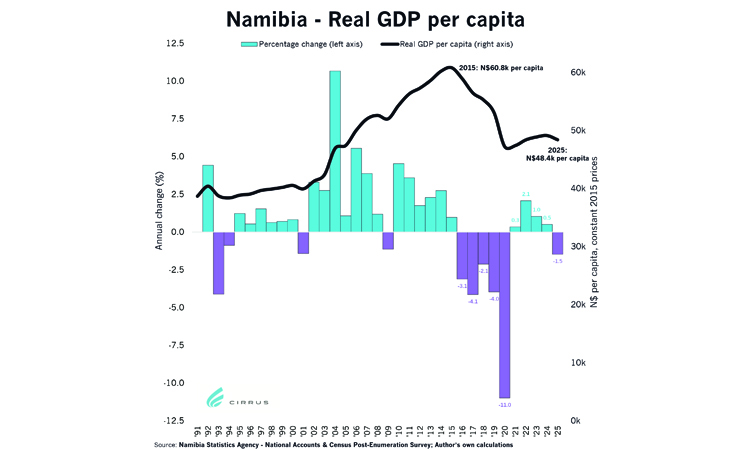
With an even faster-growing population base than expected, Namibia now requires real gross domestic product growth of more than 3.3% per year simply to keep real output per person from declining.
Extrapolating this population growth rate forward suggests that Namibia’s population reached around 3.31 million in 2025.
Part of the reason headline growth can at times give a misleading impression is that overall performance has been heavily influenced by mining, especially post-pandemic.
In 2023, growth came from most fronts in mining, as oil and gas exploration and appraisal activities, alongside strong uranium and gold production, drove growth.
In 2024 and 2025, however, the mining industry saw contractions as momentum from oil and gas activities slowed, while global diamond prices began to slide even more steeply.
The mining industry is highly capital-intensive and, by its nature, does not employ a great many individuals.
The real strength of mining lies in attracting significant investment volumes, providing tax revenue, and generating export earnings.
Namibia’s reliance on the mining industry therefore means that the total economy is susceptible to global commodity prices, because the main beneficiary of the mining industry is government, and what therefore ripples into the non-mining economy is partly a function of how government uses this revenue.
Given that this growth is extremely concentrated in mining, even a 3.3%+ economic growth rate does not necessarily mean that living conditions on the ground are improving.
A challenging non-mining business environment means that achieving 3.3% growth is especially difficult during downturns in commodity prices or production, and since independence, the non-mining economy has failed to achieve that growth rate in more than half of all years – and since the peak of 2015, has failed to reach that rate in every year except one (2024).
- Tannan Groenewald is the head of data and analytics at Cirrus.