



Namibian Population by Education Status
Education status gives a quick read on Namibia’s human-capital pipeline and the shape of the future labour force.
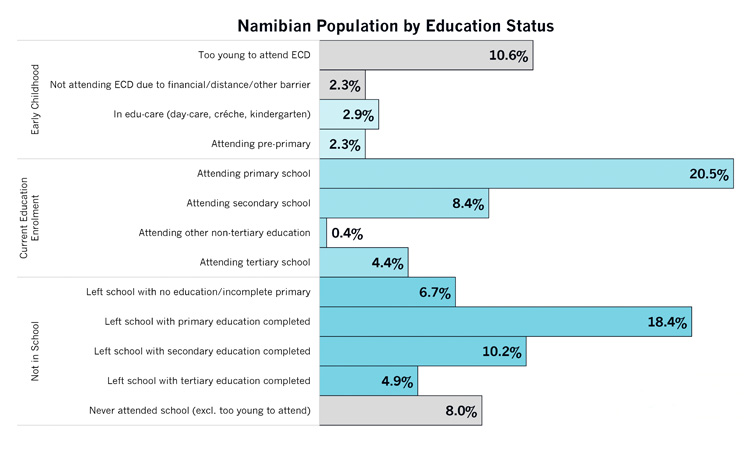
If one were to plot the education status of the Namibian population (in or out of school, current enrolment and highest level of educational attainment among those who have left school), about 39% of the population is still in some form of education, consistent with Namibia’s young population structure and median age of 22.
The largest cohort is primary school pupils at 20.5% of the total population. By comparison, 8.4% of Namibians are currently in secondary schooling and 4.4% are currently attending tertiary education.
About 61% of Namibians sit outside the education system (finished school or never attended).
This includes 10.6% who are simply not of eligible age or are too young for early childhood development (ECD), although 2.3% of the total population (about 70 000 children) are Namibians eligible or old enough for ECD, but are not attending due to constraints such as affordability, distance or other barriers.
Among those who have left education, attainment remains concentrated at lower levels.
The most common non-school-going adult has completed primary education as their highest level achieved (18.4% of all Namibians), followed by secondary completed (10.2%).
About 6.7% left school with no education or incomplete primary, while 8% of Namibians are adults who have never attended school.
Finally, about 4.9% of the population are adults who hold some form of tertiary education.
In the labour market, this distribution often presents a weak transition from schooling into work, pressure on entry-level job absorption and strong returns to pathways that convert years of schooling into marketable skills which employers value, particularly at upper-secondary, technical and vocational education and training and tertiary levels.
Consistent with that transition challenge, 44.1% of Namibians aged 15 to 34 are not in employment, education or training, indicating a large share of young people currently outside both learning and work, and currently unable to capitalise on their youth.
Figures are compiled by reconciling the 15th Day of School Report by the Ministry of Education, Innovation, Youth, Sport, Arts and Culture, with available census population distributions.
Percentages are based on harmonised categories and exclude a small share of ‘don’t know’ responses.
In an age of information overload, Sunrise is The Namibian’s morning briefing, delivered at 6h00 from Monday to Friday. It offers a curated rundown of the most important stories from the past 24 hours – occasionally with a light, witty touch. It’s an essential way to stay informed. Subscribe and join our newsletter community.

The Namibian uses AI tools to assist with improved quality, accuracy and efficiency, while maintaining editorial oversight and journalistic integrity.
Stay informed with The Namibian – your source for credible journalism. Get in-depth reporting and opinions for
only N$85 a month. Invest in journalism, invest in democracy –
Subscribe Now!