



NAMIBIA’s Rugby World Cup ended in huge disappointment when their final pool match against Canada was cancelled due to Typhoon Hagibis, but despite failing to register a first-ever victory at the World Cup, Namibia has made steady progress at the global sporting spectacle.
With their other pool matches against New Zealand, South Africa and Italy never been realistic targets for victory, the Canada encounter was the one that Namibia had been targeting for a first victory in 23 attempts at the World Cup.
Both teams weighed up very evenly, with Canada ranked 22nd in the world and Namibia 23rd, while Namibia held a slight 16-points difference advantage going into the match.
After Typhoon Hagibis’ intervention, Namibia is now still in search of a victory, but statistically they have done the best yet at the World Cup.
Both teams received two points for a draw, but Namibia had a better points aggregate and finished third on the log, with Canada fourth. The two points is the most that Namibia has received at the World Cup, after they registered their first bonus point in a 17-16 defeat to Georgia at the 2015 Rugby World Cup in England.
Regarding points accumulated and conceded in World Cup matches over the years, Namibia has a bit of a chequered history and an improvement over the years is not very apparent.
At their first world cup in 1999 they accumulated 42 points and conceded 186 in four matches, for an average defeat of 62-14.
Four years later they conceded a massive 310 points and scored 28 for an average defeat of 77-7, but that included their disastrous 142-0 defeat to Australia, which is still a world cup record for the biggest margin of defeat.
In 2011, Namibia’s average defeat was 66-11 and four years later it had improved to 43-17.
At this year’s World Cup, Namibia’s average defeat was 58-11, but that was without the Canada match, which would most likely have brought the average down.
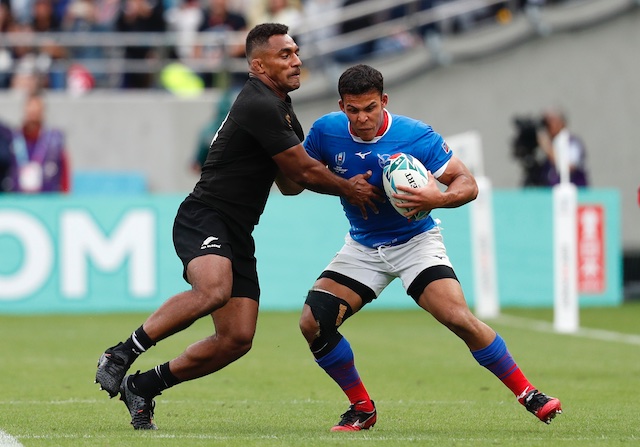
In stead, Namibia had to weigh themselves up against the world champions New Zealand, the fifth ranked South Africa and 12th ranked Italy, where they suffered defeats of 71-9, 57-3 and 47-22 respectively.
It would, therefore, seem that Namibia has stagnated since 2015, when they lost 58-14 to New Zealand, but in an interesting article by Mike Henson of the BBC, other factors point to an improvement on 2015.
“Namibia made only 57 metres with ball in hand in 2015, living off 30% possession and 27% territory. Four years later, and despite the heavier defeat, they made 302 metres and enjoyed 46% possession and 43% territory. By every statistic, bar the scoreline, they were closer to their fabled opponents,” he reported in an article entitled, ‘Rugby World Cup: are Tier Two nations closing the gap?’
Namibia coach Phil Davies also said that the New Zealand defeat was a personal highlight.
“Our match against New Zealand was a highlight for me and even though the scoreboard was very unkind in the end, to be 10-9 down to the world champions after 35 minutes was a testimony to how far the players have come over the past four years, and the country should be very proud of the way they played on the field, and also the way they conducted themselves off the field,” he said.
According to the BBC article, Tier Two nations like Namibia have shown a definite improvement against Tier One nations (the traditional rugby powerhouses from Europe and Sanzaar – South Africa, New Zealand, Australia and Argentina) over the years.
The average points gap between Tier One and Tier Two nations has gradually decreased over the years, from 45 points in 2003, to 30 points this year, although Tier Two victories are still quite rare, with only two recorded this year and 11 in total since 1991.
According to the article, World Rugby has played a big role in assisting Tier Two nations, with more than 60 million pounds committed to help Tier Two nations compete at this year’s World Cup, but how it is spent by each country varies.
The article concludes that more chances for Tier Two nations to play against Tier One nations would give more clarity the situation, while some leading commentators have called for more such international matches.
“There’s no question the Tier Two nations have definitely improved. The blow-outs of the past haven’t happened,” former England fly half and BBC commentator, Paul Grayson said.
“Tier Two nations need more exposure to Tier One teams with a more cohesive fixture list – that’s a potential solution, but some of the core traditional teams in the northern hemisphere seem reluctant to allow that,” he added.
In an age of information overload, Sunrise is The Namibian’s morning briefing, delivered at 6h00 from Monday to Friday. It offers a curated rundown of the most important stories from the past 24 hours – occasionally with a light, witty touch. It’s an essential way to stay informed. Subscribe and join our newsletter community.

The Namibian uses AI tools to assist with improved quality, accuracy and efficiency, while maintaining editorial oversight and journalistic integrity.
Stay informed with The Namibian – your source for credible journalism. Get in-depth reporting and opinions for
only N$85 a month. Invest in journalism, invest in democracy –
Subscribe Now!