



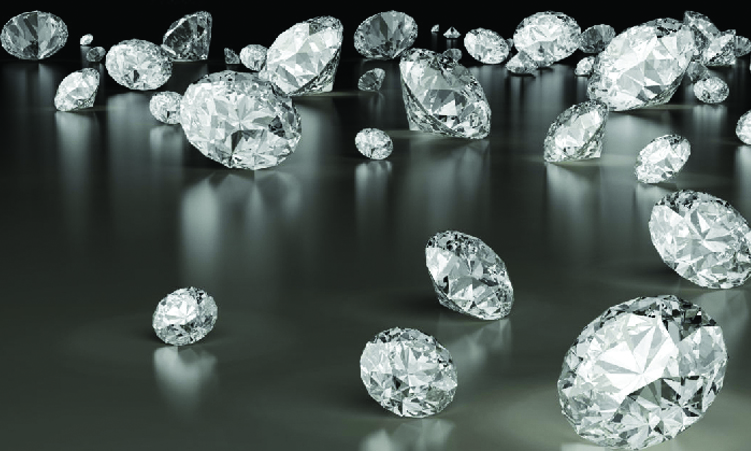
The demand for diamonds has increasingly dropped over the years, a move attributed to an increased market for synthetic diamonds, slacking demand from China, and global economic instability.
Local experts say diamond prices have been dwindling over the years, with the realisation that diamonds are not forever.
Diamonds deliver Namibia’s biggest revenue, with a decline in the price of mined diamonds spelling disaster for the fiscus, the experts say.
Multinational mining company Anglo American has dramatically reduced the internal valuation of diamond company De Beers to US$2.3 billion (about N$36.9 billion), following consistent financial struggles.
This is a decline from US$4.1 billion (N$65.7 billion), according to parent company Anglo American’s annual results released on Monday.
De Beers’ total revenue rose 6% to US$3.49 billion in 2025.
Namibia is feeling the pinch at Namdeb and Debmarine, which are both 50/50 joint ventures between the government and the De Beers Group, operating under Namdeb Holdings.
An analysis by the Rapaport Group indicates that while the volume of rough diamond sales rose in 2025, profits suffered because the company resorted to discounted bulk deals to move less desirable stock.
DIVEST OR DEMERGE
Furthermore, the substantial underlying loss reported by De Beers prompted its parent firm to accelerate plans to divest or de-merge the business.
This means potential buyers, including national governments and private consortia, are currently in negotiations as the industry faces a difficult rebalancing period.
Anglo chief executive Duncan Wanblad has told Rapaport that the parent company continues those efforts to offload De Beers.
He says the company is “in the advanced stages of discussions with a select group of interested parties. We continue to have very constructive discussions with the government of Botswana, which is going to be crucial in the determination of the end point of this process.”
“There is a possibility that…our [85%] share [of De Beers] will be sold in three parts, potentially, or two parts, potentially,” Wanblad says.
Namibia, Botswana and Angola are rumoured to be negotiating with Anglo American.
‘NOBODY WANTS DIAMONDS’
Economics professor Roman Grynberg says Namibia would be “a fool” to invest in diamonds.
This is due to the fact that diamonds can be reproduced in laboratories in China, Thailand or Malaysia, he says.
Grynberg says lab-grown diamonds cost about a quarter of the price of mined diamonds.
“They are anywhere between a third and a quarter of the price of mined diamonds. So that’s the reason why they’re taking over the diamond market. And you can’t tell whether a diamond is lab-grown or mined,” he says.
Grynberg says nobody wants diamonds, which is why Anglo American wants to sell De Beers, of which the value has dropped in the past 15 years.
“You’d have to be a fool to invest in Anglo. Think about it: Oppenheimer sold his 40% share for US$5.2 billion 15 years ago.
“Now, the 85% is worth less than half that. Why would we buy into this company? This is madness. I mean, Botswana and Luanda want to buy this company. Let them have it,” he says.
Former Cabinet minister Calle Schlettwein says De Beers has reacted appropriately by producing its own artificial diamonds.
He says although the move has worked well, it has shown that diamonds “are not forever”.
Schlettwein says buying a stake in a collapsing industry would not be the best move.
“The diamond industry will not recover to levels we were used to,” he says.
Former diamond commissioner and former chief executive officer of Namib Desert Diamonds (Namdia) Kennedy Hamutenya says lab-grown diamonds are competitive, but no equivalent for natural diamonds.
He says the economic impact of lab-grown diamonds is the price pressure it adds on certain categories of natural diamonds.
“In Namibia, the consequences are real. Reduced production at Debmarine Namibia and Namdeb means lower revenues, reduced royalties, and fiscal pressure. Diamonds fund schools, hospitals, roads and social programmes. Synthetic diamonds do not,” he says.
He says although synthetic producers have aggressively marketed their product as ethical and environmentally superior, it is misleading because they require significant energy input, often generated from fossil fuels in major manufacturing centres.
Debmarine Namibia yesterday said the company would respond today.
In an age of information overload, Sunrise is The Namibian’s morning briefing, delivered at 6h00 from Monday to Friday. It offers a curated rundown of the most important stories from the past 24 hours – occasionally with a light, witty touch. It’s an essential way to stay informed. Subscribe and join our newsletter community.

The Namibian uses AI tools to assist with improved quality, accuracy and efficiency, while maintaining editorial oversight and journalistic integrity.
Stay informed with The Namibian – your source for credible journalism. Get in-depth reporting and opinions for
only N$85 a month. Invest in journalism, invest in democracy –
Subscribe Now!