



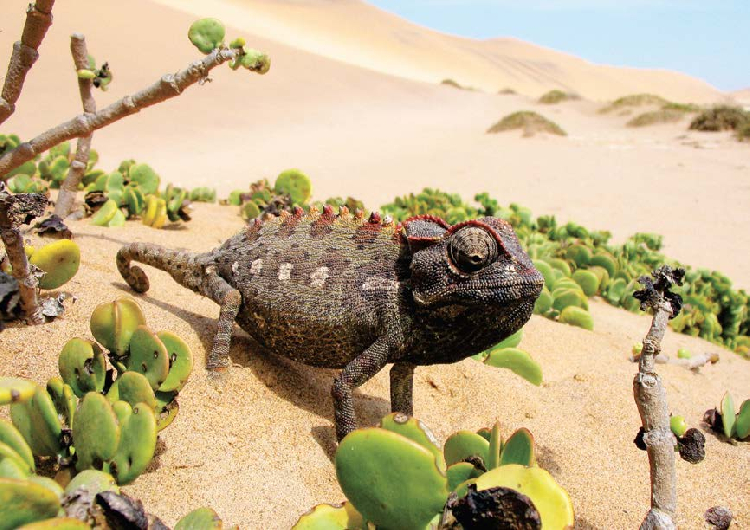
REPTILES are “disappearing at an alarming rate” from the central Namib Desert, conservationists have warned, blaming mostly poaching.
Tour operators working in the Dorob National Parks dunes between Swakopmund and Walvis Bay told The Namibian that they hardly see chameleons anymore, and sightings of snakes and lizards are also becoming rare.
There are currently four operators that specialise in driving tourists along the plains and dunes of the central Namib, showing off the deserts unique variety of indigenous creatures (known as the little five) that include chameleons, snakes, geckos and lizards, as well as a variety of insects.
“Together we could take a 100 tourists a day, which generates major foreign revenue for Namibia on the one hand, creates employment, and on the other hand, creates awareness of the creatures to ensure their conservation as a Namibian natural heritage worth preserving. If they are gone, we lose all of it,” says tour operator Duan Opperman.
“There was a time when tourists were guaranteed to see most of these creatures daily, but now the chances of seeing, especially a chameleon, is very rare. In fact, for the last month, we have not seen a single chameleon,” says Opperman.
Tommy Collard, who has been involved in desert tourism for the past 25 years, told The Namibian that the black market price for Namibian reptiles has soared over the last few years, which has fuelled the crime of poaching.
“The problem is aggravated by the fact that some of these creatures are endangered too, like the chameleon,” he says.
There is a lot of suspicious activity along the routes of operators, says Collard.
“Human tracks are noticed at spots where creatures are known to live. Now the creatures are no longer there.”
The creation of the Dorob National Park did not help much, he says, because there is not enough manpower and resources to patrol the entire area.
Collard says people are just driving where they want and breaking down fences where they can.
“Just last week, two people were caught poaching and fined N$3 500 for being in possession of a snake and a legless lizard (skink) and a bunch of beetles, which desert reptiles eat. The culprits, however, vowed that they were not poaching but were just enthusiastic collectors. They did not have permits.”
Collard says human activity, especially people walking with their dogs in the dunes, and unbridled quad biking, were also disturbing the creatures habitats, resulting in the death of some which are either bitten or driven over.
He warns that those stealing reptiles must know that they will be arrested and prosecuted.
“This is about Namibias GDP as well as the sustainable conservation of our natural heritage. People cannot just come here and destroy it like that,” he says.
Angela Curtis of the Swakopmund Snake Park said people keeping reptiles are required to have permits from the environment ministry, and many of these creatures require very special conditions in captivity.
“People do not realise this. These reptiles are not happy to see you like a dog or cat. They are unhappy and need to be in their environment,” said Curtis.
She acknowledged that poaching is increasingly occurring due to the high prices on the international black market.
“Its not just live animals, but dried up ones too,” she said, “and while we all are aware of the poaching, it is very hard to identify and catch the culprits.”
Environment ministry spokesperson Romeo Muyunda told The Namibian that the Dorob National Park, being an open park (without fencing), makes it difficult to manage reptile poaching.
“We do general patrols, but we cannot cover the entire area at once. Therefore, we rely on the public to report any such cases to us. We are also working on issues of capacity, to ensure the park is sufficiently provided with manpower and the necessary equipment such as vehicles.
“Also, to enhance effective patrols, we are looking at the activities in the park to equip our staff accordingly,” he says.
A “smart system for monitoring and reporting” is also expected to be implemented soon with funding from development partners, says Muyunda.
In an age of information overload, Sunrise is The Namibian’s morning briefing, delivered at 6h00 from Monday to Friday. It offers a curated rundown of the most important stories from the past 24 hours – occasionally with a light, witty touch. It’s an essential way to stay informed. Subscribe and join our newsletter community.

The Namibian uses AI tools to assist with improved quality, accuracy and efficiency, while maintaining editorial oversight and journalistic integrity.
Stay informed with The Namibian – your source for credible journalism. Get in-depth reporting and opinions for
only N$85 a month. Invest in journalism, invest in democracy –
Subscribe Now!