



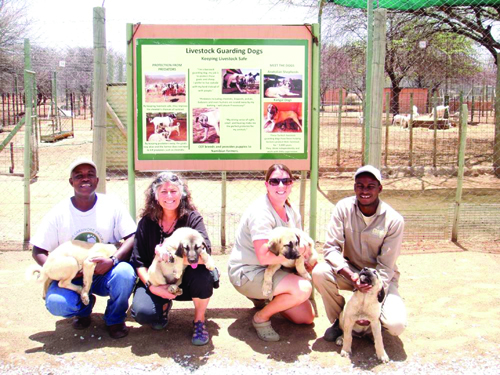
THE Cheetah Conservation Fund (CCF) sent four puppies from its Livestock Guarding Dog (LGD) programme to the Ruaha Carnivore Project in Tanzania last week.
The four puppies, two males and two females, are of the Kangal breed, a dog famous in Turkey for guarding small livestock against wolves and bears. The puppies were born in August to CCF’s pure-bred Kangals.
CCF’s guarding dog programme has placed 450 dogs with Namibian farmers since 1994. The livestock guarding dogs bond with their herds, and are highly effective at deterring predators. Their loud and ferocious bark deters predators, and farmers using a CCF dog see the predation rates reduced by 80% to 100%. Because the farmers feel more secure in their livelihoods, they are less likely to harm cheetahs and other predators.
The four pups were sent to the RCP, which is run by Amy Dickman. RCP is part of Oxford University’s Wildlife Conservation Research Unit (WildCRU). Dickman spent six years in Namibia working with CCF Founder and Executive Director Laurie Marker on the LGD programme, and has published several research papers with her documenting the effectiveness of the dogs.
The RCP works to develop conservation strategies for large carnivores in the important Ruaha landscape. The puppies will be placed with farmers from the Maasai and Barabaig tribes.
The placement with RCP in Tanzania marks the fourth country in which CCF has placed puppies so that other organisations may start their own LGD programmes.
“We’ve been developing programmes in Namibia to save predators for nearly 25 “years working from here to help cheetahs in other countries. Our research shows that solutions like the dogs are very effective. Every time we help start a new programme in another country, we’re thrilled, because we know we’re making real progress in the race to save the cheetah, and all predators,” said Marker.
Ayoub Msago, RCP’s Community Liaison Office, travelled back to Tanzania with the dogs, after spending two weeks at CCF in Namibia to learn about the LGD programme. He traveled through Namibia to visit working dogs on farms, learning how the dogs are trained, and how CCF’s LGD programme is managed.
On his return to Tanzania with the dogs, goats from neighboring farms will be brought to a specially prepared kraal in the RCP research area and will be introduced to their new keepers next week under Dickman’s supervision. This will be the first known attempt to bring in specialised guard dogs to help Tanzanian pastoralists protect their livestock. The communities these dogs will serve are extremely poor, with the majority living on less than N$10 per day. Carnivore attacks cause major problems for these pastoralists and lead to high levels of carnivore killing.
“We are very excited about getting these dogs,” said Dickman. “The protection the LGD provide reduces the cost of living alongside predators, which means a decrease in human-wildlife conflict. With these dogs, we will learn much more about how well this conflict mitigation tool can be applied to East Africa, which will help us develop effective plans for the future.”
“Together we can make a big difference to assist livestock farmers and save predators. The dogs have protected livestock for thousands of years, we just need to help teach farmers how the dogs work and help them to be more successful. We can live together,” said Marker.
In an age of information overload, Sunrise is The Namibian’s morning briefing, delivered at 6h00 from Monday to Friday. It offers a curated rundown of the most important stories from the past 24 hours – occasionally with a light, witty touch. It’s an essential way to stay informed. Subscribe and join our newsletter community.

The Namibian uses AI tools to assist with improved quality, accuracy and efficiency, while maintaining editorial oversight and journalistic integrity.
Stay informed with The Namibian – your source for credible journalism. Get in-depth reporting and opinions for
only N$85 a month. Invest in journalism, invest in democracy –
Subscribe Now!