



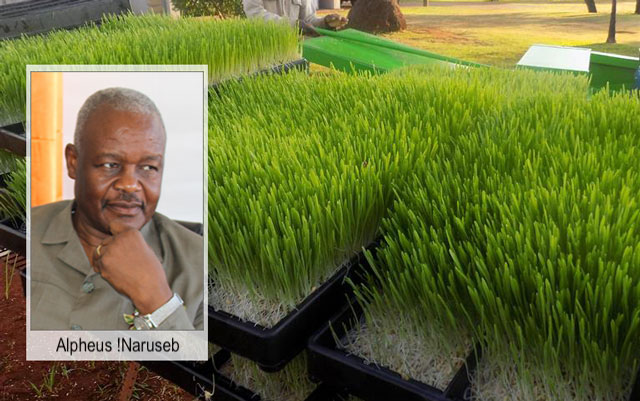
THE government will spend N$45,5 million to subsidise 7 000 individual farmers to produce their own fodder by using the hydroponic system as it tries to mitigate the effects of the recurrent drought.
This was said by agriculture minister Alpheus !Naruseb in a statement on the promotion of ‘Non-Mechanised Small-Scale Farmer Hydroponic Fodder Production’ presented in parliament last Friday.
“The total fodder production scheme will cost N$45,5 million, which comprises N$29,6 million for material subsidies, N$3,9 million for seeds, and N$10,7 million for training the 7 000 farmers around the country,” he added.
The balance of N$1,2 million will be for the training of trainers (N$210 000), as well as monitoring and mentoring farmers (N$1,05 million).
The scheme will target communal, emerging, resettled and commercial farmers who have been trained in hydroponic fodder production.
The ministry of agriculture will identify beneficiaries who are full-time farmers.
“The farmers can use their Fan Meat, Meat Board cards and identity documents to claim the subsidy, while invoices from reputable companies and parastatals can be used to claim input subsidies,” explained the minister.
The subsidy will be given per household.
However, the scheme will exclude farmers who are renting out grazing elsewhere, and those who are working and receiving salaries.
“The ministry will train 140 extension workers (10 per region) to train farmers in their respective regions. The government is aiming at training 500 farmers per region in fodder production, disease management, and feed ratio calculation.
“The government will provide a once-off subsidy of 50% to trained farmers up to a maximum of N$190 per bag of seeds until the end of March 2020,” the statement added.
The government will also subsidise the cost of construction materials up to a maximum of N$4 250 until March 2020.
The structures to grow the fodder would preferably be green net structures, with complementary material comprising poles, nails, plastic or aluminium growing strays as well as watering cans. The main aim of the hydroponic fodder production initiative is to build resilience and empower farmers to produce their own fodder, and thus reduce dependence on the government drought relief scheme.
Under the hydroponic fodder production system, a kilogramme of fodder can be grown in seven days, requiring a maximum of three litres of water. A tonne of fodder will require a minimum of 45 square metres of land.
The main input required in the production of fodder are seed, mainly barley, maize, wheat or sorghum.
The scheme is earmarked for six months from October 2019 to 30 March 2020. However, it can end as soon as the budget is exhausted. The ministry is yet to announce the specific date when the training of farmers will begin.
In an age of information overload, Sunrise is The Namibian’s morning briefing, delivered at 6h00 from Monday to Friday. It offers a curated rundown of the most important stories from the past 24 hours – occasionally with a light, witty touch. It’s an essential way to stay informed. Subscribe and join our newsletter community.

The Namibian uses AI tools to assist with improved quality, accuracy and efficiency, while maintaining editorial oversight and journalistic integrity.
Stay informed with The Namibian – your source for credible journalism. Get in-depth reporting and opinions for
only N$85 a month. Invest in journalism, invest in democracy –
Subscribe Now!